

Key Takeaways
- A signature style builds a recognizable aesthetic around a small set of consistent choices.
- Versatile dressing prioritizes flexibility, allowing outfits to adapt across multiple contexts.
- Neither approach is objectively superior — the right one depends on your lifestyle and personality.
- Many people naturally land somewhere between the two extremes.
- Understanding both philosophies helps you shop with more intention and less regret.
Our Verdict
Signature style rewards those who thrive on consistency and want getting dressed to feel effortless and intentional. Versatile dressing suits people whose lives span many contexts and who enjoy the creative challenge of mixing and matching. Most wardrobes benefit from drawing on both principles simultaneously.
| Best for | Recommended |
|---|---|
| Those who want a strong, recognizable personal aesthetic with minimal daily decision-making | Signature Style |
| Those with varied daily contexts — work, social, active, formal — who value flexibility | Versatile Dressing |
| First-time shoppers building a wardrobe from scratch on a limited budget | Versatile Dressing |
| Those who already know their aesthetic preferences and want to deepen them | Signature Style |
Defining the Two Approaches
Before choosing a lane, it helps to understand what each philosophy actually means in practice — not just as a concept, but as a day-to-day way of building and using a wardrobe.
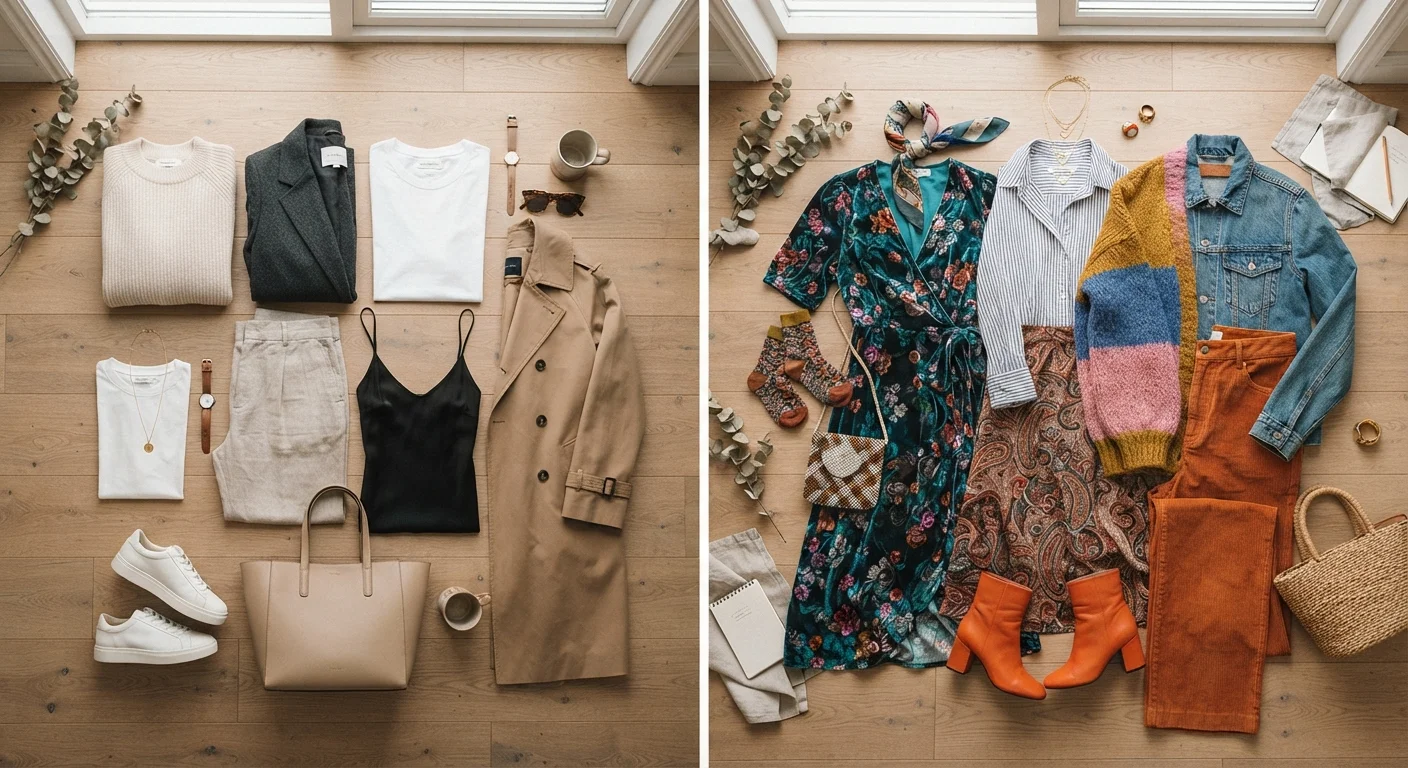
Signature style means anchoring your wardrobe around a specific, recurring aesthetic. Think consistent silhouettes, a defined colour palette, particular fabrics or textures you return to again and again. The goal is coherence: every piece you own reinforces a recognizable visual identity. Getting dressed becomes faster because there are fewer variables, and your wardrobe feels curated rather than accumulated. For a deeper look at what actually creates that sense of cohesion, see the building blocks of a coherent personal style.
Versatile dressing, by contrast, is organized around adaptability. The wardrobe is built from pieces that can shift across contexts — a blazer that works over a casual tee or a silk blouse, trousers that read smart in one setting and relaxed in another. The emphasis is on maximizing outfit combinations rather than projecting a single aesthetic signature. Versatile wardrobe pieces that work across multiple occasions explores this category of clothing in detail.
Both are legitimate frameworks. Neither is a shortcut or a compromise.
The Case for a Signature Style
There is a reason so many confident dressers eventually settle into a signature — it removes friction. When your wardrobe is built around consistent choices, almost everything pairs with almost everything else. Decision fatigue, a real cognitive phenomenon where the quality of decisions declines with each choice made, is genuinely reduced when you narrow your style variables.
A signature style also signals authenticity. Over time, the people in your life come to associate a look with you — and that consistency can reinforce your own sense of identity and confidence. Research into the psychology of clothing suggests that deliberate, self-expressive dressing has measurable effects on mood and self-perception. Dressing for confidence: what research and style experts say goes into the evidence behind this idea.
The challenge? A signature style requires self-knowledge. You need to be reasonably clear on what you actually like — not what's trending or what looks good on someone else. If you're early in your style journey, it may take some exploration before a genuine signature emerges naturally.
Start With What You Actually Wear
Before committing to a signature or versatility-first approach, spend a few weeks noticing which pieces you instinctively reach for. Those are your data points. A genuine signature tends to emerge from existing habits rather than abstract planning — so look at what you already love before deciding what you want more of.
The Case for Versatile Dressing
For many people — especially those navigating multiple dress codes across a single week — versatility isn't a consolation prize, it's the most practical strategy available. A wardrobe built on flexible pieces can handle a Monday morning meeting, a Wednesday lunch, and a Saturday dinner without requiring a separate "category" of clothing for each.
Versatile dressing also tends to be more budget-friendly in the early stages of wardrobe building. Investing in pieces with wide application means each item gets more use, which spreads the cost more efficiently. If you're working through budgeting basics for your wardrobe, flexibility-first purchasing is a sensible default.
The trade-off is that without some intentionality, a versatility-focused wardrobe can feel generic or disconnected. If everything is designed to go with everything, nothing necessarily says anything in particular. The solution isn't to abandon flexibility — it's to apply it within a loose aesthetic framework so the wardrobe still has personality.
| Signature Style | Versatile Dressing | |
|---|---|---|
| Core goal | Visual consistency and identity | Maximum outfit flexibility |
| Decision-making effort | Low — fewer variables to combine | Moderate — more combinations to manage |
| Self-knowledge required | High — needs clear aesthetic preferences | Lower — preferences can still be evolving |
| Budget efficiency | High once core palette established | High when pieces are genuinely multi-use |
| Best for lifestyle | Consistent daily contexts | Multiple contexts across the week |
| Risk of getting it wrong | Wardrobe feels too narrow or rigid | Wardrobe feels generic or disconnected |
| Style evolution over time | Gradual, deliberate refinement | Can shift more freely as tastes change |
How to Figure Out Which Fits Your Life
A useful starting exercise: track your actual getting-dressed experience for one week. Note when you feel rushed, when you feel confident, and which pieces you reach for repeatedly. Patterns emerge quickly.
Ask yourself a few honest questions:
- Do I move between very different contexts most days, or is my life fairly consistent in its dress code?
- Do I already gravitate toward a particular aesthetic, or am I genuinely still exploring?
- Does variety in my wardrobe energize me, or does it create decision anxiety?
- Am I shopping to build something intentional, or to solve daily problems as they arise?
If your instincts run toward a defined visual identity, style archetypes: six common fashion personalities is a useful framework for narrowing down what that identity might look like. If consistency across different occasions feels like the bigger challenge, keeping your style consistent across casual, work, and formal contexts offers practical approaches for threading your aesthetic through every dress code.
Most people end up working with a hybrid — a clear aesthetic point of view applied through pieces that earn their place by being adaptable. That's not a compromise; it's just how thoughtful wardrobes tend to work in real life.
~35
Decisions made about clothing daily on average
Researchers studying everyday decision-making estimate the average person makes dozens of small clothing-related choices each day, contributing to overall decision fatigue.
80%
Of wardrobe worn only 20% of the time
The "80/20 rule" is frequently cited by wardrobe consultants and decluttering researchers to describe how most people regularly wear only a small fraction of what they own.