

Key Takeaways
- Style archetypes are useful self-awareness tools, not rigid labels you have to live inside.
- Most people blend two or more archetypes, and that overlap is where personal style gets interesting.
- Knowing your archetype helps you shop with more focus and fewer regrets.
- Your archetype can evolve as your life, environment, and confidence shift over time.
- Each archetype has a set of core principles that translate across seasons and trends.
Why Archetypes Are Worth Your Attention
Style archetypes — broad personality-driven categories like "minimalist," "romantic," or "eclectic" — give you a shared vocabulary for something that can otherwise feel frustratingly hard to articulate. They're not personality tests and they're not boxes. Think of them as mirrors: helpful for recognising your instincts, not for limiting them.
If you've ever found yourself drawn to the same colour palette or silhouette over and over, that pull is data. Archetypes help you decode it. And once you know what you're working with, shopping and getting dressed become much less overwhelming. For a broader foundation, the beginner's guide to finding your aesthetic is a great companion to this article.
The Minimalist
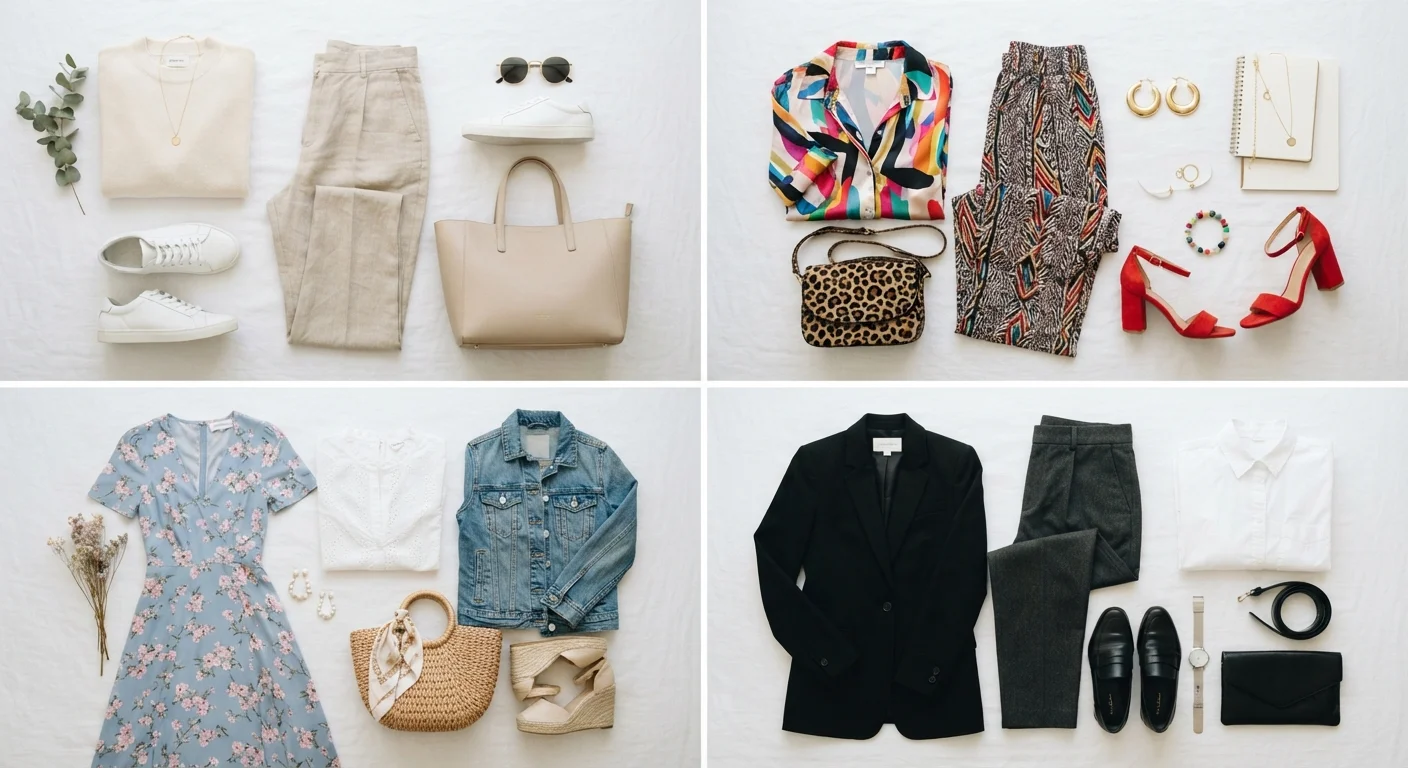
The minimalist is drawn to clean lines, restrained palettes — typically neutrals and earth tones — and a "less is more" philosophy. Every piece earns its place. The wardrobe tends to be small but highly functional, with quality prioritised over quantity.
Work with it: Focus on fit above all else, since simplified outfits live or die by how well clothes sit on your body. Invest time (not necessarily money) in understanding which silhouettes suit you. A tonal outfit — different shades of the same colour family — creates visual interest without introducing pattern or contrast.
For minimalists, fit is everything — a simple outfit becomes striking when the proportions are right.
The Romantic
Soft fabrics, florals, delicate details — lace, ruffles, gathered sleeves — and a generally feminine sensibility define the romantic archetype. The palette tends toward blush, cream, dusty rose, and muted lavenders rather than bold primaries.
Work with it: Romantic dressing can veer into costume territory if every element leans soft simultaneously. Ground the look with one structured or neutral piece — a well-fitted blazer, a crisp pair of trousers, or a simple leather-look shoe — to anchor the dreamier elements.
Balance romantic softness with one structured piece to keep the look grounded and intentional.
The Classic
The classic archetype values timelessness over trend. Think tailored trousers, structured outerwear, button-down shirts, and a largely neutral palette punctuated by one or two signature colours. This is the wardrobe that photographs well a decade later.
Work with it: The risk for the classic dresser is staleness. Introduce freshness through accessories or one contemporary silhouette per season rather than overhauling your approach. A classic foundation also pairs well with a signature style mindset, since the wardrobe's coherence does most of the work.
A classic wardrobe stays relevant longest when accessories carry the contemporary detail.
The Eclectic Maximalist
Pattern mixing, colour clashing, layering, vintage finds alongside contemporary pieces — the eclectic maximalist treats dressing as creative expression. The wardrobe is often dense, varied, and highly personal.
Work with it: The challenge is avoiding visual chaos. One anchoring principle goes a long way: a consistent colour that recurs across pieces, a repeated silhouette, or a unifying texture. When something ties the elements together — even loosely — the look reads as intentional rather than accidental. Mood boards are a genuinely useful tool here; see how to use mood boards without getting overwhelmed.
Even the most eclectic wardrobe benefits from one anchoring element that ties disparate pieces together.
The Streetwear-Influenced
Rooted in youth culture, music, and sportswear, this archetype prioritises comfort, cultural relevance, and self-expression through graphics, logomania, sneakers, and relaxed silhouettes. It has significant crossover with athleisure but carries a stronger aesthetic intention.
Work with it: Proportions are central — oversized on top often works best balanced with a more fitted bottom, or vice versa. Avoid buying trend-driven pieces impulsively; streetwear moves fast, and the most lasting wardrobes in this space are built around a consistent personal vocabulary (a favourite colour, a recurring graphic style) rather than chasing every drop.
Streetwear longevity comes from building a personal vocabulary, not chasing every trend cycle.
The Artisan / Bohemian
This archetype gravitates toward natural fibres, handcrafted or artisanal details, earthy and saturated colour palettes, and a relaxed, unconstructed fit. There's often an interest in the provenance or story of clothing — where it came from, how it was made.
Work with it: The bohemian wardrobe can sometimes feel formless. Introducing one fitted piece per outfit — a cinched waist, a tailored jacket over a flowy dress — adds definition without disrupting the relaxed spirit. This archetype also tends to be naturally compatible with a more sustainable or secondhand approach to building a wardrobe, which can also help manage your shopping budget more effectively.
One fitted element per outfit prevents bohemian dressing from feeling shapeless or unintentional.
Making Your Archetype Work in Real Life
Identifying your archetype is only useful if it leads somewhere practical. Start by doing a quick audit of what you already own — you might be surprised how clearly a pattern emerges. Our wardrobe audit checklist can help you spot those patterns before you spend a single dollar on anything new.
You Don't Have to Pick Just One
Most people find themselves drawn to two or even three archetypes depending on context — work, weekends, social events. Rather than forcing a single label, try identifying your primary archetype (the one that feels most "you" most often) and a secondary one that surfaces in specific contexts. This pairing is often where the most interesting and personal style decisions happen.
If you sit at the intersection of two archetypes — say, Romantic and Minimalist — lean into that tension rather than fighting it. A pared-back palette with one deliberately soft or feminine detail per outfit can feel more authentically "you" than committing fully to either end. The building blocks of a coherent personal style breaks down exactly how elements like silhouette and fabric can unify even a hybrid wardrobe. And when you're ready to take your archetype across every setting — weekend, office, event — keeping your style consistent across contexts offers a practical roadmap.