
Wardrobe Colour Strategy: Understanding Neutrals, Accent Colours, and Why They Work Together

Key Takeaways
- Neutrals form the foundation of a coordinated wardrobe and should make up the majority of your pieces.
- Accent colours add personality and interest without disrupting overall cohesion.
- Limiting your palette to two or three accent colours dramatically increases outfit combinations.
- A deliberate colour strategy reduces decision fatigue every morning.
- Your neutrals and accents should share a compatible undertone — warm or cool — to look harmonious together.
Wardrobe Colour Strategy
A wardrobe colour strategy is a deliberate plan for which colours you buy and keep in your closet so that pieces naturally work together. It typically divides clothing into two groups: neutrals (the versatile base colours) and accent colours (the expressive hues that add personality). When your wardrobe follows this structure, getting dressed becomes faster and less stressful because almost everything already coordinates.
Colour strategy draws loosely from colour theory principles — specifically the relationships between hue, saturation, and value — but you don't need formal design training to apply it practically to a real wardrobe.
Why a Colour Strategy Changes Everything
Most wardrobe frustration doesn't come from owning too few clothes — it comes from owning colours that don't speak to each other. When every item was bought independently, getting dressed can feel like solving a puzzle with mismatched pieces. A colour strategy fixes this at the root.
The idea is straightforward: decide in advance which colours belong in your wardrobe, then let that framework guide future purchases. The result is a closet where the majority of pieces can mix and match without effort. If you're already curious about the broader system this fits into, our capsule wardrobe guide explains how colour strategy and selective buying work hand in hand.
~80%
Wardrobe experts' suggested ratio of neutrals to accent pieces
A commonly cited guideline in fashion styling education suggests building roughly 80% of a wardrobe around neutral colours to maximise outfit combinations.
2–3
Recommended accent colours for a cohesive wardrobe
Style educators and wardrobe consultants generally advise limiting accent colours to two or three to ensure pieces work together rather than in isolation.
The Role of Neutrals: Your Wardrobe's Foundation
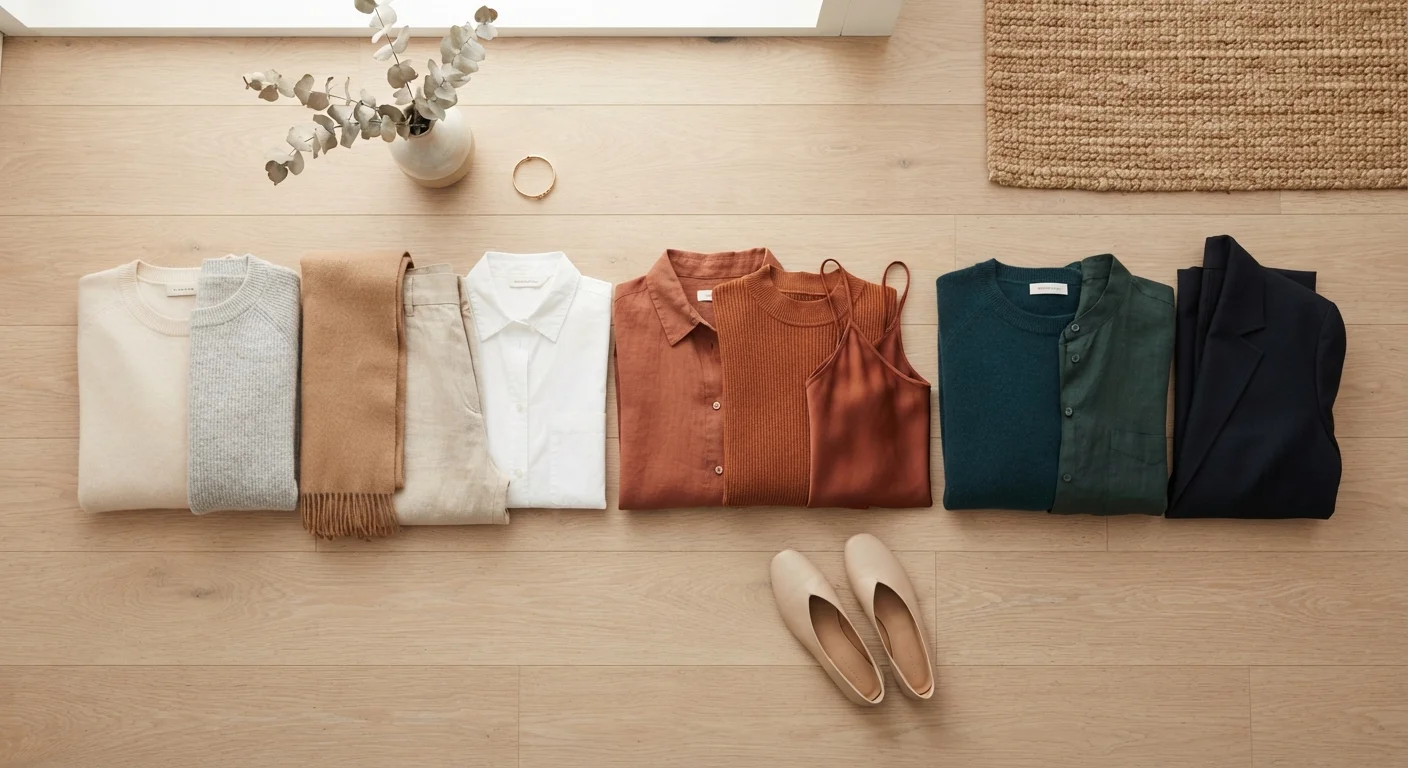
Neutrals are the workhorses of a functional wardrobe. Colours like navy, white, black, grey, camel, and cream are described as neutral because they carry low colour saturation — they don't compete aggressively with other hues. That quality is exactly what makes them endlessly combinable.
Aim for roughly 70–80% of your clothing to fall into neutral territory. This doesn't mean bland. A beautifully cut camel coat, a crisp white shirt, or a well-fitted pair of dark trousers all read as stylish without requiring much coordination effort. These pieces become the connective tissue of your wardrobe — the items that make everything else work.
Test Your Neutrals Before Committing
Before building your whole wardrobe around a neutral, drape the fabric near your face in natural light and observe how your complexion looks. Some people find warm neutrals like camel and ivory particularly flattering; others feel more at ease in cool tones like charcoal or navy. Your neutrals will be your most-worn pieces, so it's worth this small test upfront.
One subtlety worth knowing: neutrals have undertones. Camel, cream, and warm grey lean warm; charcoal, pure white, and cool taupe lean cool. Mixing warm and cool neutrals together can sometimes look slightly disjointed, so it's worth identifying which undertone family appeals to you more. For a deeper look at this, see our article on understanding colour tones and palettes.
Accent Colours: Personality Without Chaos
Accent colours are the hues that make your wardrobe feel distinctly yours. Think a warm terracotta, a rich forest green, a dusty mauve, or a bold cobalt — colours with enough saturation to stand out. The key is choosing them intentionally rather than impulse-buying whatever catches your eye in the moment.
Two to three accent colours is the sweet spot for most people building a wardrobe from scratch. When your accents are limited and chosen to complement your neutrals, something useful happens: your accent pieces coordinate with each other, not just with your neutrals. A terracotta blouse paired with forest green trousers can look effortlessly cohesive when both colours share a warm undertone and both work with your neutral base.
Accent colours show up best in pieces that are naturally more noticeable — tops, lightweight layering pieces, scarves, or shoes. This also means that when trends shift, you can update accents without overhauling your whole wardrobe. Your foundational wardrobe essentials stay constant; the accents evolve around them.
Making It Work: Putting the Strategy Into Practice
Start by auditing what you already own. Group your clothing by colour and look for patterns — which neutrals appear most often? Are there accent colours you keep returning to? That information tells you what your instincts already lean toward, which is a reliable starting point.
From there, write down your intended palette: three or four neutrals and two accent colours. Use this list as a filter the next time you shop. If a piece doesn't fit the palette, that's a signal to pause — not necessarily a hard no, but worth questioning whether it will actually get worn. Versatile pieces that work across occasions are the ideal candidates for your neutral slots, since they'll carry the most outfit-building weight.
If outfits still feel slightly off even after you've applied a colour strategy, the issue might be proportion, texture, or fit rather than colour itself. Our article on why outfits feel off even when everything matches explores exactly that. And if you want a visual reference to anchor your palette decisions, using mood boards effectively is a natural next step.
“A wardrobe built on a clear colour palette isn't restrictive — it's the most creative foundation you can give yourself, because every piece you own is already in conversation with every other.”
— Tim Gunn, Fashion educator and author on style fundamentals