

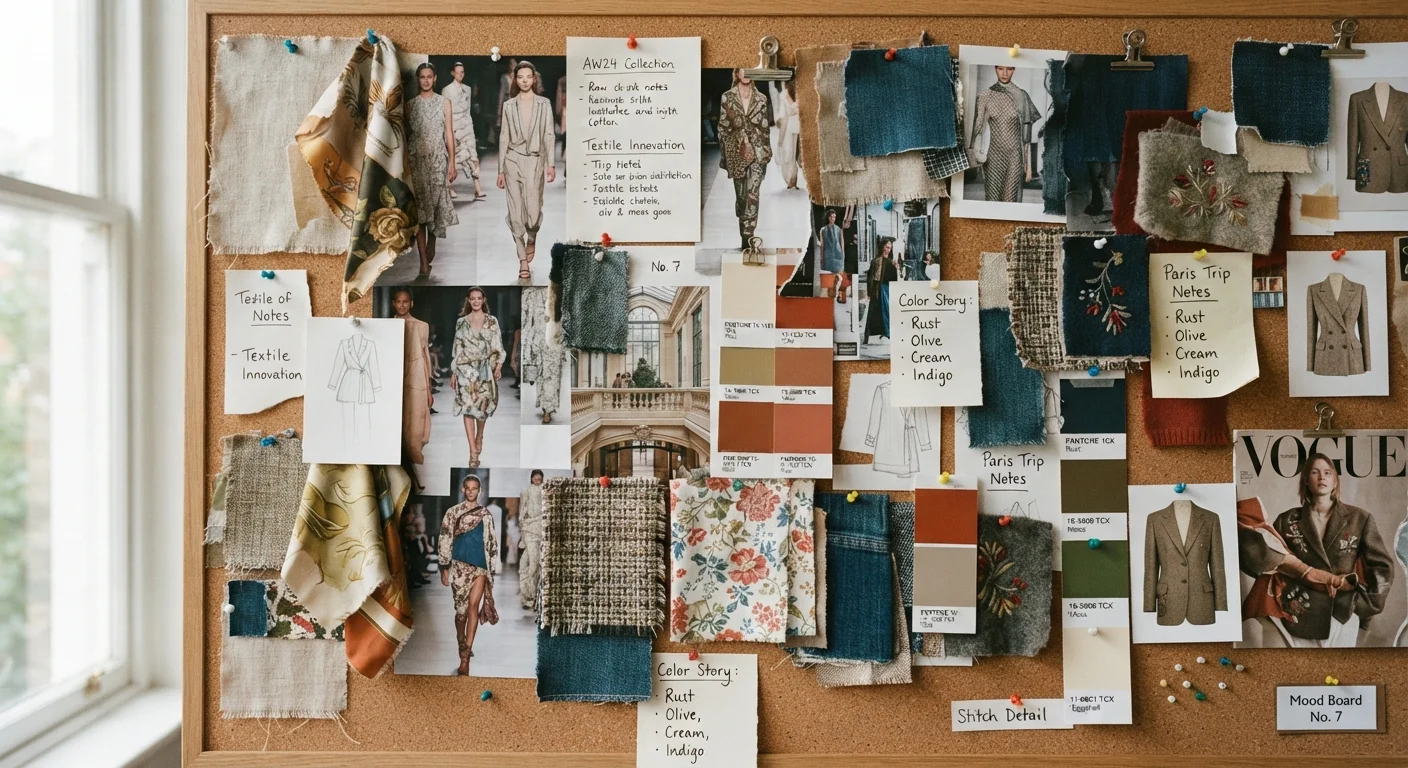
Key Takeaways
- A mood board works best when it reflects feeling and lifestyle, not just visually pretty images.
- Editing your board down to 10–15 images is where the real clarity happens.
- Recurring colors, textures, and silhouettes reveal your genuine aesthetic instincts.
- Your mood board should translate directly into outfit decisions, not just decorative inspiration.
- Digital and physical boards both work — the editing process matters more than the format.
What you will need
Why Mood Boards Go Wrong (and How to Avoid It)
Most people build mood boards the same way they browse social media: scroll, save, repeat. The result is a massive collection of beautiful images that all contradict each other — maximalist one moment, minimalist the next, with three different color stories competing for attention. That kind of board doesn't reduce overwhelm. It just relocates it.
The problem isn't the tool. It's the process. A mood board only becomes useful when it goes through a genuine editing phase — where you decide what you're actually drawn to versus what you simply appreciate on other people. If you're not sure where your instincts begin, finding your aesthetic as a beginner is a good place to start before you collect a single image.
Don't let the board become a shopping list
A mood board is a reference for direction and feeling, not a checklist of items to acquire. If you find yourself trying to recreate specific outfits item by item, you've shifted from developing your own aesthetic to copying someone else's. Use it to extract principles — silhouette, palette, texture — not products.
Done well, a mood board becomes a visual shorthand for your own aesthetic logic. It answers the question does this feel like me? faster than any amount of deliberation. The steps below walk you through building one that actually works.
What You'll Need Before You Start
The good news: mood boarding requires almost nothing. The format — physical or digital — genuinely doesn't matter. What matters is that you can see all your images at once and move them around freely. Choose whichever format you'll actually stick with.
What you will need
Cork board or foam board
Provides a physical surface to pin and rearrange images until the right composition emerges.
Pinterest board (private or public)
A free digital tool for collecting, organizing, and editing visual inspiration quickly.
Print magazines or catalogs
Offer tactile, curated imagery that can be cut and grouped to spot pattern themes.
Sticky notes or index cards
Used to jot keywords and feelings next to image clusters, reinforcing the emotional logic of the board.
Fabric swatches or paint chips
Add a tactile color and texture reference that goes beyond what a screen or printed photo can convey.
Building Your Mood Board Step by Step
Collect without filtering
Set a timer for 20 minutes and gather images purely on instinct. Pull from magazines, screenshot outfits you pause on, save editorial shots that make you feel something — even if you can't explain why yet. Don't ask whether the look is wearable or realistic for your life. At this stage, you're taking inventory of your gut reactions, not making decisions.
Lay everything out at once
Spread all your collected images in front of you — physically on a table or digitally on a single screen. Seeing everything together is the step most people skip, and it's the most important one. Your eye will naturally start grouping similar pieces, and you'll notice what actually dominates versus what you thought you liked.
Edit ruthlessly to 10–15 images
Remove anything that feels aspirational in a disconnected way — meaning you admire it on someone else but can't picture it in your actual daily context. Keep only images that give you a specific, grounded feeling: calm, energized, put-together, playful. Ask yourself: Does this reflect how I want to move through my day, or just what looks good on a screen?
Identify recurring patterns
Look at your edited board and note what repeats. Are most silhouettes relaxed or structured? Do the colors cluster around neutrals, earth tones, or something bolder? Are there particular textures — linen, leather, knitwear — showing up consistently? Write down three to five words that describe what you see. These words become your style filters for future shopping and outfit building. For deeper color pattern work, our guide on understanding color tones and palettes can help you translate what you're noticing into a usable palette.
Map board patterns to your actual wardrobe
Pull out five pieces you already own and wear regularly. Hold them against your board — literally or conceptually. Do they share any of the colors, textures, or proportions you identified? Note the gaps and the alignments. This comparison tells you whether your existing wardrobe is already leaning in a direction you like, or whether there's a clear mismatch worth addressing over time.
Use the board as a decision filter
Before adding anything new to your wardrobe, hold it up against your three-to-five style words and the visual direction of your board. Not as a rigid rule, but as a gut-check: does this belong in that world? This simple practice prevents impulse purchases that feel exciting in the moment but disconnected from your actual style direction. For a broader framework on building wardrobe coherence, see the building blocks of a coherent personal style.
Your board should feel like you, not aspirational you
The most common mood board mistake is collecting images of a lifestyle rather than a life. If every image requires a different budget, body, or schedule than you currently have, the board becomes discouraging rather than useful. Build toward who you actually are today, with room to grow.
Putting Your Board to Work
Once your board is edited and your style words are written down, you have something genuinely functional. Use those words when describing what you're looking for to a tailor, a stylist, or even a knowledgeable sales associate. Use the visual to audit your existing wardrobe, identify what's missing without just buying more, and stay consistent across different dressing contexts — a challenge explored thoroughly in our guide to keeping your style consistent across contexts.
If you find that even a well-edited board still produces outfits that feel slightly off, the issue may be subtler than aesthetic direction. Our piece on why outfits feel off even when everything matches unpacks the underlying reasons cohesive-looking combinations can still miss the mark.
Edit the board, then revisit it
A mood board isn't finished once it's assembled. Plan to revisit and re-edit it every few months. Tastes shift, contexts change, and a board that felt right six months ago may no longer reflect where you're heading. Letting it evolve is a feature, not a flaw — see our piece on letting your style evolve without losing yourself for guidance on navigating that process.
Style is a practice, not a destination. A mood board is simply one of the clearest tools for making that practice feel intentional rather than accidental — and for turning inspiration into decisions you'll actually wear.