

Key Takeaways
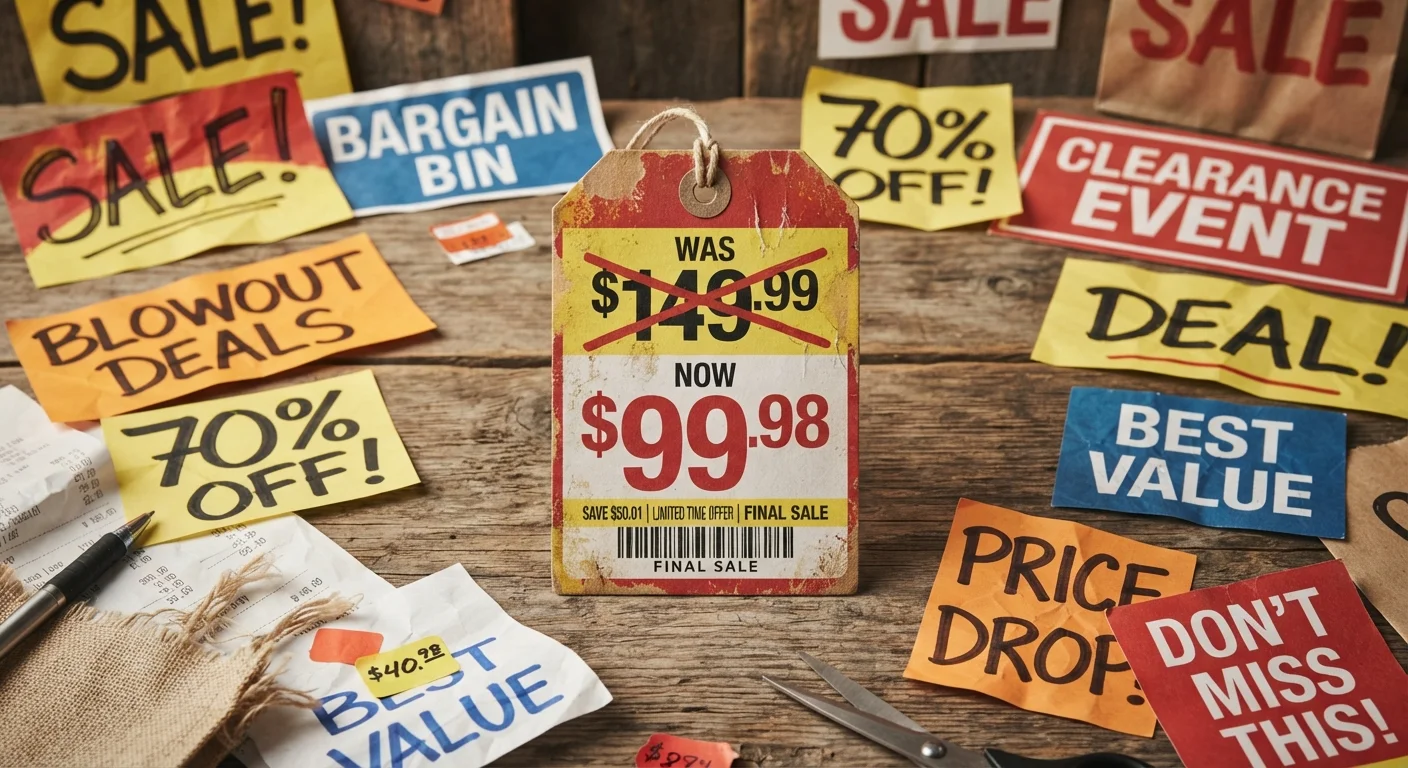
- The 'was' price on a sale tag is often set high specifically to make the discount look larger.
- Anchor pricing exploits a cognitive bias — our brains judge deals relative to the first number we see.
- Seasonal sale events frequently involve price increases before the markdown window opens.
- Comparing a product's price across retailers is more reliable than trusting a single store's discount claim.
- A genuine deal saves you money versus what the item actually sells for elsewhere, not versus a made-up figure.
Manufactured Discount
A manufactured discount is a sale price that appears to offer significant savings but is calculated against a reference price that was artificially inflated, rarely charged, or never meaningfully in effect. The percentage off looks impressive, but the actual savings compared to a fair market price is often much smaller — or nonexistent.
In the U.S., the FTC has guidelines requiring that advertised 'former' prices reflect prices actually offered to the public for a substantial period. However, enforcement is inconsistent, and many consumers never see behind the math.
The Anchor Price Illusion
When you see a tag that reads Was $180 — Now $89, your brain immediately frames $89 as the relevant number to evaluate. That first figure — the $180 — is called an anchor price, and its primary job is psychological, not informational. It sets a mental reference point that makes the lower number feel like a rescue.
The problem is that anchor prices are often set by the retailer, not determined by the market. A product that has never sold at $180 — or sold there for only a few days before the markdown — still gets to wear that figure as its 'original' price. Your sense of savings is calculated against a number that may have had no real-world meaning.
Price anchoring is a well-documented cognitive bias. Once an anchor is set, people adjust from it insufficiently — meaning even skeptical shoppers often end up paying more than they would if they'd started from a neutral reference point.
“Consumers consistently anchor on the first price they see and adjust insufficiently from it. Retailers understand this better than shoppers do, and they design their pricing displays accordingly.”
— Richard Thaler, Nobel Prize-winning economist and behavioral economics researcher
How 'Was' Prices Get Manufactured
Retailers have several methods for creating reference prices that look legitimate but aren't grounded in real value:
- Brief high-price windows: An item is listed at a premium price for a short period — sometimes just days — then 'discounted' for weeks or months. The markdown is technically real but practically meaningless.
- Suggested retail inflation: Some products are listed at a Manufacturer's Suggested Retail Price (MSRP) that nobody ever actually charges, purely to create headroom for discount theater.
- Pre-sale price bumps: Studies of major retail events have found that prices on certain items are quietly raised in the weeks before a sale, then 'cut' back to or near their original level during the event.
Understanding these mechanics doesn't mean every sale is a scam — genuine markdowns exist. But it does mean the percentage-off figure on a tag is not a reliable measure of value. For a deeper look at how sale events are structured, see our piece on why sales events can cost you more than you save.
~33%
Black Friday deals cheaper before the event
A Which? investigation found that roughly a third of Black Friday 'deals' were available at the same price or lower in the six months prior to the sale.
60%+
Shoppers who trust 'was' prices without checking
Consumer research has repeatedly found that a majority of shoppers accept displayed reference prices at face value rather than verifying them against other sources.
Judging a Deal on Its Actual Merits
The most useful shift you can make as a shopper is to stop evaluating a price against the 'was' figure and start evaluating it against the market. Here's a practical framework:
- Search the item across at least three retailers. If the 'sale' price at one store is the everyday price at others, the discount is cosmetic.
- Check price history. Free browser extensions and third-party tools can show how a product's price has moved over time — revealing whether today's deal is genuinely unusual or routine.
- Separate price from value. A lower number on the tag doesn't automatically mean a better outcome for you. Our guide on understanding price vs. value walks through how to measure what you're actually getting.
- Set your own ceiling first. Before you open a sale page, decide what you're willing to pay for the item based on its utility to you. That personal anchor is far more useful than a retailer's crossed-out number.
Set Your Price Before You Shop
Before visiting any sale page or entering a store during a promotional event, write down the maximum you'd pay for the item based on its usefulness to you — not based on any discount label. This personal ceiling insulates your decision from anchor effects and prevents you from buying something simply because it looks cheap relative to an inflated 'was' price.
These habits also transfer to contexts beyond retail. Car pricing involves similar reference-price dynamics — the difference between MSRP, invoice price, and out-the-door cost matters for exactly the same reasons. And many of the broader car-buying myths that trip up first-timers stem from the same anchor-price logic applied to dealership stickers.