
Dog Owner vs. Cat Owner Supply Needs: Where They Overlap and Where They Don't

Key Takeaways
- Both dogs and cats need food and water bowls, a comfortable resting space, and regular veterinary care.
- Dogs require leashes, collars, and outdoor waste supplies that cats generally don't need.
- Cats need a litter box setup and scratching surfaces — neither of which applies to dogs.
- Enrichment looks very different between species: dogs lean on walks and training tools, cats on climbing and hiding spaces.
- Overbuying is common for both species; focusing on true essentials saves money and reduces clutter.
- Breed, age, and individual temperament shape the supply list more than species alone in some categories.
Option A
Dog Owner Supplies
The active, outdoor-oriented supply list.
Best for: Owners of dogs of any age or breed who need gear for walks, training, and daily outdoor routines.
Option B
Cat Owner Supplies
The self-contained, home-focused setup.
Best for: Owners of indoor or indoor-outdoor cats who need to create an enriched, private, low-maintenance home environment.
If you're bringing home a dog for the first time
Dog Owner Supplies
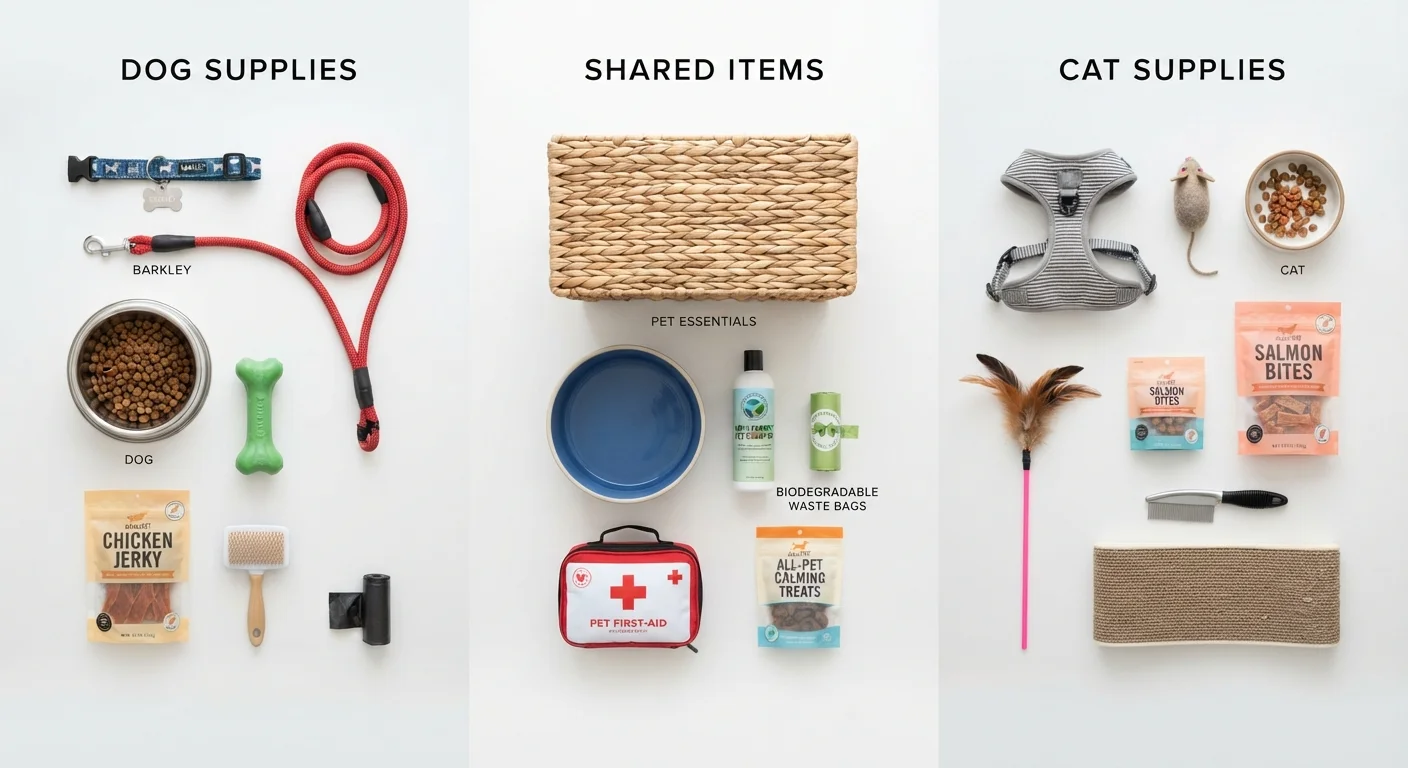
Prioritize a collar, ID tag, leash, appropriate crate or bed, food and water bowls, and waste bags before adding anything else.
If you're bringing home a cat for the first time
Cat Owner Supplies
Start with a litter box, litter, food and water bowls, a scratching post, and a quiet resting space — that core list covers most immediate needs.
If you already own one species and are adding the other
Cat Owner Supplies
Cats typically require more new infrastructure — particularly litter box placement and vertical space — so plan those additions before the cat arrives.
The Shared Foundation
Regardless of which species you've chosen, a handful of supplies apply equally to both dogs and cats. Every pet needs dedicated food and water bowls — ideally separate, easy-to-clean vessels sized appropriately for the animal. Both species need a designated resting space, whether that's a bed, crate, or a quiet corner with a blanket. Identification — via a collar with an ID tag and, ideally, a microchip — is essential for both. And both dogs and cats require routine veterinary care, including vaccinations, parasite prevention, and annual wellness visits.
Feeding itself is an area where the two species overlap more than many new owners expect. The decision between dry food, wet food, or a combination applies to both dogs and cats, though the nutritional requirements differ significantly between species. For a closer look at how feeding approaches compare, see how dry, wet, and raw diets differ.
| Criterion | Dog Owners | Cat Owners |
|---|---|---|
| Food & water bowls | Required | Required |
| Resting space | Bed or crate | Bed or quiet perch |
| ID & microchip | Essential | Essential |
| Leash & collar/harness | Non-negotiable | Not typically needed |
| Waste management | Bags or yard tools | Litter box & scoop |
| Scratching surface | Not required | Essential |
| Vertical space / perches | Rarely needed | Strongly recommended |
| Training tools | High priority | Lower priority |
| Crate or exercise pen | Commonly used | Not standard |
What Dogs Need That Cats Don't
The most distinct dog-specific supplies center on outdoor life and behavior management. A leash and collar or harness are non-negotiable from day one — dogs need structured, safe movement outside the home. Waste bags or a yard cleanup tool are equally essential. Dogs that are crate-trained (a widely recommended approach for puppies and newly adopted adults) need an appropriately sized crate — something with no real parallel in cat care.
Training tools also occupy a meaningful part of the dog supply list. Treat pouches, long lines for recall practice, and interactive puzzle feeders support the behavioral structure dogs generally need more explicitly than cats do. Gates or exercise pens are often necessary to manage a dog's access to different parts of the home, especially during the adjustment period. For a fuller picture of what to prioritize before stocking up, what new dog owners should know before buying supplies offers grounded, practical guidance.
~90M
Pet dogs in the U.S.
The American Pet Products Association estimates roughly 90 million dogs are owned in the United States, underscoring the scale of the dog supply market.
~94M
Pet cats in the U.S.
Cats slightly outnumber dogs in total population according to American Pet Products Association estimates, though dog-owning households are more numerous.
What Cats Need That Dogs Don't
Cats require a litter box setup — typically one box per cat plus one extra, placed in low-traffic areas. This includes litter (clumping or non-clumping, depending on your preference and your cat's), a scoop, and a mat to catch tracking. None of this has a dog-care equivalent.
Scratching is a normal, necessary feline behavior, which means scratching surfaces — posts, boards, or cat trees — are genuine essentials, not optional extras. Cats also benefit from vertical space: shelves, perches, or cat trees give them the elevated vantage points they instinctively seek. Whether your cat lives entirely indoors or has some outdoor access shapes this list further — the trade-offs between indoor and outdoor cat life are worth understanding before finalizing your setup. For a comprehensive starting-point list, see what new cat owners need to know before buying supplies.
Avoiding the Overbuying Trap
Pet supply aisles — and their online equivalents — are engineered to trigger impulse purchases. Both dog and cat owners are susceptible, though the categories differ. Dog owners tend to over-invest in training gadgets and novelty toys early on. Cat owners frequently overbuy on beds (cats often ignore them) or specialty feeders before understanding their individual cat's preferences.
The practical answer is the same for both: start with a short, validated essentials list and add only when a clear need emerges. Why new pet owners overbuy — and what to do instead breaks down the psychology behind those purchases and offers a more intentional approach to shopping. For broader guidance on evaluating options before you spend, the comparing products hub provides useful frameworks. Your veterinarian is also a reliable resource for a species- and age-specific supply checklist tailored to your individual pet.
Breed and Age Change the List
A large, high-energy dog breed needs more substantial exercise equipment and enrichment than a small or low-energy one. A senior cat may need a low-sided litter box or orthopedic bedding that a kitten doesn't. These individual factors often matter more than species alone when finalizing your supply list. Always consult your veterinarian to tailor essentials to your specific pet's age, health status, and lifestyle.