

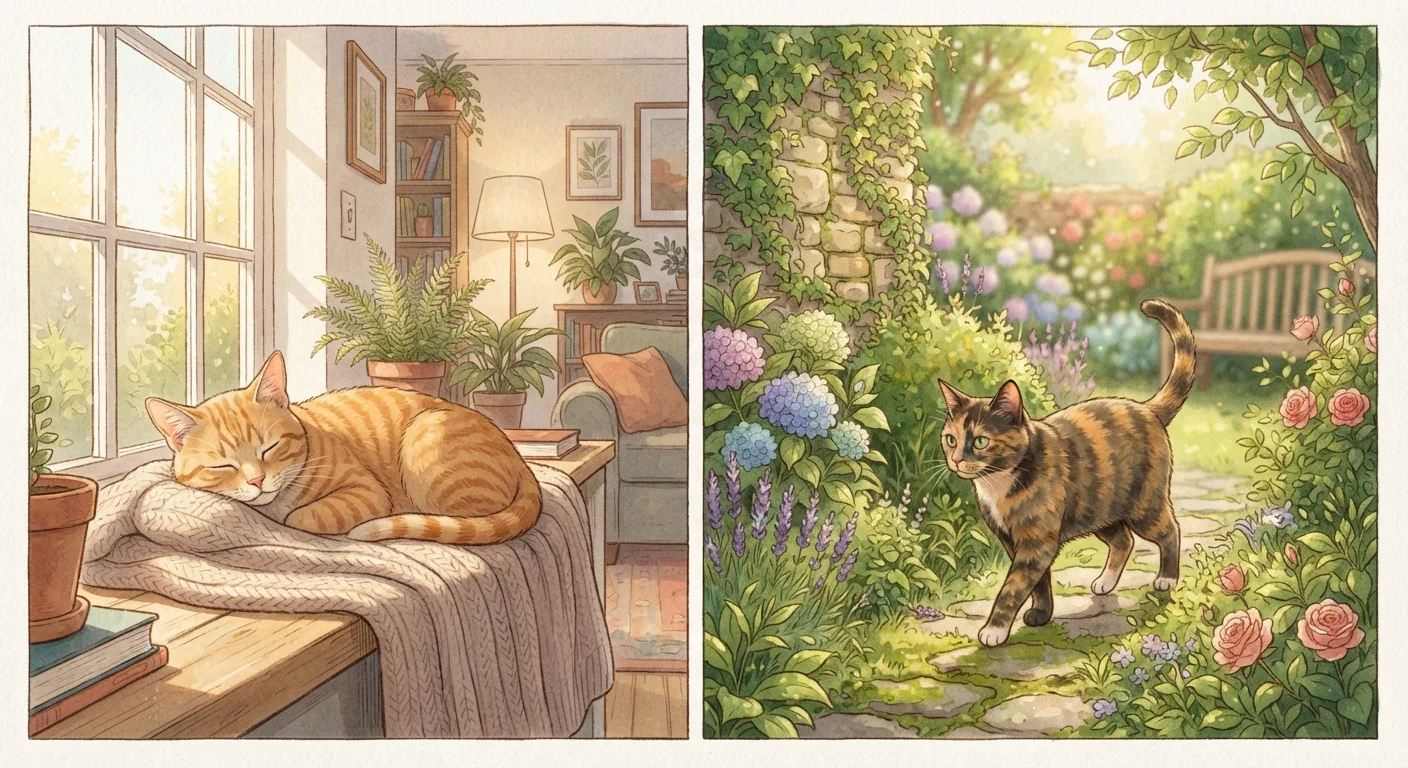
Key Takeaways
- Indoor cats generally live longer on average due to reduced exposure to traffic, predators, and disease.
- Outdoor cats experience greater natural stimulation but face significant safety and health risks.
- Indoor cats require deliberate enrichment to prevent boredom-related behavioral and health problems.
- A supervised outdoor compromise — such as a catio or leash walks — can balance safety and stimulation.
- Your cat's individual temperament and history matter as much as your environment when making this decision.
Option A
Indoor Cats
The protected, enrichment-dependent lifestyle.
Best for: Owners in urban or suburban areas who can commit to providing active mental and physical stimulation inside the home.
Option B
Outdoor Cats
The free-roaming, naturally stimulated lifestyle.
Best for: Cats with strong roaming instincts living in low-traffic, rural settings where owners understand and accept the additional risks.
If you live in a busy urban area with heavy traffic
Indoor Cats
Traffic is one of the leading causes of injury and death for outdoor cats. Keeping cats indoors eliminates this risk entirely.
If your cat was previously a stray or feral with strong outdoor instincts
Outdoor Cats
Some cats adapt poorly to full indoor confinement. A managed outdoor arrangement with vaccinations and parasite prevention may better suit their temperament.
If you want to balance safety with natural enrichment
Indoor Cats
A supervised setup like a catio or harness walks gives indoor cats outdoor stimulation without most of the associated dangers.
If you live in a rural area with low traffic and few predators
Outdoor Cats
Lower environmental hazards make outdoor access more manageable, though vaccination, parasite control, and monitoring remain essential.
The Core Difference: Control vs. Freedom
When new cat owners face this decision, it often feels like a values question — but it's really a practical one. The indoor vs. outdoor debate comes down to a fundamental trade-off: controlled safety with deliberate enrichment versus natural freedom with real, unavoidable risks.
Indoor cats live in a managed environment where owners control nearly every variable — food, hazards, and social exposure. Outdoor cats, by contrast, encounter the world on their own terms, which comes with both genuine benefits and serious dangers that owners should understand before deciding.
This isn't a one-size-fits-all choice. Your living environment, your cat's temperament, and your capacity to provide enrichment all factor in. Before settling on a feeding routine, it also helps to understand the full picture of cat care — including what cats actually need from their environment.
| Criterion | Indoor Cats | Outdoor Cats |
|---|---|---|
| Average lifespan | Generally longer (10–15+ years) | Often shorter (varies widely) |
| Disease exposure risk | Low (FeLV, FIV, parasites) | Higher through contact with other cats |
| Natural stimulation | Must be provided deliberately | Largely self-generated outdoors |
| Obesity risk | Higher without active play | Lower due to natural activity |
| Traffic and predator risk | Minimal to none | Significant, especially in urban areas |
| Owner monitoring ease | High — cat is always accessible | Lower — cat may roam unseen |
| Parasite prevention need | Lower but still recommended | Essential and ongoing |
Health and Lifespan: What the Evidence Suggests
Veterinary and animal welfare organizations generally note that indoor cats tend to live significantly longer than outdoor cats, often citing median lifespans that differ by several years. The reasons are straightforward: outdoor cats face vehicle traffic, predators, contagious diseases, parasites, and territorial fights with other cats.
Infectious diseases like feline leukemia virus (FeLV) and feline immunodeficiency virus (FIV) spread through contact with infected cats — something far more likely outdoors. Intestinal parasites and fleas are also considerably more prevalent in cats with outdoor access.
That said, indoor life carries its own health risks. Obesity, dental disease, and stress-related conditions are more common in cats without adequate stimulation. Being inside doesn't mean being healthy by default — see why indoor-only cats still need regular vet care for a closer look at this.
10–15+ yrs
Typical indoor cat lifespan
Veterinary and animal welfare organizations consistently report that indoor cats outlive outdoor cats by a substantial margin on average.
~3x
Higher parasite exposure outdoors
Cats with outdoor access are significantly more likely to carry intestinal parasites and fleas compared to strictly indoor cats, according to veterinary parasitology data.
60%+
US cats estimated overweight or obese
The Association for Pet Obesity Prevention has found that a majority of cats in the US are overweight, a condition more common in under-stimulated indoor cats.
Enrichment: The Indoor Cat's Biggest Challenge
The most common mistake new indoor cat owners make is underestimating how much stimulation a cat needs. Cats are natural hunters — their brains are wired to stalk, chase, and problem-solve. An unstimulated indoor cat may develop destructive behaviors, anxiety, or compulsive habits.
Effective enrichment for indoor cats includes interactive play sessions (at least two per day), puzzle feeders, vertical spaces like cat trees, and window access to watch birds or wildlife. Mental enrichment for pets is not optional — boredom is a genuine health concern, not just a behavioral inconvenience.
Outdoor cats largely self-enrich through exploration and hunting, but this doesn't mean they need nothing from their owners. Regular interaction, health monitoring, and a safe return point remain important regardless of where a cat spends its time.
Making the Right Call for Your Cat
For most new owners in the US — particularly those in urban and suburban areas — an indoor lifestyle with active enrichment is the lower-risk starting point. It gives you more control over your cat's health and safety while you learn their personality and needs.
If your cat shows strong outdoor drive, consider a middle path: a fully enclosed catio (outdoor enclosure attached to the home), supervised leash walks with a well-fitted harness, or a secured yard. These approaches reduce — though don't eliminate — outdoor risks.
Whatever you decide, ensure your cat is spayed or neutered, up to date on core vaccinations, and on a parasite prevention protocol recommended by your veterinarian. Outdoor cats especially should be microchipped and wear a breakaway collar with identification. You'll also want to make sure your supply setup matches your cat's lifestyle — the pet supplies guide for new owners is a useful reference for building that list.
This article is for general informational purposes only and is not a substitute for veterinary advice. Always consult a licensed veterinarian for guidance specific to your cat's health and circumstances.