

Key Takeaways
- Morning skincare focuses on protection from UV, pollution, and environmental stressors.
- Evening skincare prioritizes repair, renewal, and deeper ingredient absorption while you sleep.
- Some ingredients — like retinoids and certain acids — belong almost exclusively in a nighttime routine.
- SPF is non-negotiable in the morning; skipping it undermines every other skincare step.
- A simple, well-sequenced routine in each window outperforms a complicated, poorly timed one.
Our Verdict
Neither routine is more important than the other — they're partners with distinct jobs. Morning skincare is your skin's defensive line against the day; evening skincare is the recovery window where real renewal happens. Building both around their core purpose, rather than just doubling up on the same products, is what makes a routine genuinely effective.
| Best for | Recommended |
|---|---|
| Newcomers building a first routine | Morning routine with cleanser, moisturizer, and SPF |
| Those targeting specific concerns like texture or uneven tone | Evening routine with targeted actives and richer moisturizer |
| Anyone using retinoids or strong exfoliating acids | Evening routine exclusively for those ingredients |
| Simplicity-first approach | Three-step versions of each routine: cleanse, treat, protect (AM) or cleanse, treat, repair (PM) |
The Core Logic: Defense vs. Repair
Think of your skin's daily cycle as a shift system. During daylight hours, your skin is in active defense mode — managing UV exposure, pollution particles, and oxidative stress. Overnight, it flips into recovery mode, ramping up cell turnover and collagen production while you sleep. Your routines should reflect those two different states.
A morning routine that's loaded with rich occlusive creams and potent actives misses the point. Equally, an evening routine built around SPF and lightweight antioxidants leaves the real renewal work undone. When you align your products with what your skin is already trying to do at each time of day, everything works more efficiently.
This doesn't mean your routines need to be elaborate. In fact, a focused three-step approach in each window — one for protection, one for repair — will consistently outperform a cluttered shelf of misapplied products. The sequence matters too; see our guide to skincare layering for how to stack products correctly in either routine.
Morning Routine: Building Your Skin's Armor
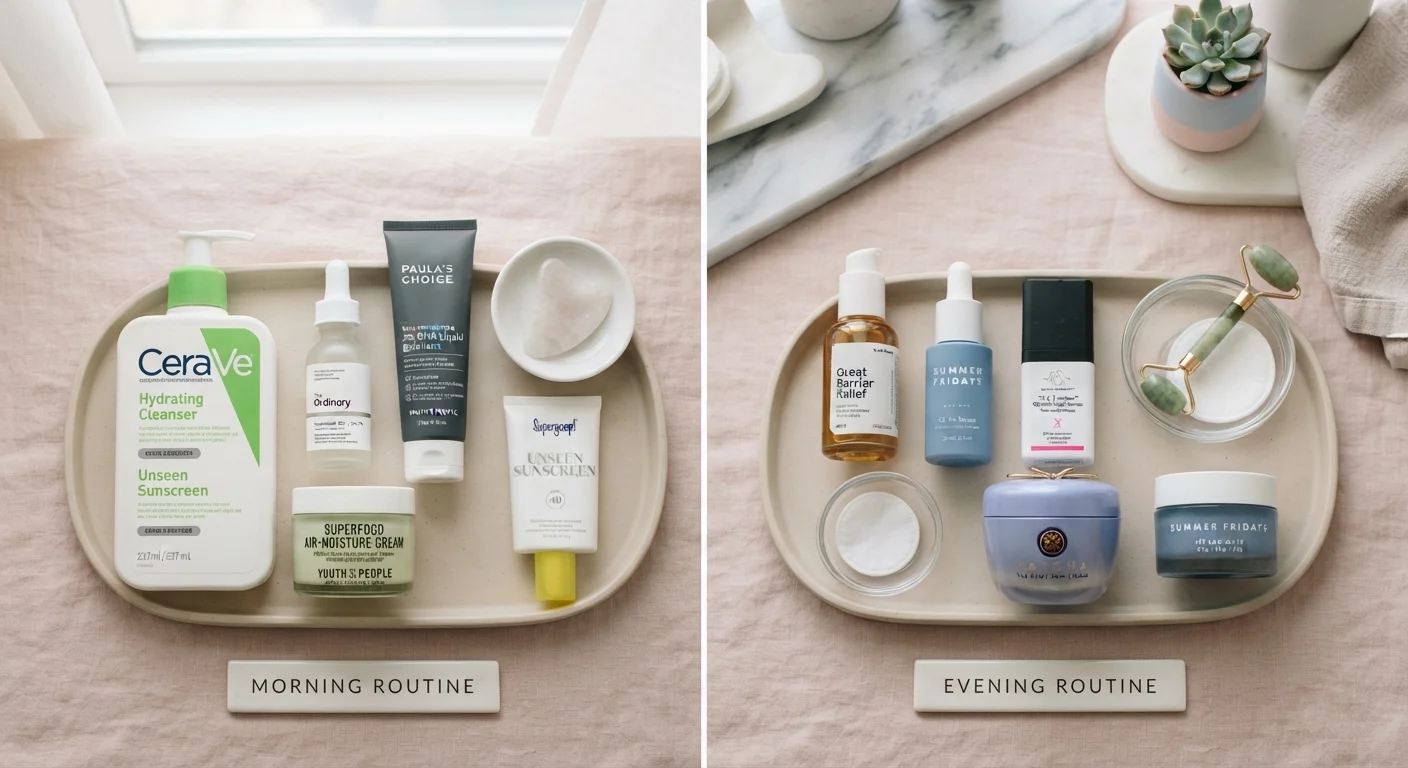
Your morning routine has one overriding mission: prepare skin to face external aggressors. That means a gentle cleanse (or simply a water rinse if your skin is on the drier side), followed by any lightweight antioxidant serum, a moisturizer suited to your skin type, and — critically — broad-spectrum SPF.
Sunscreen isn't optional in the morning, and it isn't just for beach days. Dermatologists consistently identify daily SPF as the single most impactful habit for preserving skin health over time. Why SPF earns that top spot comes down to how cumulative UV exposure drives photoaging and other concerns — even on cloudy days or indoors near windows.
Morning is also when antioxidants like vitamin C earn their place: they help neutralize free radicals generated by UV and pollution throughout the day. Apply an antioxidant serum before your moisturizer and SPF for best effect.
Keep Actives in Their Lane
If you're new to retinoids or exfoliating acids, introduce them only in your evening routine and start with lower concentrations a few nights per week. This minimizes irritation and ensures you're not inadvertently increasing sun sensitivity during daytime. Always follow with SPF the next morning regardless of which actives you used the night before.
What to keep out of your morning routine: retinoids and high-concentration exfoliating acids. These ingredients increase photosensitivity, making your skin more vulnerable to sun damage — exactly the opposite of what a morning routine should achieve.
Evening Routine: Letting Your Skin Recover
Nighttime is when your skin does its most productive work. Cell turnover accelerates, and the absence of UV exposure means you can safely use ingredients that would cause problems in daylight. This is the window for actives.
Start with a thorough cleanse — or double-cleanse if you've worn SPF or makeup. Removing everything that's accumulated during the day is the foundation of an effective evening routine. From there, layer your targeted treatments: retinoids (vitamin A derivatives that support cell renewal), exfoliating acids like AHAs or BHAs, or peptide serums. Finish with a moisturizer that's slightly richer than your daytime one to support the skin barrier overnight.
Not sure whether a serum or a moisturizer should take priority for your concerns? Our explainer on moisturizers vs. serums breaks down what each actually does. If you're incorporating exfoliation, physical vs. chemical exfoliation covers which method suits different skin types.
Sleep quality also plays a meaningful role in how well your skin recovers overnight — it's worth noting that no evening routine fully compensates for consistently poor sleep. Lifestyle factors like sleep and hydration influence skin in ways products alone can't replicate.
Side-by-Side: How the Two Routines Compare
The table below captures the key differences at a glance — useful if you're figuring out where a specific product or ingredient belongs.
| Morning Routine | Evening Routine | |
|---|---|---|
| Primary goal | Protect from environmental damage | Repair and renew overnight |
| Key product | Broad-spectrum SPF | Targeted active (retinoid, acid, or peptide) |
| Cleanser type | Gentle or water rinse | Full cleanse; double-cleanse if wearing SPF/makeup |
| Moisturizer weight | Lightweight, non-occlusive | Richer, more emollient |
| Retinoids and acids | Avoid — increase photosensitivity | Ideal window for these ingredients |
| Antioxidant serums | Highly beneficial (e.g., vitamin C) | Optional; actives take priority |
| Routine length | 3–4 steps, efficiency-focused | 4–5 steps, more thorough |
This article is for informational purposes only and does not constitute medical or dermatological advice. Individual skin responses vary; consult a qualified dermatologist if you have specific skin concerns or conditions.