

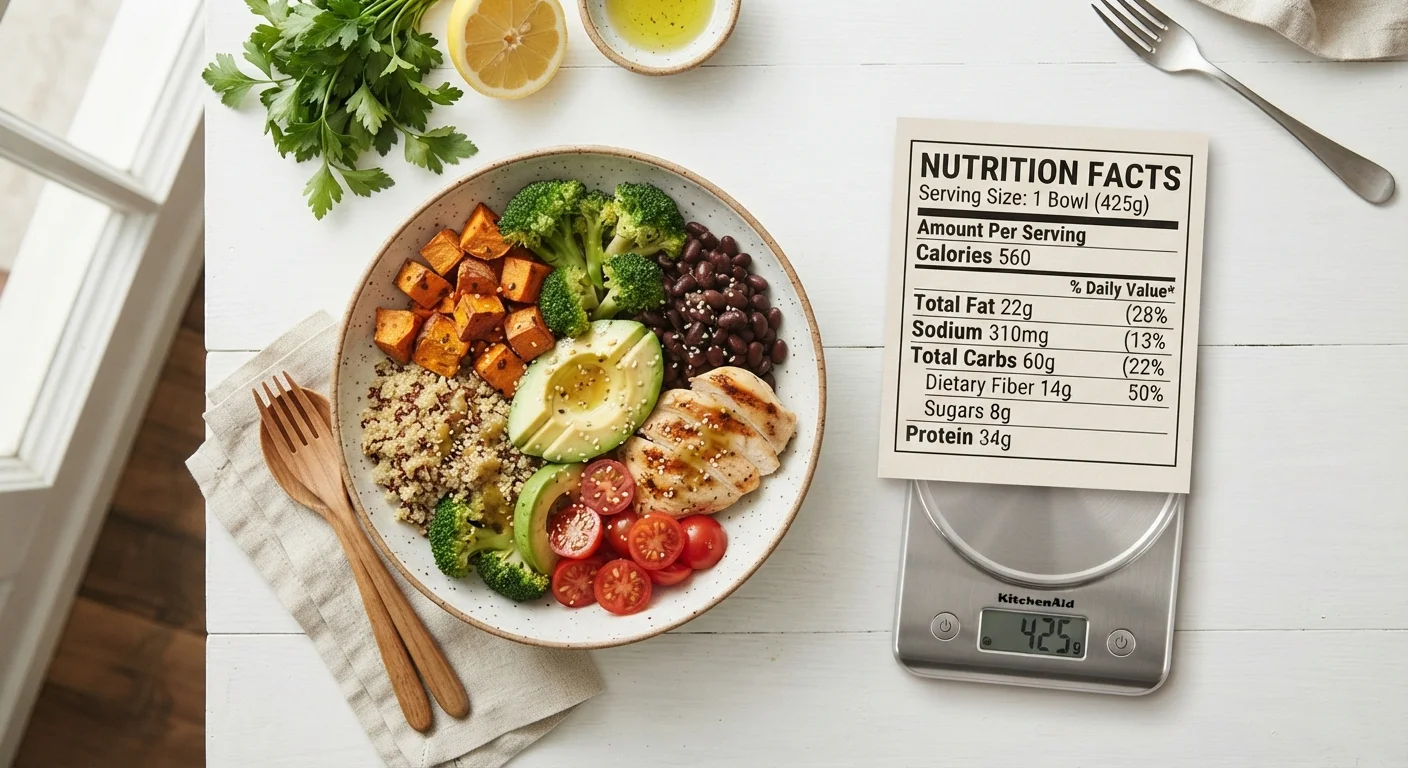
Key Takeaways
- Calories measure energy content only — they say nothing about a food's nutritional value.
- Nutrients include vitamins, minerals, fiber, and macronutrients that perform specific functions in the body.
- Two foods can share the same calorie count while delivering very different health benefits.
- Focusing solely on calories can lead to missing important nutritional gaps in your diet.
- A balanced approach considers both energy intake and nutrient quality together.
Option A
Calories
The energy currency of food.
Best for: Measuring how much fuel a food provides to power bodily functions and physical activity.
Option B
Nutrients
The functional building blocks your body actually uses.
Best for: Understanding what a food does inside your body — from building tissue to supporting immunity.
If you want to understand food as fuel for daily energy
Calories
Calories give you a straightforward measure of the energy a food supplies, which is useful context for overall diet planning.
If you want to understand how food supports your body's functions
Nutrients
Nutrients describe what food actually does — supporting immune function, bone density, muscle repair, and much more.
If you're building a sustainable, health-supporting diet
Both together
Neither metric alone tells the full story. Paying attention to both helps you choose foods that energize and nourish simultaneously.
What a Calorie Actually Measures
A calorie is a unit of energy. Specifically, it measures how much energy your body can extract from a given food to power everything from breathing to exercise. When a nutrition label reads "200 calories," it's telling you the potential energy stored in that portion — nothing more.
Calories come from just three sources: carbohydrates and protein each supply roughly 4 calories per gram, while fat supplies about 9 calories per gram. Alcohol, if present, contributes about 7 calories per gram. That's the entirety of what a calorie communicates — pure energy potential.
This is useful context, but it has a clear ceiling. A 200-calorie handful of mixed nuts and a 200-calorie serving of a sugary snack cake both register identically on the energy scale. Whether those calories come packaged with fiber, healthy fats, vitamins, and minerals — or with very little else — is information the calorie count alone cannot provide.
4 kcal/g
Energy from carbohydrates or protein
Both carbohydrates and protein yield approximately 4 kilocalories per gram — a foundational figure in nutrition science.
9 kcal/g
Energy from dietary fat
Fat is the most energy-dense macronutrient, providing more than twice the calories per gram compared to carbs or protein.
13+
Essential vitamins the body requires
The U.S. National Institutes of Health identifies 13 vitamins considered essential for normal human physiological function.
What Nutrients Actually Do
Nutrients are the specific substances in food that your body uses to function. They fall into two broad categories:
- Macronutrients — carbohydrates, proteins, and fats — are needed in relatively large amounts and provide energy as well as structural and functional roles. See our guide to macronutrients for a deeper look at what each one does.
- Micronutrients — vitamins and minerals — are needed in smaller amounts but are essential for processes like immune response, bone formation, oxygen transport, and nerve signaling.
Beyond macros and micros, components like dietary fiber and water also play critical functional roles even though fiber provides minimal usable calories. A food rich in nutrients delivers tools your body can actually use; a food high in calories but low in nutrients is sometimes described as offering "empty calories" — energy without much functional benefit.
For an accessible reference to common nutrition terms, our plain-language nutrition glossary is a helpful starting point.
| Criterion | Calories | Nutrients |
|---|---|---|
| What it measures | Energy content of food | Functional substances in food |
| Unit | Kilocalories (kcal) | Grams, milligrams, micrograms, % Daily Value |
| Examples | 200 kcal per serving | Vitamin C, calcium, protein, fiber |
| What it tells you | How much fuel a food provides | What the food does inside your body |
| What it misses | Whether food has functional value | Total energy contribution |
| Found on labels as | "Calories" (large number) | Nutrient rows with % Daily Values |
Why Conflating the Two Causes Confusion
Much of the confusion in everyday nutrition talk comes from treating calories and nutrients as interchangeable measures of "how healthy" a food is. They aren't. A food can be:
- High in calories and high in nutrients — such as avocados or salmon, which are energy-dense but also rich in healthy fats, vitamins, and minerals.
- Low in calories and low in nutrients — such as diet sodas, which contribute virtually nothing functional.
- Low in calories and high in nutrients — such as leafy greens, which pack vitamins, minerals, and fiber into very few calories.
- High in calories and low in nutrients — such as highly processed snack foods made primarily from refined starch and added sugar.
Understanding this matrix helps you move beyond calorie counting as the only lens for evaluating food. When you learn to read a nutrition label — our article on reading a nutrition label without getting lost walks through this step by step — you start seeing both dimensions at once.
"Nutrient-Dense" vs. "Calorie-Dense" — A Quick Distinction
Nutrition professionals often use the term nutrient-dense to describe foods that deliver a high proportion of vitamins, minerals, and other functional components relative to their calorie count. Calorie-dense foods, by contrast, pack a lot of energy into a small volume — which isn't inherently bad, but matters for context. These terms appear frequently on food packaging and in dietary guidance, so knowing what they mean helps you interpret both labels and health recommendations more clearly.
Putting Both Measures to Work
Neither calories nor nutrients should be ignored entirely — they answer different questions. Calories help you understand the energy density of what you eat. Nutrients help you evaluate the functional quality of that energy.
A practical approach for anyone starting out: rather than obsessing over calorie totals, look at whether the foods you eat regularly are also delivering meaningful nutrients — fiber, vitamins, minerals, and quality proteins and fats. Foods that do both tend to keep you fuller longer and support more consistent energy levels, though individual responses vary and general nutrition information is not a substitute for personal guidance from a qualified healthcare professional or registered dietitian.
Curious how whole foods compare to supplements as a way to fill nutritional gaps? Our piece on nutrition from whole foods vs. supplements explores what the current evidence suggests. And if you want to go further with label reading, fiber, sugar, and sodium are three numbers worth understanding in more depth.
This article is for general informational and educational purposes only and does not constitute medical or nutritional advice. Consult a qualified healthcare professional or registered dietitian for guidance tailored to your individual health needs.