

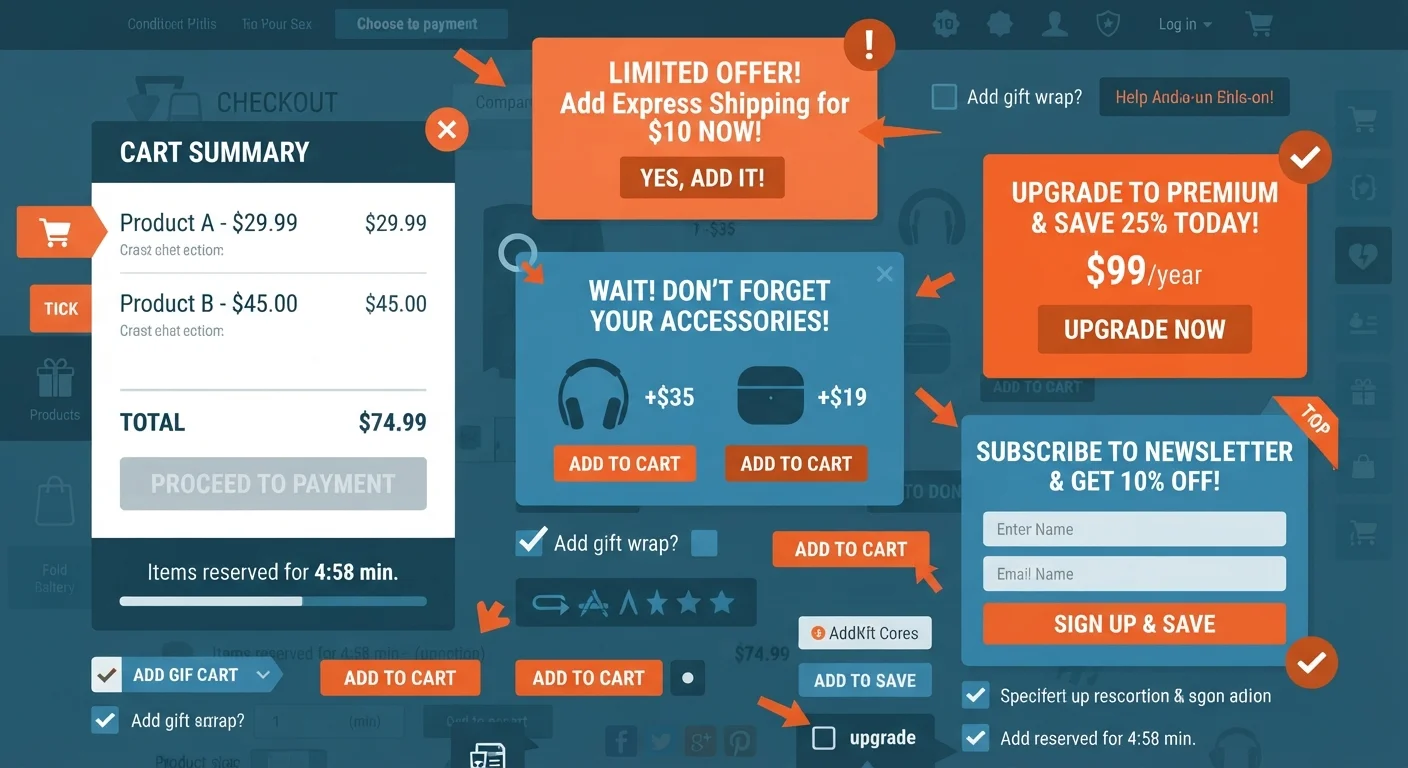
| Where pressure peaks | Cart review and final payment screens |
| Most common add-on category | Extended warranties and protection plans |
| Default opt-in risk | Pre-checked boxes can add charges you didn't notice |
| Key consumer right | You can always decline or remove any optional item |
| Common cross-sell trigger | 'Customers also bought' or 'Frequently bought together' |
| Urgency overlay risk | Countdown timers and stock warnings accelerate decisions (See: The Psychology Behind 'Limited Time' Offers) |
Why Checkout Is the Most Pressured Moment in Shopping
By the time you reach the payment screen, retailers know several important things about you: you have already decided to buy, you have invested time selecting a product, and you are psychologically primed to complete the transaction. That combination makes checkout the highest-leverage point for additional revenue — which is why it is also the most engineered.
Upsells, cross-sells, and add-ons are not random suggestions. They are deliberate, sequenced, and often personalised based on what you placed in your cart. Understanding the mechanics behind each one allows you to evaluate them clearly rather than react under pressure. For a broader look at how shopping environments — digital and physical — are structured to encourage spending, see how retail environments are engineered to make you spend more.
| Where pressure peaks | Cart review and final payment screens |
| Most common add-on category | Extended warranties and protection plans |
| Default opt-in risk | Pre-checked boxes can add charges you didn't notice |
| Key consumer right | You can always decline or remove any optional item |
| Common cross-sell trigger | 'Customers also bought' or 'Frequently bought together' |
| Urgency overlay risk | Countdown timers and stock warnings accelerate decisions (See: The Psychology Behind 'Limited Time' Offers) |
The Three Tactics Defined — and How to Spot Each One
Upsells appear when a retailer substitutes or recommends a superior version of the item you chose. Phrases like "upgrade for just $X more" or "most customers choose the Pro model" are typical signals. The tactic exploits your sunk-cost investment in the original decision — you are already buying, so why not get the better one?
Cross-sells expand your cart horizontally rather than vertically. They suggest complementary items: cables, carrying cases, cleaning kits, matching accessories. The logic is reasonable on the surface — you may genuinely need them — but the cross-sell arrives at the worst time for clear thinking. Ask yourself: would you have sought this item out independently?
Add-ons are optional enhancements bolted on at the payment stage: extended warranties, insurance plans, priority shipping, gift packaging, installation services. These vary widely in actual value. Some add-ons (like accidental damage cover on a fragile device) may be worth examining; many are higher-margin products for the retailer and lower-value for the buyer. If you are prone to impulse additions, run through a pre-purchase sanity check before you reach checkout.
Pressure Patterns to Watch for at Every Checkout
Beyond the three core tactics, retailers layer in psychological triggers that make each offer feel more urgent or reasonable than it is. Recognising these patterns is as important as understanding the offer types themselves.
- Pre-checked boxes: Always scroll through every option on a checkout page. Subscription services, donation round-ups, and protection plans frequently default to opted-in. Unchecking takes seconds; missing them costs money.
- Anchor pricing: A crossed-out "original" price next to the add-on price is designed to make the extra feel like a bargain. Evaluate the add-on at its own absolute cost, not relative to the anchor.
- Urgency overlays: Countdown timers or "only 2 left at this price" messages on add-on offers borrow the same mechanics used in flash sales. Urgency tactics are designed to short-circuit rational thinking — pausing for even thirty seconds disrupts their effect.
- Bundling framing: "Complete the set" or "bundle and save" language can obscure whether the savings are real or whether you needed the additional items at all.
Your right to opt out always applies
No upsell, cross-sell, or add-on is mandatory unless it is a legal or safety requirement of the primary product. If an item appears in your cart that you did not select, you are entitled to remove it before completing payment. If an item cannot be removed, contact the retailer or abandon the transaction.
Unplanned additions at checkout are a significant driver of budget drift. For the underlying psychology, see how impulse buying affects your budget. And if subscription-style add-ons are involved, subscription creep is worth understanding separately — small recurring charges are easy to forget and hard to cancel.