

Key Takeaways
- Subscription services are intentionally priced low to reduce the perceived cost of sign-up.
- Free trials that require payment details convert to paid plans automatically if not cancelled.
- A regular audit of bank and card statements is the most reliable way to catch forgotten subscriptions.
- Annual billing plans often obscure the true monthly cost and make cancellation feel more costly.
- Cancellation flows are frequently designed to be deliberately time-consuming or confusing.
Subscription Creep
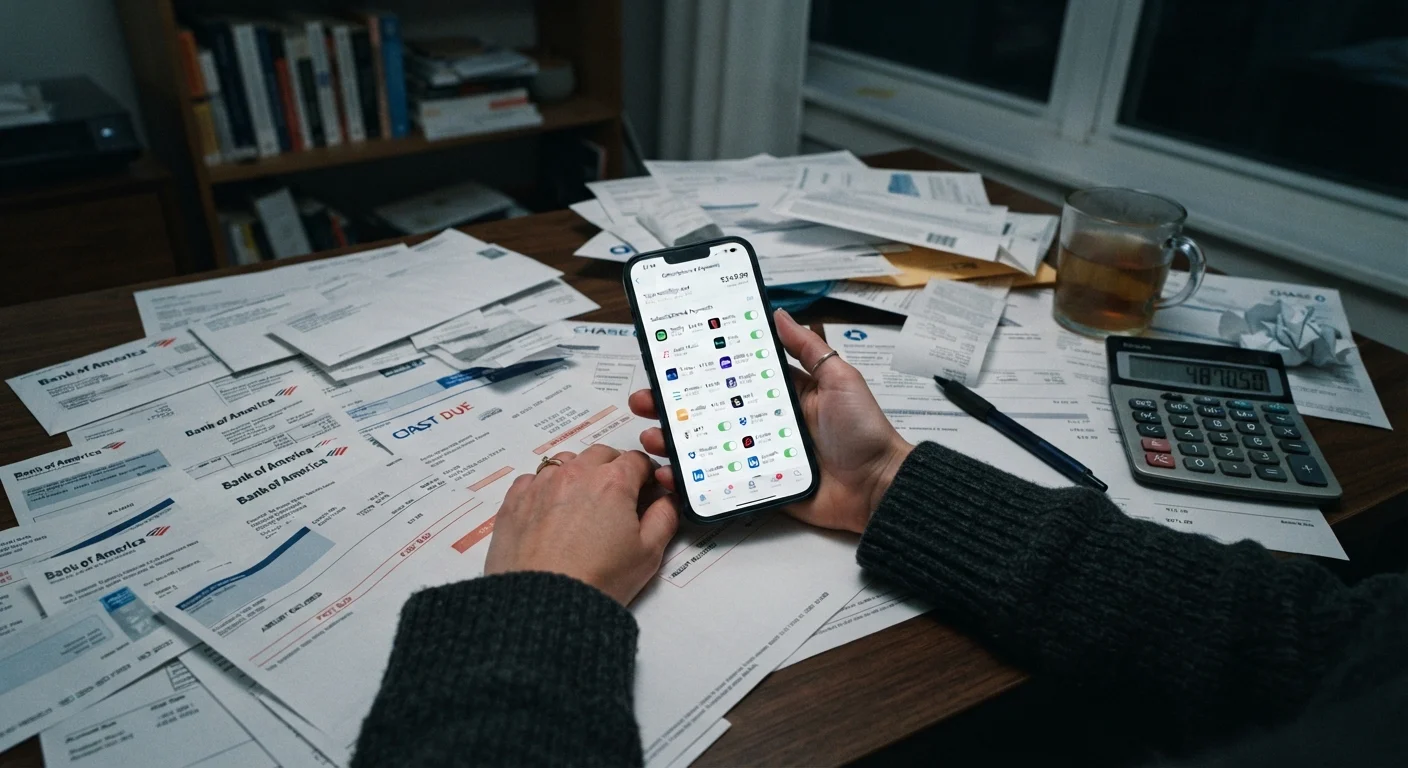
Subscription creep is the gradual, often unnoticed accumulation of recurring charges — monthly or annual — that individually seem affordable but collectively drain a significant portion of your budget. It happens when you sign up for services over time, forget about them, and never cancel the ones you no longer use. The result is a sprawling set of commitments that were never consciously budgeted for as a group.
In behavioral economics, this phenomenon is partly explained by the 'pain of paying' being dulled by small, automated charges — a dynamic that recurring billing models are specifically structured to exploit.
Why Subscriptions Feel Smaller Than They Are
A $4.99 charge barely registers on a statement. Neither does $7.99, $9.99, or $12. But hold five or six of these simultaneously and you are spending $50 to $70 every month on services you may rarely open. This is not accidental — it is the economic logic behind subscription pricing.
Recurring billing models work because they exploit a well-documented cognitive bias: small, automated payments feel less real than a single lump-sum purchase. When you hand over $600 for a single item, you feel it. When $9.99 leaves your account silently on the 14th of each month, it rarely prompts the same scrutiny. Businesses know this, and price accordingly.
This dynamic is closely related to broader budget-eroding patterns explored in our guide to hidden saving traps — where small, invisible costs quietly undermine financial goals over time.
$219/month
Average consumer subscription spend (U.S.)
A 2022 survey by C+R Research found U.S. consumers underestimated their monthly subscription spending by more than 100% on average — guessing $86 when the actual figure was closer to $219.
42%
Subscribers paying for unused services
The same C+R Research study found that nearly four in ten subscribers were actively paying for at least one service they had not used in the prior month.
How Subscription Traps Form
Most subscription creep does not begin with a single reckless decision. It builds through a series of individually reasonable choices — a streaming trial here, a fitness app there, a cloud storage upgrade you needed at the time. The trap forms in the gaps between sign-up and review.
Common entry points include:
- Free trials with mandatory payment details: These are designed to convert. The trial end date is rarely made prominent, and cancellation often requires navigating multiple confirmation screens.
- Annual billing presented at checkout: Paying a year upfront can feel like a deal, but it also raises the psychological cost of cancelling mid-period — even when the service is no longer useful.
- App store bundled subscriptions: Charges routed through a phone's app store are billed differently from direct bank charges, making them harder to spot in a standard account review.
- "Free" add-ons at checkout: A month of premium access offered at point of purchase is designed to convert into a forgotten paid plan. This tactic is part of a wider pattern covered in our field guide to checkout pressure tactics.
How to Audit Your Subscriptions
A subscription audit does not need to be complicated. The goal is to surface every recurring charge, assess its value, and cancel anything that fails the test.
A straightforward three-step process:
- Pull three months of statements. Review every line item on your bank accounts and all credit or debit cards. Flag any charge that repeats or that you do not immediately recognise.
- Categorise by use. For each flagged item, estimate honestly how often you actually use it. Daily? Monthly? Not in the past six months? Usage frequency is your primary filter.
- Cancel, downgrade, or consolidate. Unused services should be cancelled immediately. For services you use occasionally, check whether a lower tier covers your needs. Where multiple subscriptions overlap in function, choose one.
Set a recurring calendar reminder to repeat this review every 90 days. New subscriptions accumulate faster than most people expect.
Use a Dedicated Card for Subscriptions
Routing all subscription charges through a single payment method — whether a specific credit card or a prepaid card — keeps recurring costs visible in one place. When you review that card's statement, every charge on it is a subscription you can evaluate. This simple separation removes one of the main reasons subscriptions go unnoticed.
Subscription management is one piece of a broader budgeting practice. The Smart Shopping Budgeting Basics hub offers practical frameworks for setting and maintaining spending limits across all categories.
Cancellation Design Is Not Neutral
If you have ever tried to cancel a subscription and found yourself clicking through five screens, reading lengthy retention offers, or searching for a phone number buried in a help article — that experience was designed. Deliberately obstructive cancellation flows are a specific category of interface manipulation.
These are part of a broader family of design tactics, sometimes called dark patterns, that use interface choices to nudge users toward outcomes that benefit the business. Our guide to dark patterns walks through how these techniques work across different types of digital products.
When facing a difficult cancellation, document each step. If a service makes cancellation unreasonably difficult, that itself is useful information — and in some cases, a consumer protection issue worth reporting. U.S. consumers can file complaints with the Federal Trade Commission (FTC), which has taken action against companies using deceptive subscription practices.
“Cancellation should be as easy as subscription. If it takes more effort to leave than to join, that asymmetry is a signal worth paying attention to.”
— Consumer Financial Protection Bureau (CFPB), U.S. federal consumer financial protection agency
This article provides general financial information for educational purposes and does not constitute personalised financial or legal advice. For guidance specific to your situation, consult a qualified financial adviser or consumer protection resource.