

Key Takeaways
- Dark patterns are intentional interface designs that manipulate users into unintended actions.
- Pre-ticked boxes, hidden unsubscribe options, and roach motel flows are among the most common types.
- Slowing down and reading every checkout step is the single most effective defence.
- Regulators in the U.S. and EU are actively scrutinising and penalising dark pattern use.
- Recognising these tactics protects your wallet and helps you shop with greater confidence.
Dark Patterns
Dark patterns are deliberate design choices in websites, apps, and checkout flows that steer users into actions they didn't consciously choose — like subscribing to a service, sharing more data than intended, or paying for extras they didn't want. They work by exploiting how people naturally read, click, and make decisions under mild time pressure. Unlike accidental bad design, dark patterns are intentional: they're engineered to benefit the company at the expense of the user.
The term was coined by UX designer Harry Brignull in 2010. Regulators in the U.S. (FTC) and EU (under the Digital Services Act) have increasingly cited dark patterns as a consumer protection concern.
How Dark Patterns Work Against You
Every time you shop online, you're navigating an interface that was designed with specific goals in mind — and those goals don't always align with yours. Dark patterns exploit predictable human behaviours: we scan rather than read, we trust defaults, and we feel mild urgency when we think we might miss out. Designers who build dark patterns understand this deeply and structure their layouts to exploit it.
The result is that you end up opting into an insurance add-on you didn't want, subscribing to a service you thought was a one-time purchase, or donating to a cause that was pre-selected at checkout. None of these feel like choices you made — because, in a meaningful sense, you didn't.
This connects directly to broader patterns of unintended spending. As explored in our guide to buyer traps across shopping categories, manipulation tactics show up across fashion, electronics, insurance, and more — dark patterns are often the mechanism that makes those traps work.
1,818
Dark patterns documented in a landmark study
A 2019 Princeton and University of Chicago study identified 1,818 dark pattern instances across 11,000 popular shopping websites.
~11%
Shopping sites found to use deceptive urgency tactics
The same Princeton/Chicago research found urgency and scarcity dark patterns on roughly 11% of the sites surveyed.
$5B+
FTC penalties linked to deceptive digital practices
The FTC has issued significant penalties to companies found using deceptive digital practices, signalling increasing regulatory pressure on dark patterns.
The Most Common Dark Pattern Types
Pre-ticked boxes and hidden opt-outs
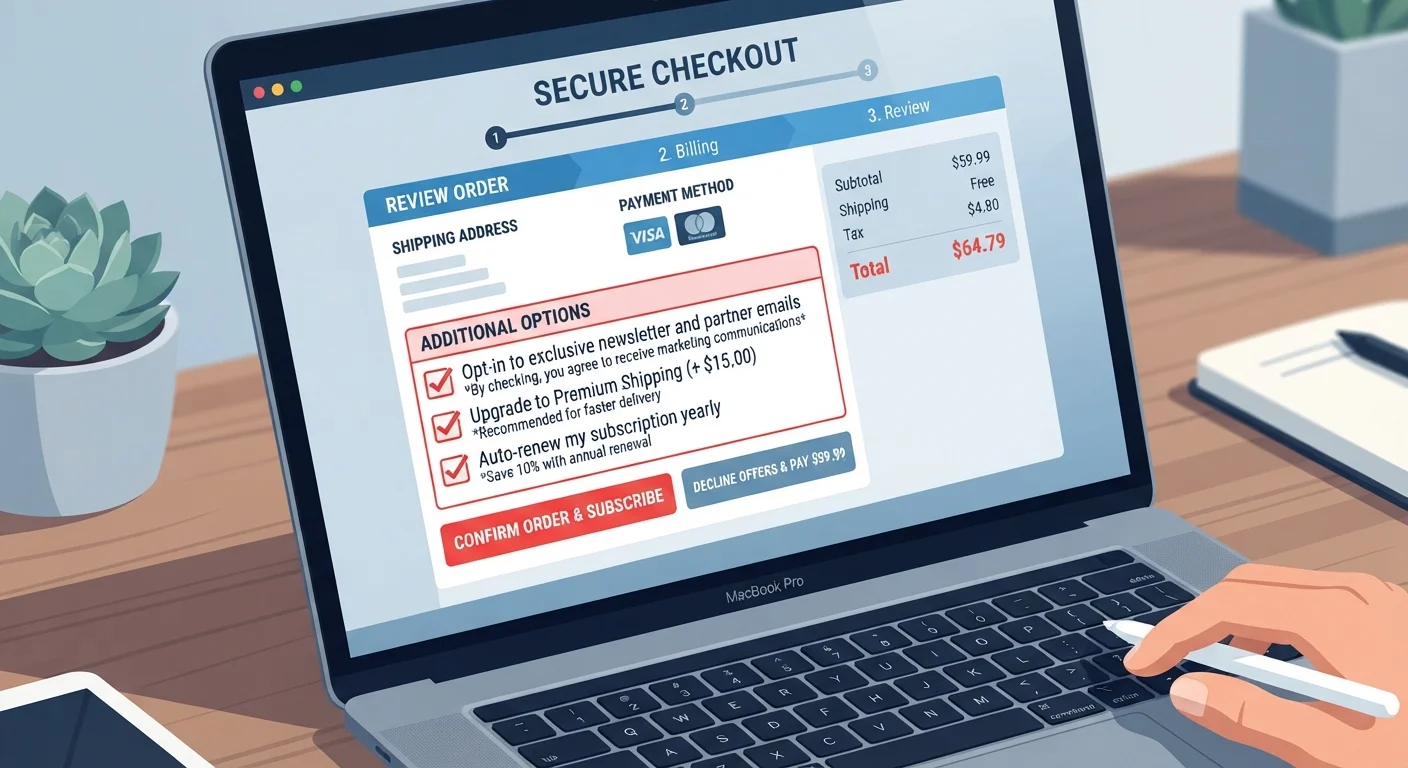
This is one of the most widespread patterns. At checkout, boxes for newsletter subscriptions, insurance add-ons, or third-party marketing are already checked by default. The assumption is that most users won't notice — and research consistently confirms that most don't. The fix is simple: scroll through every checkbox before you confirm an order.
Confirmshaming
This pattern uses emotionally loaded language to make declining feel shameful. A cookie banner might offer "Yes, I want great deals" versus "No, I prefer to pay full price." The wording is designed to make the 'no' option feel irrational rather than simply different. Recognising the framing removes its power.
Roach motel flows
Sign-up is frictionless; cancellation is a maze. Companies bury cancellation inside nested settings menus, require a phone call during limited hours, or add multiple "are you sure?" screens with retention offers. Subscription creep often relies on roach motel design to persist long after you've stopped using a service.
Disguised ads and hidden costs
Search results on retail platforms sometimes blend sponsored listings with organic results using only subtle visual cues. Similarly, mandatory fees — service charges, processing costs, delivery — are sometimes revealed only at the final confirmation screen, after you've already invested time in the purchase.
Pause Before You Click 'Confirm'
Make it a habit to stop at every final confirmation screen and read the full order summary — not just the item you came to buy. Look for line items you didn't add, pre-checked boxes for add-ons, and any recurring billing language. Two minutes of review at this stage can prevent charges that take much longer to reverse.
The Psychology Behind Why They Work
Dark patterns are effective because they exploit cognitive shortcuts, not gullibility. Default bias — our tendency to accept whatever is pre-selected — is a well-documented psychological phenomenon. When a checkout page presents 50 fields and one pre-ticked box, our attention is spent on the fields, not the box.
Urgency cues compound the problem. Countdown timers, low-stock warnings, and "only 2 left" notices narrow attention further, pushing people to act before they've fully reviewed what they're agreeing to. Sales events use similar urgency mechanics to trigger fast, under-considered decisions.
These unintended purchases also quietly compound over time. Recurring charges from dark-pattern sign-ups are among the most overlooked drains on saving progress.
“Dark patterns are not accidents. They are the result of deliberate decisions made by designers and product managers to prioritise business metrics over user wellbeing.”
— Harry Brignull, UX designer and researcher who coined the term 'dark patterns' in 2010
How to Protect Yourself at Every Checkout
Awareness is the foundation, but habits make protection reliable. Treat checkout pages the way you'd treat a contract: scroll completely before clicking, read every checkbox state, and verify the order summary against what you intended to buy.
- Use a dedicated payment method with a low limit or virtual card number for online purchases — it limits exposure if you're enrolled in something without realising.
- Screenshot your cart before and after checkout so you have a record of what was — and wasn't — selected.
- Search for the cancellation process before you sign up for any subscription. If it's difficult to find, that's information.
- Check your statements monthly for charges you don't recognise. Budgeting basics include regular audits as a core habit.
Understanding how to compare products and services before committing is another layer of defence — when you know what you want before you arrive at checkout, you're less susceptible to in-flow upsells and confusing defaults.
Retail environments — digital and physical — are increasingly engineered to maximise spending. Understanding how those environments are structured helps you navigate them with your intentions intact.