

Key Takeaways
- Countdown timers and 'only X left' notices are designed to trigger emotional, not rational, decision-making.
- Loss aversion makes the fear of missing a deal feel worse than the actual cost of the purchase.
- Many 'limited time' offers are not genuinely limited — they recur or are extended regularly.
- Pausing before purchasing gives your rational mind time to override the urgency response.
- Knowing the tactic exists significantly reduces its psychological power over you.
Artificial Scarcity
Artificial scarcity is a sales tactic in which retailers create the impression that a product, deal, or window of opportunity is rare or disappearing — even when it may not be. It exploits a basic human fear of missing out to accelerate purchasing decisions. The goal is to make you act before you think.
In behavioral economics, this tactic leverages 'loss aversion' — the well-documented tendency for people to weigh potential losses more heavily than equivalent gains, first formalized by psychologists Daniel Kahneman and Amos Tversky.
How Urgency Tactics Work on the Human Brain
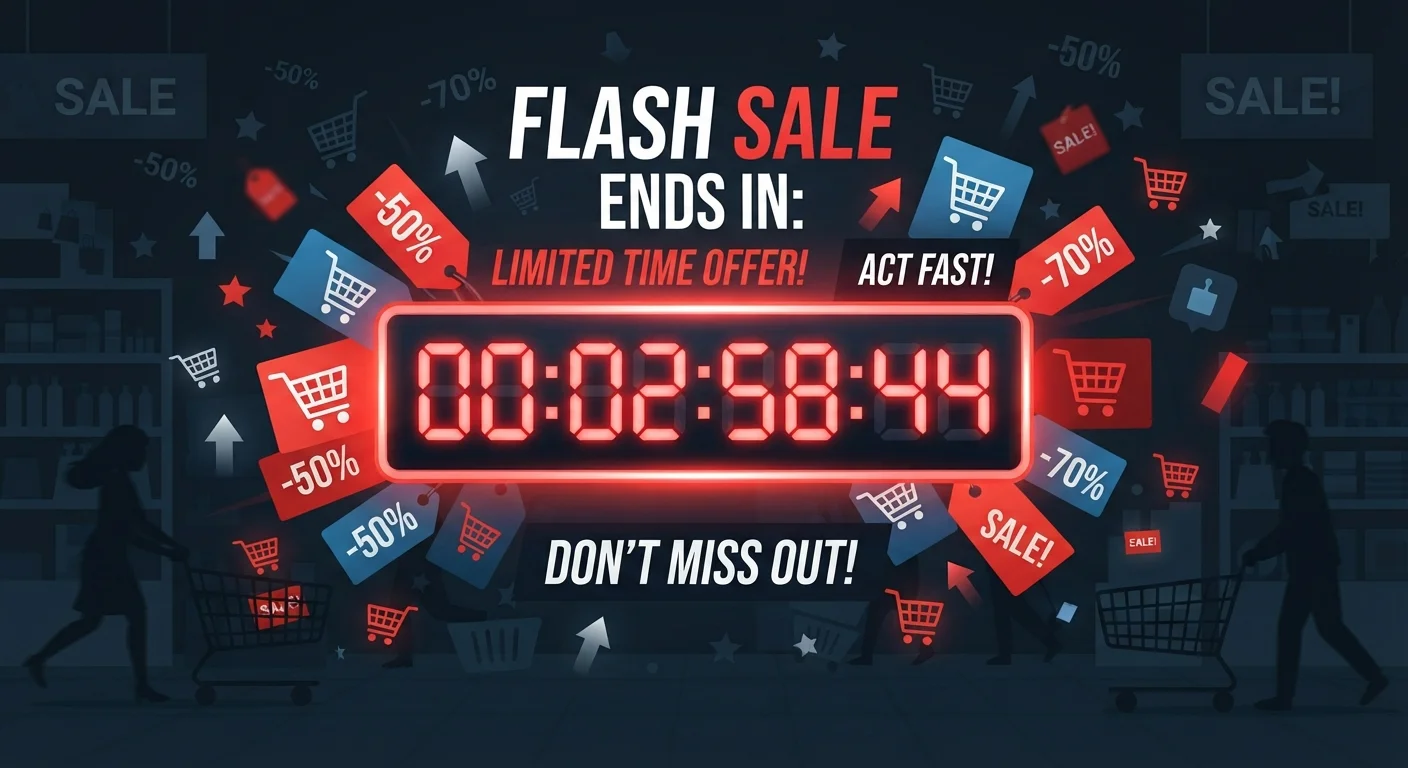
When a retailer places a countdown clock on a product page or flashes a message reading 'Only 3 left in stock,' something predictable happens in your brain: the threat-detection system activates. This is not a character flaw — it is how human cognition is wired. Scarcity historically signaled real danger, and the brain still responds to it with a burst of urgency that prioritizes speed over reflection.
This urgency short-circuits what psychologists call System 2 thinking — the slower, deliberate reasoning process that weighs pros, cons, and alternatives. Instead, it hands control to System 1: the fast, emotional, pattern-matching mode that is highly susceptible to framing. Retailers understand this distinction, and urgency design is built around exploiting it.
The result is that shoppers make purchasing decisions they might not make in a neutral setting — not because the product is worth it, but because the emotional cost of not buying feels unexpectedly high. See how this same mechanism drives unplanned purchases across shopping contexts.
This Is General Consumer Education
This article explains documented psychological principles in a shopping context for informational purposes. It is not financial advice. Your individual spending decisions depend on your own circumstances, and a licensed financial professional can help with personalized guidance.
The Role of Loss Aversion in 'Limited Time' Messaging
Central to urgency tactics is a concept called loss aversion: the psychological asymmetry between how we experience gains and losses. Research in behavioral economics has consistently shown that people feel the pain of a loss roughly twice as intensely as the pleasure of an equivalent gain.
A 'limited time' offer weaponizes this asymmetry. By framing inaction as a loss — you will miss this price, you will lose your cart spot, this deal will be gone — retailers make the neutral act of not buying feel actively harmful. The emotional math tips sharply toward purchasing, regardless of whether the item was on your list or within your budget.
This is closely related to why sales events can end up costing you more than the discount is worth — the urgency itself becomes a cost you pay in the form of an unplanned or poorly considered purchase.
“The framing of a choice — not just its substance — can have a decisive influence on the decision a person makes. People respond to losses and gains differently, and skilled choice architects know how to use that asymmetry.”
— Richard Thaler, Nobel Prize-winning economist and co-author of 'Nudge'
Recognizing Manufactured vs. Genuine Scarcity
Not every urgency signal is fictional, but many are designed to appear more pressing than the underlying reality warrants. A few patterns are worth learning to recognize:
- Recycled countdown timers: Timers that reset after expiring, or 'sale' prices that persist indefinitely, signal manufactured urgency rather than a real deadline.
- Fluctuating stock counters: Stock indicators that jump around or reset are rarely reflecting live inventory — they are often a static persuasion element.
- Vague social proof: Notices like '47 people are viewing this item right now' cannot typically be verified and are frequently designed to manufacture competitive pressure.
- Recurring 'one-time' events: A sale that returns every few weeks is not a rare opportunity. Tracking price history using publicly available tools can quickly reveal whether a discount is genuine.
Understanding these signals does not require cynicism — it requires the same comparison mindset you would apply to any purchase. Our guide to comparing products covers how to evaluate options methodically before committing.
Use Price History to Check Urgency Claims
Before acting on a 'limited time' price, search for the product's price history using publicly available browser extensions or price-tracking websites. If the current 'sale' price has appeared frequently in recent months, the urgency framing is likely misleading. This single step can prevent a significant number of regret purchases.
Building a Personal Defense Against Urgency Design
Awareness is the most durable defense against urgency-based pressure, but it works best when paired with a concrete habit. A brief, intentional pause — stepping away from the page, closing the tab, or simply waiting before entering payment details — interrupts the automatic urgency response and allows deliberate thinking to re-engage.
A few practical habits help:
- Ask whether you planned this purchase before landing on the page. Urgency tactics are most effective on unplanned decisions. If the item was not on your list, treat the urgency signal as a reason to slow down, not speed up.
- Separate the product decision from the timing decision. First ask: do I actually want this? Then ask: does the timeline genuinely affect whether I can get it? These are different questions that urgency design conflates deliberately.
- Check the offer's history. Price-tracking tools and a brief search can reveal whether 'this price' is unusual or routine. Many deals that appear fleeting are actually baseline pricing dressed in countdown-clock clothing.
If you find patience in purchasing difficult, it is worth exploring when waiting genuinely pays off — patience is often more financially rewarding than urgency messaging implies. And if checkout pressure is a recurring challenge, understanding how upsells and add-ons work can help you arrive at the payment screen with a clearer head.
~2×
How much more losses hurt vs. equivalent gains
Research by Kahneman and Tversky on loss aversion suggests losses are felt roughly twice as intensely as gains of the same size.
Up to 332%
Conversion lift from countdown timers in some studies
Some e-commerce research has found that countdown timers can dramatically increase conversion rates, underscoring why urgency tactics are so widely deployed.
49%
Shoppers who report impulse buys due to urgency cues
Consumer behavior surveys have found that nearly half of shoppers report making unplanned purchases specifically in response to scarcity or time-pressure messaging.