

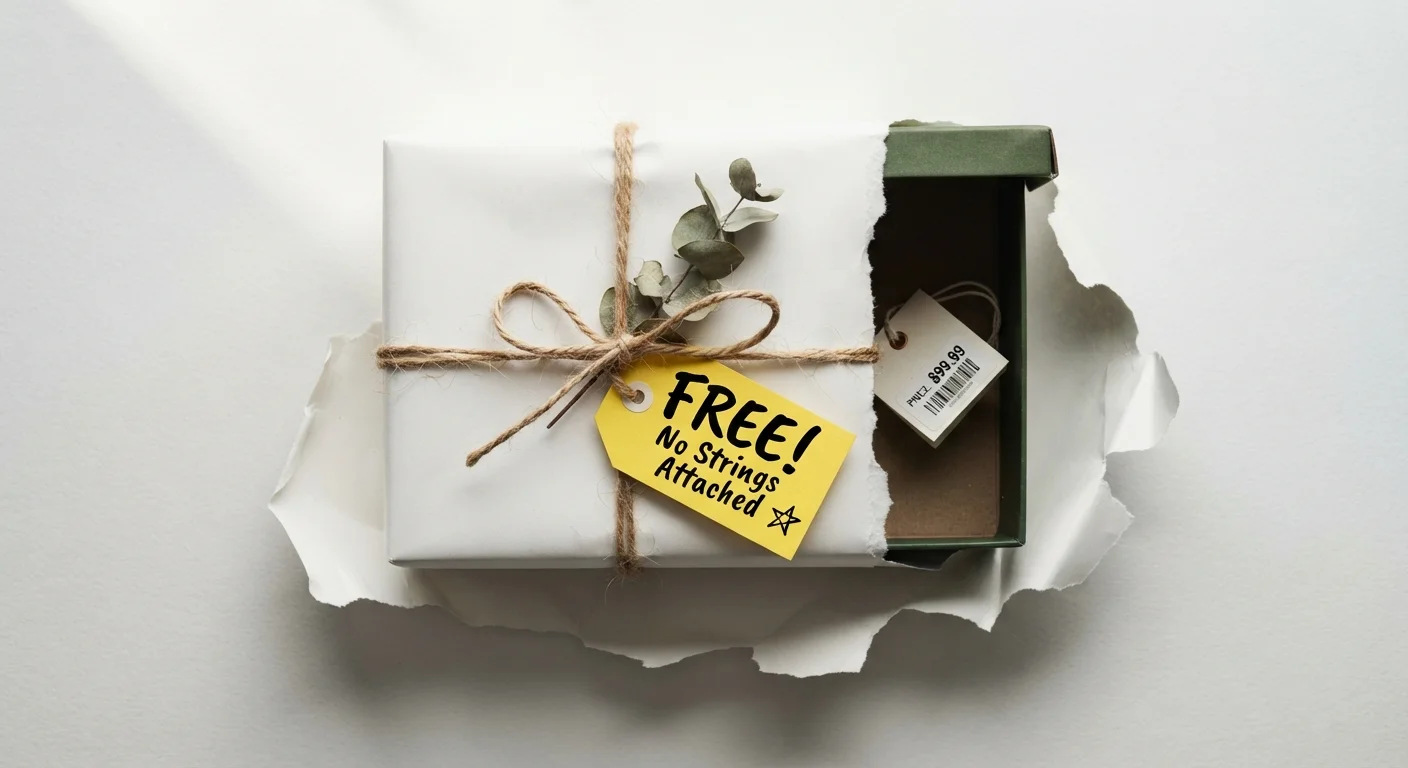
Key Takeaways
- 'Free' is a conditional offer — there is almost always a behavioral, financial, or data-related cost attached.
- Free trials often convert to paid subscriptions automatically; mark your calendar before signing up.
- Free shipping thresholds can push you to spend more than you intended to save a small delivery fee.
- Free gifts add perceived value but rarely change whether a product is right for you.
- Asking 'what do I give up or commit to?' is the single most useful question before accepting any free offer.
Start here
Why 'Free' Is a Marketing Word, Not a Guarantee
Next
Free Trials: The Clock Is Always Ticking
Then
Free Shipping Thresholds: Spending More to Save Less
Also worth knowing
Free Gifts With Purchase: Value or Distraction?
Apply it
A Simple Framework for Evaluating Any 'Free' Offer
Why 'Free' Is a Marketing Word, Not a Guarantee
'Free' is one of the most powerful words in advertising — and one of the most misleading. When something is labeled free, it doesn't mean it costs nothing. It means the cost has been moved, delayed, reframed, or exchanged for something other than cash.
Common cost structures hidden inside 'free' offers include:
- Behavioral costs: Your time, attention, or personal data.
- Deferred financial costs: A charge that kicks in after a trial or commitment period.
- Conditional costs: A minimum spend required to unlock the benefit.
- Opportunity costs: Choosing a product primarily because of its free add-on rather than its actual fit for your needs.
This isn't a cynical take — it's a practical one. Understanding what drives 'free' offers helps you engage with them on your own terms. For a broader look at how design and language nudge shoppers into unintended spending, see how dark patterns work.
Free trial
A limited-period offer letting you use a product or service at no immediate charge, typically requiring payment details upfront and converting to a paid plan automatically when the period ends.
Shipping threshold
A minimum order value set by a retailer that, once reached, waives the delivery fee. Designed to encourage higher cart totals.
Auto-renewal
A billing arrangement where a subscription or membership charges your payment method automatically at the end of each period unless you actively cancel.
Perceived value
How valuable a shopper believes an item or offer to be, which can differ significantly from its actual market or functional value.
Opportunity cost
The value of the next-best option you give up when making a choice — for example, buying an unwanted item to reach a free shipping threshold instead of keeping that money.
Deferred cost
A charge that doesn't appear immediately but activates after a set condition is met, such as the end of a free trial period.
Free Trials: The Clock Is Always Ticking
Free trials serve a legitimate purpose: they let you evaluate a product or service before committing money. The problem is that most are designed with friction that makes cancellation easy to forget and hard to complete.
Watch for these mechanics when you sign up for any free trial:
- Credit card capture upfront: Entering payment details at signup creates a default billing trigger. When the trial ends, you're charged automatically unless you've actively cancelled.
- Short windows: Seven- or fourteen-day trials pass quickly. Set a calendar reminder for two days before the trial ends so you have time to cancel if needed.
- Buried cancellation flows: Some services make cancellation intentionally hard to find. Search for cancellation instructions before you sign up, not after.
- Rollover commitment: Some trials lock you into a minimum subscription term once the trial converts — cancelling doesn't always mean stopping charges immediately.
Set a Trial-End Reminder Before You Start
Before completing any free trial signup, open your calendar and set a reminder two days before the trial expires. This gives you time to evaluate the service calmly and cancel if needed — without rushing or missing the cutoff entirely.
This pattern appears across software, streaming, fitness apps, and subscription boxes. The category changes; the structure doesn't.
Free Shipping Thresholds: Spending More to Save Less
Free shipping thresholds — 'spend $50 and shipping is on us' — are among the most common 'free' mechanics in retail. They work because avoiding a delivery fee feels psychologically rewarding, even when spending more to reach the threshold costs more than the fee itself.
Before you add items to reach a free shipping minimum, do a quick calculation:
- What is the shipping charge if you don't reach the threshold?
- What would the additional item(s) cost?
- Do you actually want or need those additional items?
If the shipping fee is $6 and you'd need to add $20 in products you wouldn't otherwise buy, you're spending $14 more to avoid $6 — not saving anything. The calculation is simple, but the impulse to 'not waste' the shipping offer is surprisingly strong.
Adding Items to Hit a Threshold Can Cost More Than Shipping
Retailers count on the psychological pull of 'unlocking' free shipping. Before padding your cart, compare the cost of extra items against the actual shipping fee. In many cases, paying for shipping is the less expensive choice — and leaves you with only what you intended to buy.
Thresholds are also used in loyalty programs, coupon unlocks, and gift-with-purchase promotions. The same arithmetic applies in every case. For more on how price framing can distort value perception, see our piece on common myths about cheap vs. expensive products.
Free Gifts With Purchase: Value or Distraction?
A free gift bundled with a purchase adds perceived value — but it rarely changes whether the purchase itself is the right decision. The risk is that the gift becomes the reason to buy, rather than a pleasant bonus on top of an already sound choice.
Ask yourself two questions before a free gift influences your decision:
- Would I buy this product without the gift? If the answer is no, the gift is doing the work of the product review — which is a problem.
- Does the gift have genuine value to me? A free item you wouldn't buy separately and won't use isn't worth anything in practice.
Gifts are also used to obscure price increases. A product that previously cost $30 may now cost $38 with a 'free' sample included — the math rarely favors the shopper as clearly as it appears. For structured help evaluating any purchase on its actual merits, the complete guide to comparing products is a useful starting point.
A Simple Framework for Evaluating Any 'Free' Offer
Regardless of the type of 'free' offer you encounter, a consistent set of questions keeps the analysis clear and fast:
- What triggers a cost?
- Identify the specific action, date, or condition that converts the free offer into a financial commitment.
- What is the true total spend?
- Add up all purchases, subscriptions, or minimums required to access the 'free' element.
- What am I exchanging?
- Consider non-financial costs: data, attention, time, and any ongoing commitment.
- How easy is it to exit?
- Look up the cancellation or return process before you commit. Difficulty exiting is a meaningful signal about the offer's design intent.
- Does the core product or service stand on its own?
- Strip away the free component. Would you still want what you're paying for?
Applying this framework takes less than two minutes and prevents most of the regret that follows impulsive 'free' offer decisions. For broader budgeting strategies that keep these small spending nudges in check, explore the budgeting basics hub. And if you want to sharpen your eye for the full range of retail manipulation tactics, spotting buyer traps across every shopping category covers the complete landscape.