
Reading a Pet Food Label: Ingredients, Guaranteed Analysis, and the Details That Actually Matter

| Regulating body (US) | AAFCO sets nutrient standards; state feed control officials enforce labeling rules |
| Ingredient list order | Listed by pre-processing weight, heaviest first |
| Required guaranteed analysis fields | Crude protein (min), crude fat (min), crude fiber (max), moisture (max) (AAFCO Model Bill and Regulations) |
| Life stages recognized by AAFCO | Growth, adult maintenance, reproduction, all life stages |
| Average moisture in dry kibble | Around 10% |
| Average moisture in wet/canned food | 75–82% |
Why Pet Food Labels Are Worth Your Attention
Walk down any pet food aisle and you'll see bold claims on every bag — "premium protein," "balanced nutrition," "vet-recommended." But the marketing text on the front of the package is largely unregulated, while the back of the label contains legally required, standardized information. Learning to read that information is one of the most practical things a new pet owner can do.
In the United States, pet food labels are regulated by the AAFCO and, at the state level, individual feed control officials. These bodies set the rules for what must appear on a label and what nutritional claims require substantiation. The result is a label that, once decoded, gives you a reliable snapshot of what you're actually feeding your pet.
For a broader look at how label reading skills apply across product categories, see our guide to pet product packaging terms.
| Regulating body (US) | AAFCO sets nutrient standards; state feed control officials enforce labeling rules |
| Ingredient list order | Listed by pre-processing weight, heaviest first |
| Required guaranteed analysis fields | Crude protein (min), crude fat (min), crude fiber (max), moisture (max) (AAFCO Model Bill and Regulations) |
| Life stages recognized by AAFCO | Growth, adult maintenance, reproduction, all life stages |
| Average moisture in dry kibble | Around 10% |
| Average moisture in wet/canned food | 75–82% |
The Ingredients List: Order and What It Signals
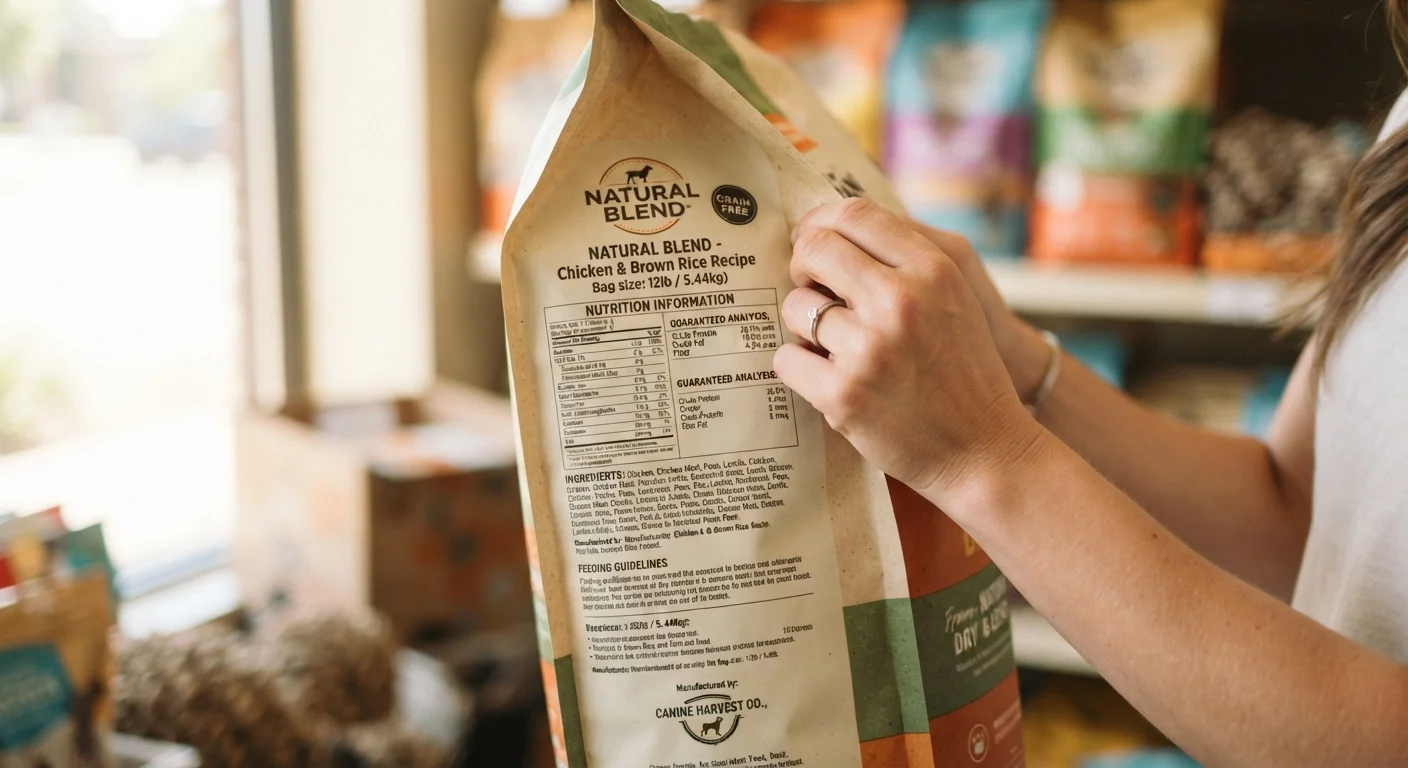
Ingredients are listed by weight before processing, heaviest first. This means the first three to five ingredients give you the clearest picture of what the food is primarily made of. If a named meat — such as chicken, beef, or salmon — appears first, that meat contributes the largest share of raw weight. However, because moisture is included in that weight, a whole meat listed first may actually contribute less protein than a meat meal listed second once water is removed during cooking.
Meat meals (e.g., "chicken meal") are rendered, concentrated protein sources with most moisture already removed, so they are protein-dense by weight. Neither whole meats nor meat meals are inherently superior — context matters.
Ingredients that sound alarming by name are not always harmful, and ingredients that sound wholesome are not always nutritionally meaningful in small quantities. The ingredient list tells you what is present, not how much of each ingredient remains after processing. For a deeper look at evidence versus hype in pet nutrition, see what the research actually says about grain-free claims.
Guaranteed Analysis
A panel on pet food labels listing minimum or maximum percentages of key nutrients — at minimum: crude protein, crude fat, crude fiber, and moisture. These are regulatory guarantees, not precise measurements.
AAFCO Nutritional Adequacy Statement
A required label statement indicating whether a food is complete and balanced for a specific life stage, and whether that was determined by feeding trials or nutrient profile formulation.
Meat Meal
A rendered, concentrated protein ingredient (e.g., chicken meal) from which most moisture has been removed. It is protein-dense by weight compared to whole meat ingredients.
Dry-Matter Basis
A method for comparing nutrients across foods with different moisture levels. Calculated by dividing a nutrient's percentage by (100 minus the moisture percentage), removing moisture as a variable.
Complete and Balanced
An AAFCO-regulated claim indicating that a food meets established nutrient profiles or has passed a feeding trial for a stated life stage. Foods without this statement should not be used as a sole diet.
Crude Protein / Crude Fat
Standardized laboratory measurements of protein and fat content in pet food. 'Crude' refers to the measurement method, not quality or digestibility.
The Guaranteed Analysis: Reading the Numbers
Below or beside the ingredients list, you'll find the guaranteed analysis panel. This section lists minimum or maximum percentages for key nutrients. AAFCO requires four values at minimum:
- Crude protein (minimum %)
- Crude fat (minimum %)
- Crude fiber (maximum %)
- Moisture (maximum %)
These are guarantees, not precise measurements — actual content may be higher (for minimums) or lower (for maximums). The moisture percentage is critical when comparing wet and dry foods: a wet food showing 10% protein and 78% moisture contains far more protein on a dry-matter basis than its percentage implies. To compare foods accurately, calculate nutrients on a dry-matter basis by dividing the nutrient percentage by (100 minus the moisture percentage).
Common missteps when interpreting these numbers are covered in our article on nutritional mistakes new pet owners often make.
75–82%
Typical moisture content in canned pet food
This high moisture level means nutrient percentages must be converted to a dry-matter basis for accurate comparison with kibble.
~10%
Typical moisture content in dry kibble
The low moisture content of kibble makes its as-fed nutrient percentages a closer approximation to dry-matter values than canned foods.
2 methods
Ways AAFCO permits 'complete and balanced' claims
A food can qualify by meeting AAFCO nutrient profiles through formulation, or by passing a structured feeding trial.
The AAFCO Statement and Feeding Guidelines
One of the most important — and most overlooked — lines on any pet food label is the AAFCO nutritional adequacy statement. It tells you two things: whether the food is complete and balanced, and which life stage it is formulated for (growth, adult maintenance, reproduction, or all life stages).
A food labeled "complete and balanced" has either been formulated to meet AAFCO nutrient profiles or passed a feeding trial. A food labeled "for supplemental feeding only" is not intended as a sole diet. Matching the life stage on the label to your pet's actual life stage — puppy or kitten, adult, senior — is a foundational step many new owners skip.
Feeding guidelines on the package are starting estimates based on average animals. Your pet's actual needs depend on activity level, body condition, health status, and whether they are spayed or neutered. Treat guidelines as a starting point and adjust based on your pet's weight trend over time. For help thinking through feeding setups and portion approaches, see feeding schedules and portion basics.
If you have questions about a specific food's suitability for your pet's health condition or life stage, consult a licensed veterinarian. This article provides general educational information and is not a substitute for professional veterinary advice.
Feeding Guidelines Are Estimates, Not Prescriptions
The portion amounts printed on pet food packaging are calculated for an average animal of a given weight. Individual pets vary considerably in metabolism, activity level, and health status. Use the guidelines as a starting range, monitor your pet's body condition over several weeks, and adjust accordingly. A veterinarian or veterinary nutritionist can help you dial in the right amount for your specific animal.