
Saving Strategies Compared: Envelope Budgeting, Pay-Yourself-First, and Zero-Based Budgeting

Key Takeaways
- Envelope budgeting uses physical or digital cash categories to prevent overspending in any one area.
- Pay-Yourself-First automates saving before discretionary spending begins, reducing reliance on willpower.
- Zero-Based Budgeting assigns every dollar a job, leaving no income unaccounted for each month.
- The right method depends on your income pattern, spending habits, and tolerance for tracking detail.
- Combining elements of multiple methods is common and often more effective than strict adherence to one.
Our Verdict
All three strategies are proven frameworks for building saving habits, but they suit different personalities and circumstances. Envelope budgeting works best for tactile, category-focused spenders; Pay-Yourself-First suits those who want simplicity and automation; Zero-Based Budgeting rewards detail-oriented planners who want full visibility over every dollar.
| Best for | Recommended |
|---|---|
| Spenders who overshoot specific categories regularly | Envelope Budgeting |
| Those who want saving to happen with minimal ongoing effort | Pay-Yourself-First |
| Planners who want complete control over every dollar | Zero-Based Budgeting |
| Anyone working with a very limited income | Pay-Yourself-First |
Why Your Saving Method Matters
Having a vague intention to "save more" rarely translates into actual savings. What makes the difference is a system — a structured way of deciding how income gets allocated before spending decisions creep in. Three methods have stood out for their practicality and wide adoption: Envelope Budgeting, Pay-Yourself-First, and Zero-Based Budgeting.
Each method is rooted in a different philosophy about how to handle money. Understanding those philosophies — not just the mechanics — is what allows you to pick the one most likely to stick. For a broader look at how these sit alongside other frameworks, see our full budgeting methods comparison.
This article is for general informational and educational purposes only. It is not personalised financial advice. Consult a qualified financial professional for guidance tailored to your situation.
How Each Method Works
Envelope Budgeting
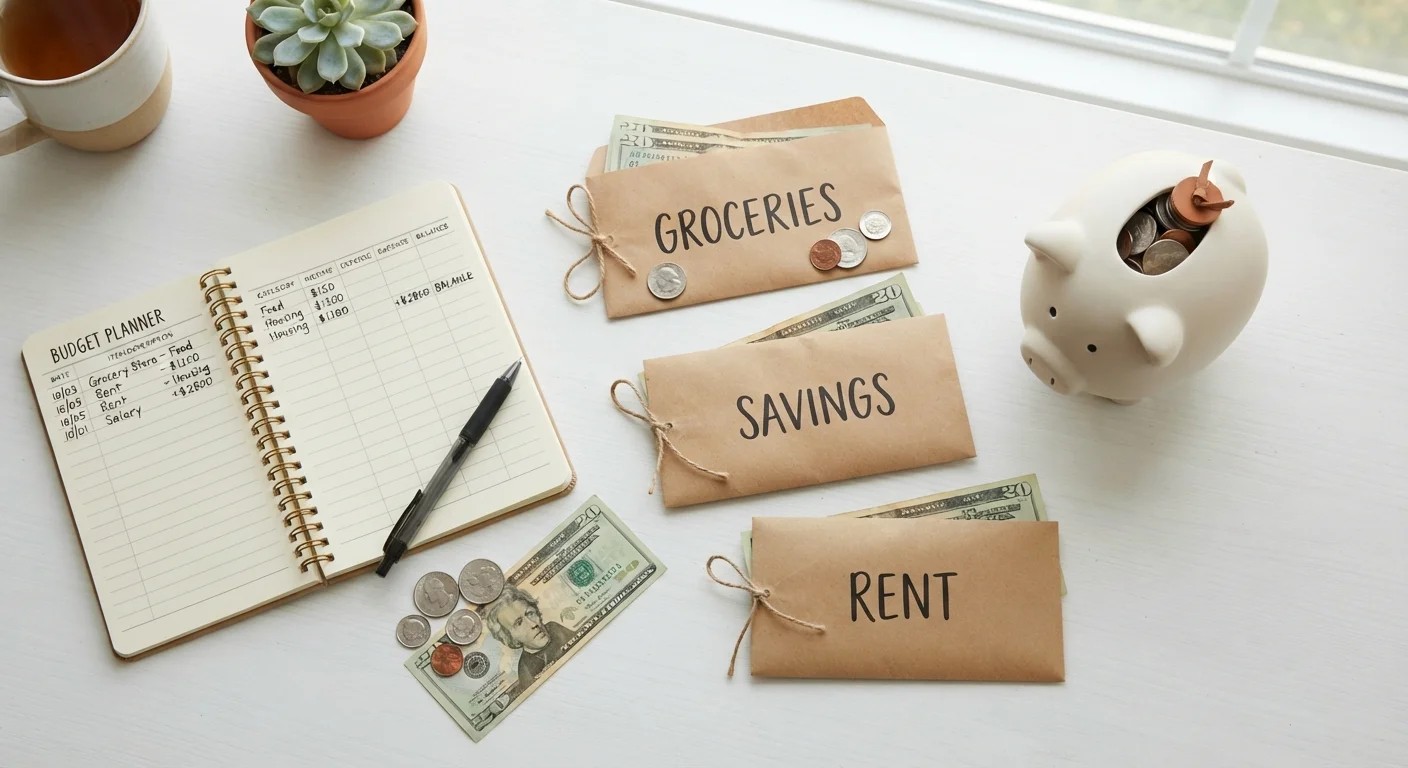
You divide your income into labeled spending categories — groceries, rent, transport, entertainment — and allocate a fixed cash amount (physical or digital) to each. Once an envelope is empty, spending in that category stops for the month. This method creates a tangible spending boundary that many people find psychologically effective.
Pay-Yourself-First
Before paying any bill or making any purchase, you move a set amount directly into savings — ideally via an automatic transfer timed to your paycheck. Whatever remains is yours to spend freely. The core principle: saving is treated as a non-negotiable expense, not an afterthought. For a practical look at setting this up, see how automating savings works.
Zero-Based Budgeting
Every dollar of income is assigned a purpose — expenses, savings, debt repayment — until the total reaches zero. This doesn't mean spending everything; it means intentionally allocating every dollar, including amounts directed to savings. The method demands monthly rebuilding of the budget from scratch. See how it compares to percentage-based budgeting for additional context.
| Envelope Budgeting | Pay-Yourself-First | Zero-Based Budgeting | |
|---|---|---|---|
| Core principle | Spend only what's in each envelope | Save before spending anything | Every dollar has a named purpose |
| Setup effort | Moderate — requires category planning | Low — one automatic transfer | High — full monthly rebuild |
| Ongoing maintenance | Medium — track each category | Very low once automated | High — review and reallocate monthly |
| Best for spending control | Strong — hard category limits | Weak — remaining spend is unrestricted | Strong — all dollars accounted for |
| Works with irregular income | Harder — fixed envelopes can misalign | Yes — use a percentage approach | Yes — rebuild budget each cycle |
| Ideal user profile | Category overspenders | Simplicity seekers | Detail-oriented planners |
Strengths and Trade-Offs
No method is universally superior. Each has real strengths — and genuine drawbacks worth weighing before committing.
Start With One Method, Not Three
It can be tempting to blend all three approaches from day one, but that often creates complexity that leads to abandonment. Pick the single method that most closely matches how you currently think about money, and use it consistently for at least two full months. Once it feels natural, you can layer in elements from the others if needed.
- Envelope Budgeting excels at curbing impulsive overspending in specific categories, but can feel rigid and requires consistent upkeep. Digital envelope tools reduce the friction of carrying cash.
- Pay-Yourself-First is the simplest to maintain and works especially well for people with variable spending or irregular schedules. Its limitation: it doesn't address how you spend what remains, which can still lead to month-end shortfalls.
- Zero-Based Budgeting gives the most complete financial picture but demands the most time — typically 30–60 minutes monthly to rebuild the plan. It suits those who find unallocated money tends to disappear.
If your income is limited, any method works better when paired with the principles outlined in saving on a tight budget.
Matching the Method to Your Situation
Consider three factors when choosing: your income pattern (steady paycheck vs. irregular freelance income), your spending habits (impulsive in certain categories vs. generally controlled), and your tolerance for tracking.
- Irregular income often pairs best with Pay-Yourself-First — save a percentage rather than a fixed dollar amount so the system flexes with earnings.
- If you consistently overspend on dining, entertainment, or shopping, Envelope Budgeting's hard limits are often more effective than willpower alone.
- If you want to understand exactly where every dollar goes — especially when trying to eliminate debt alongside saving — Zero-Based Budgeting offers that granularity.
It's also worth thinking about your saving horizon. Short-term goals like an emergency fund behave differently than long-term goals like a down payment. Learn how to balance both saving horizons to avoid building a plan that optimises for one at the expense of the other.
Finally, these methods aren't mutually exclusive. Many people use Pay-Yourself-First for their core savings goal, then apply Envelope Budgeting to the discretionary spending that remains. Pairing goal-based saving with any of these methods can further strengthen your plan.