

Key Takeaways
- Automated savings transfers move a set amount to savings on a recurring schedule, removing manual effort.
- The 'pay yourself first' principle underpins automation — savings happen before discretionary spending.
- Automation works best when paired with a realistic transfer amount that won't trigger overdrafts.
- You can adjust or pause automated transfers at any time, so flexibility is built in.
- Reviewing your automation setup every few months keeps it aligned with income and goal changes.
Eliminates reliance on willpower or memory
Because the transfer happens automatically, you never have to actively decide to save each month — the habit runs in the background regardless of mood or distraction.
Smaller amounts accumulate meaningfully over time
Even modest weekly transfers — say, $25 — add up to $1,300 in a year without any single large sacrifice, making saving feel manageable.
Reduces spending on whatever remains
When savings leave your checking account early, your perceived 'available' balance is lower, which naturally curbs discretionary spending.
Supports goal-based savings structures
You can direct separate automated transfers to different accounts, keeping funds for distinct goals — emergency fund, vacation, repairs — organized and ring-fenced.
Easy to set up and adjust
Most banks allow you to change the amount, frequency, or destination of an automated transfer in minutes through online banking or a mobile app.
Risk of overdraft if timing is off
If the transfer processes before a paycheck clears, the account may go negative, triggering overdraft fees that can outweigh the amount saved.
Can create a false sense of financial security
Knowing money is being saved automatically may lead some people to underestimate other budget pressures, particularly variable expenses that spike unexpectedly.
Requires periodic review to stay relevant
An amount set during one income level may be too tight or too loose months later; automation that isn't reviewed can become misaligned with your real financial situation.
Doesn't address underlying spending habits
Automation moves money out of reach but doesn't help you understand or change spending patterns that may be the root cause of not saving.
Our Verdict
Automated savings is one of the most effective tools a beginner can use to build a consistent saving habit. It removes the friction of manual decisions and helps smaller amounts accumulate steadily over time. That said, it requires an honest upfront assessment of your cash flow so the automation supports — rather than strains — your budget.
Ideal for first-time savers who struggle with consistency or who want to make progress on a financial goal without relying on willpower alone.
How Automated Savings Actually Works
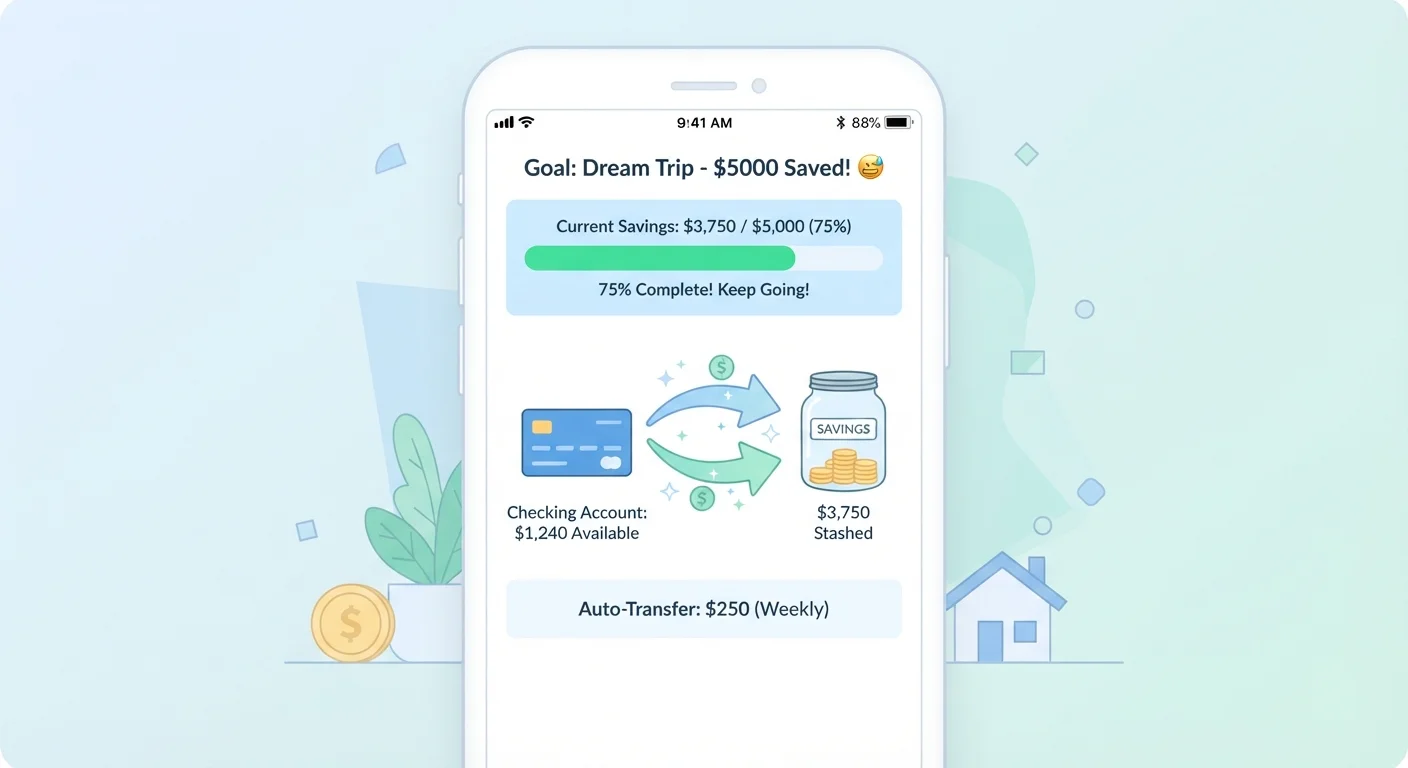
At its core, automated saving is a scheduled transfer — you instruct your bank or financial institution to move a fixed dollar amount from your checking account to a savings account on a recurring basis, typically on payday. Once the instruction is in place, the transfer happens without any action on your part.
Most banks offer this feature directly through their online banking portal. You set three things: the amount, the frequency (weekly, biweekly, or monthly), and the destination account. Some people use separate savings accounts for specific goals — for example, one for an emergency fund and another for a planned expense — and set up individual transfers to each.
This approach aligns with the pay-yourself-first principle: treating savings as a non-negotiable expense that comes out before you spend on anything else. If you want to explore how this compares to other saving structures, see our overview of popular saving strategies.
Automation Works With Any Account Type
You don't need a special account to automate savings. A standard savings account at your existing bank works fine. High-yield savings accounts, which typically offer higher interest rates than standard accounts, are another option worth researching — though rates vary and are subject to change. The key is consistency of transfer, not the account type.
The Case For Automating Your Savings
Automation addresses the most common reason people don't save consistently: they rely on what's left over at month's end. When savings are transferred automatically, the decision is made once rather than monthly.
Eliminates reliance on willpower or memory
Because the transfer happens automatically, you never have to actively decide to save each month — the habit runs in the background regardless of mood or distraction.
Smaller amounts accumulate meaningfully over time
Even modest weekly transfers — say, $25 — add up to $1,300 in a year without any single large sacrifice, making saving feel manageable.
Reduces spending on whatever remains
When savings leave your checking account early, your perceived 'available' balance is lower, which naturally curbs discretionary spending.
Supports goal-based savings structures
You can direct separate automated transfers to different accounts, keeping funds for distinct goals — emergency fund, vacation, repairs — organized and ring-fenced.
Easy to set up and adjust
Most banks allow you to change the amount, frequency, or destination of an automated transfer in minutes through online banking or a mobile app.
Research in behavioral economics consistently shows that removing friction from a beneficial habit dramatically increases follow-through. By setting the amount once, you sidestep the mental effort — and temptation — of deciding each pay period whether to save and how much.
The Drawbacks Worth Knowing
Automation isn't a set-it-and-forget-it solution. Without periodic review, it can create problems rather than solve them.
Risk of overdraft if timing is off
If the transfer processes before a paycheck clears, the account may go negative, triggering overdraft fees that can outweigh the amount saved.
Can create a false sense of financial security
Knowing money is being saved automatically may lead some people to underestimate other budget pressures, particularly variable expenses that spike unexpectedly.
Requires periodic review to stay relevant
An amount set during one income level may be too tight or too loose months later; automation that isn't reviewed can become misaligned with your real financial situation.
Doesn't address underlying spending habits
Automation moves money out of reach but doesn't help you understand or change spending patterns that may be the root cause of not saving.
The most common risk is overdrafting — if your transfer date doesn't align with your paycheck deposit, or an unexpected bill arrives, the automated transfer can pull funds your account doesn't have, potentially triggering fees. Starting with a smaller, comfortable amount reduces this risk while you get familiar with the system.
What to Decide Before You Set It Up
Taking ten minutes to answer a few questions before enabling automation will make the setup far more effective.
- How much can you realistically spare? Review two to three months of bank statements to find a recurring surplus. Start with 50–80% of that figure, not the full amount, to leave a buffer.
- What are you saving toward? Named goals — an emergency fund, a car down payment, a trip — make it easier to stay motivated. Our article on goal-based vs. general saving can help you decide how to structure your accounts.
- When should the transfer happen? Schedule it for the day after your paycheck typically clears, not the day before.
- Do you have a financial baseline in place? If you're carrying high-interest debt or don't yet have a budget, review the savings readiness checklist first.
73%
Americans who save more consistently with automation
According to a survey by America Saves, people who have automatic transfers in place report saving more regularly than those who rely on manual transfers.
$1,300
Saved in one year at $25 per week
A consistent $25 weekly automated transfer compounds to over $1,300 annually without any individual large deposit or financial sacrifice.
Once your automation is running, set a calendar reminder to review it quarterly — income changes, new expenses, and achieved goals all call for an adjustment.
This article is for general informational and educational purposes only and does not constitute personalized financial advice. Consult a licensed financial professional for guidance specific to your situation.