

Key Takeaways
- Zero-based budgeting assigns every dollar of income a specific job, leaving a balance of zero.
- Percentage-based budgeting allocates income into broad categories by proportion, such as the 50/30/20 rule.
- Zero-based budgeting requires more time each month but delivers granular visibility into spending.
- Percentage-based budgeting is faster to maintain and adapts easily when income fluctuates.
- Neither method is universally superior — the right choice depends on your habits and financial goals.
Option A
Zero-Based Budgeting
The detailed, dollar-by-dollar approach.
Best for: People who want full control over every spending decision and don't mind spending time on their budget each month.
Option B
Percentage-Based Budgeting
The flexible, proportional framework.
Best for: People who want a simple structure that scales automatically with income changes.
If you want to eliminate wasteful spending and track every dollar
Zero-Based Budgeting
Assigning a purpose to each dollar forces you to confront where money actually goes, making it easier to spot and cut unnecessary expenses.
If your income varies month to month
Percentage-Based Budgeting
Proportional categories adjust automatically when your paycheck changes, so you don't need to rebuild your budget from scratch each month.
If you're new to budgeting and want a simple starting point
Percentage-Based Budgeting
Broad categories like needs, wants, and savings are easier to set up quickly and require less ongoing maintenance.
If you have specific savings goals or debt payoff targets
Zero-Based Budgeting
Line-item precision lets you direct exact dollar amounts toward goals each month, keeping you accountable to a concrete plan.
How Each Method Works
Understanding how these two approaches are structured is the first step to deciding which fits your life.
Zero-Based Budgeting
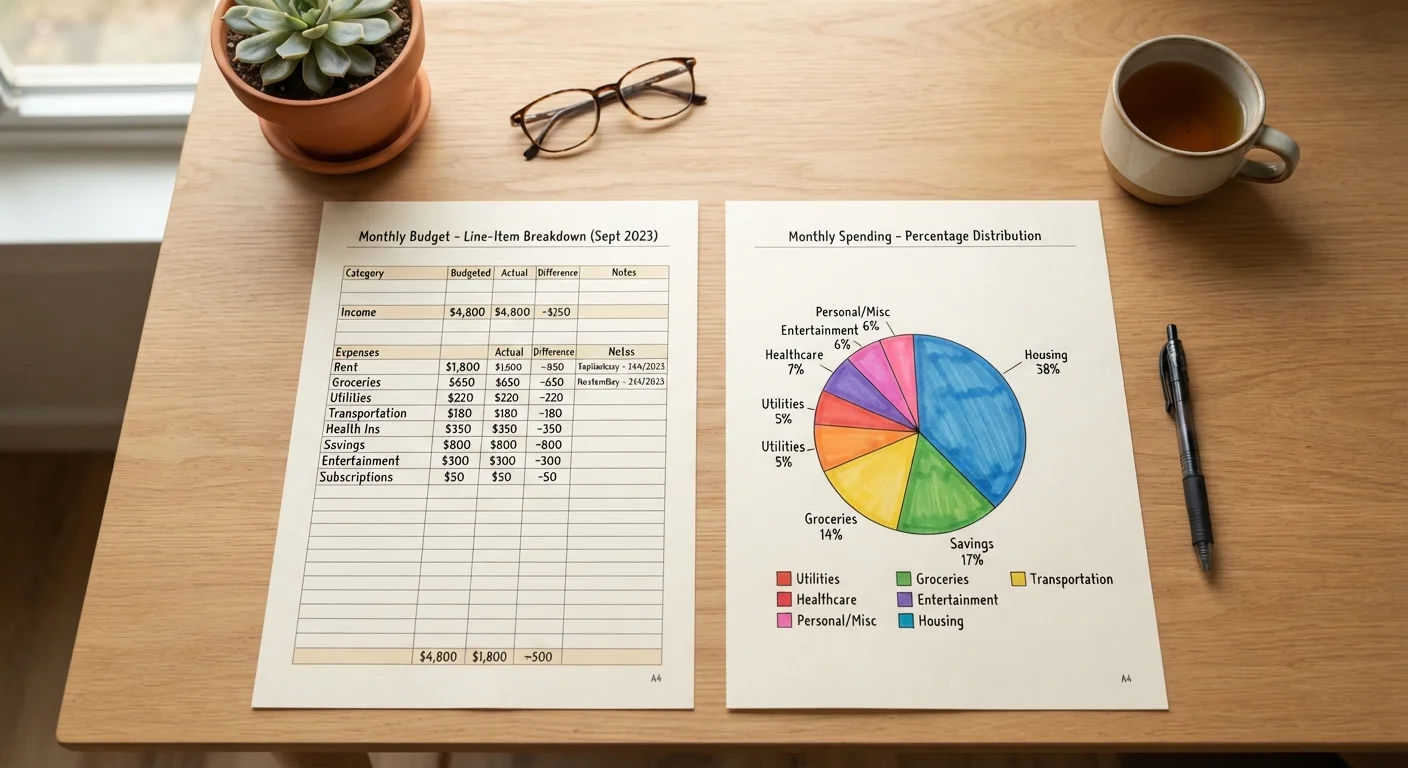
With zero-based budgeting, you start with your total monthly take-home income and assign every dollar to a category — rent, groceries, savings, debt payments, entertainment — until the remaining balance equals zero. That doesn't mean you spend everything; it means every dollar has a designated purpose, including dollars that go into savings or an emergency fund. At the start of each month, you rebuild the budget from scratch based on that month's actual income.
Percentage-Based Budgeting
Percentage-based budgeting divides income into broad proportional buckets. The most widely recognized version is the 50/30/20 rule: roughly 50% toward needs (housing, utilities, groceries), 30% toward wants (dining out, subscriptions, hobbies), and 20% toward savings and debt repayment. You can adjust the percentages to suit your situation. Because the math is proportional, the budget scales up or down with your income automatically. For a deeper look at the 50/30/20 framework specifically, see The 50/30/20 Rule Explained.
| Criterion | Zero-Based Budgeting | Percentage-Based Budgeting |
|---|---|---|
| Core principle | Every dollar assigned a specific job | Income split by proportional categories |
| Setup time | Higher — rebuilt each month | Lower — set ratios once |
| Ongoing effort | Regular line-item tracking required | Periodic category-level review |
| Works best with | Stable, predictable income | Variable or changing income |
| Spending visibility | Very granular — dollar level | Broad — category level |
| Flexibility | Lower — requires deliberate adjustment | Higher — scales with income automatically |
| Best for goals | Specific savings targets, debt payoff | General financial health maintenance |
Trade-Offs to Weigh Before You Choose
Both methods have genuine advantages — and real limitations. Knowing the trade-offs upfront prevents frustration later.
Time and Effort
Zero-based budgeting demands more work. Because you rebuild the plan each month and track spending against specific line items, it can take 30–60 minutes to set up and ongoing check-ins throughout the month. Percentage-based budgeting is considerably lighter: set your ratios once and review spending in broad strokes periodically.
Flexibility vs. Control
Percentage-based budgeting is inherently flexible — if your income rises, your savings bucket grows automatically. Zero-based budgeting gives you tighter control, which is valuable when you're trying to break a spending habit or accelerate debt payoff, but it can feel rigid if your expenses are unpredictable. Understanding which of your costs are fixed versus variable is essential to making either method work — Fixed vs. Variable Expenses explains the difference clearly.
Suitability for Irregular Income
If your paycheck varies — freelancers, hourly workers, or those with seasonal income — percentage-based budgeting tends to adapt more gracefully. Zero-based budgeting can still work, but you'll need a consistent base income figure to plan from, or use a conservative estimate and adjust mid-month.
You Don't Have to Choose Permanently
Many people blend elements of both methods as their financial situation evolves. For example, you might use percentage-based ratios to set broad guardrails but apply zero-based logic within your discretionary spending category. Budgeting methods are tools, not contracts — adjust them as your income, expenses, and goals change over time.
Putting Either Method Into Practice
Whichever method you choose, the underlying habit is the same: review your income, allocate it deliberately, and track what actually happens.
For zero-based budgeting, a simple spreadsheet or a dedicated budgeting app works well. List income at the top, then list every anticipated expense below it. Keep subtracting until you reach zero. Revisit the budget weekly to compare planned allocations against actual spending.
For percentage-based budgeting, calculate your monthly take-home pay, then multiply by your chosen ratios to get dollar targets for each category. You don't need to track every individual purchase — just monitor whether your broad category totals stay within range by the end of the month.
If you're unsure which to start with, consider trying percentage-based budgeting for one month to get oriented, then experimenting with zero-based budgeting once you have a clearer picture of your spending patterns. You can also explore how these methods compare with other approaches in Budgeting Methods Compared.
~33%
Americans with a detailed household budget
Gallup polling has consistently found that only about one in three U.S. adults reports maintaining a detailed monthly budget.
20%
Savings target in the 50/30/20 rule
The percentage-based 50/30/20 framework reserves 20% of take-home income for savings and debt repayment as a general guideline.
This article is for general informational and educational purposes only and does not constitute personalised financial advice. Consult a qualified financial professional for guidance tailored to your individual circumstances.