

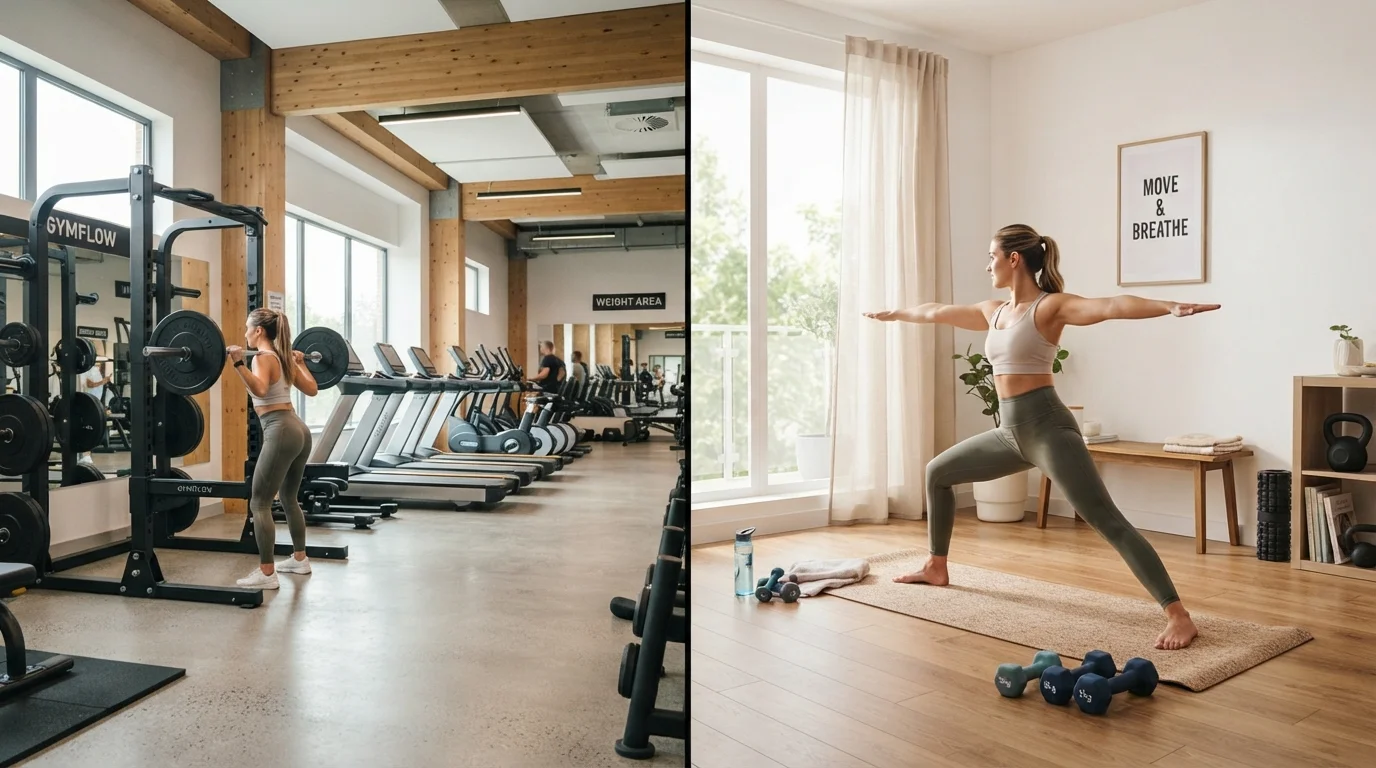
Key Takeaways
- Consistency matters more than location — choose the setting where you'll actually show up.
- Gyms offer equipment variety and coaching access; home workouts offer flexibility and no commute.
- Starting costs differ significantly, but long-term expenses depend on your choices in both settings.
- Neither option is universally superior — your schedule, budget, and personality all play a role.
- Beginners can make meaningful progress with either approach when they follow a structured plan.
Option A
Gym Membership
The structured, equipment-rich environment.
Best for: Beginners who thrive with variety, professional guidance, and social accountability.
Option B
Home Workouts
The flexible, low-barrier alternative.
Best for: Beginners who value convenience, privacy, and want to keep recurring costs low.
If you need external motivation and accountability to stay consistent
Gym Membership
The social environment, scheduled classes, and access to trainers make it easier to stick to a routine when self-discipline is still developing.
If a busy schedule makes commuting to a gym difficult
Home Workouts
Removing travel time eliminates one of the most common barriers to consistency for time-pressed beginners.
If you want access to a wide range of equipment without a large upfront purchase
Gym Membership
A membership gives you access to cardio machines, free weights, and resistance equipment for a predictable monthly fee.
If privacy and comfort are priorities when starting out
Home Workouts
Training at home removes self-consciousness entirely, which helps many beginners build confidence before exercising in public spaces.
If you want to keep long-term recurring costs minimal
Home Workouts
After an initial investment in basic equipment, ongoing costs are typically much lower than a monthly membership fee.
The Real Question: Where Will You Actually Show Up?
Before comparing costs or equipment, it helps to understand what fitness actually requires at the beginner stage. As outlined in our guide on what fitness means for a complete beginner, the foundation is consistency — not intensity or gear. That reframing changes how you should evaluate gym membership versus home workouts. The better environment is the one where you're most likely to exercise regularly, not the one that looks most impressive on paper.
Both settings are genuinely capable of producing cardiovascular health improvements, strength gains, and better mobility over time. The variables that tip the balance are personal: your schedule, personality, budget, and how much friction you can tolerate in your routine.
Gym Membership: What It Offers and What It Costs
A gym membership provides immediate access to equipment most people couldn't afford to own outright — treadmills, cable machines, squat racks, rowing machines, and more. For beginners who aren't sure which type of training they'll enjoy, this variety is genuinely useful. You can experiment with free weights versus resistance machines without committing to purchasing either.
Many facilities also offer access to group classes, which provide structure and social energy. If you're curious about that environment, our breakdown of the trade-offs of group fitness classes walks through both the advantages and the limitations honestly.
The cost side deserves candid attention. Monthly fees vary widely depending on the facility type and location. Beyond dues, factor in the time cost of commuting — for some people, a 20-minute round trip adds enough friction to derail the habit entirely, especially in the early weeks when motivation is still fragile.
| Criterion | Gym Membership | Home Workouts |
|---|---|---|
| Upfront cost | Low to moderate (enrollment fee) | Moderate (equipment purchase) |
| Ongoing cost | Monthly membership fee | Minimal after initial setup |
| Equipment variety | Very high | Limited by space and budget |
| Convenience | Requires travel time | Available instantly at home |
| Professional guidance | Often available on-site | Online resources only |
| Social accountability | Built into the environment | Must be self-created |
| Privacy | Shared public space | Fully private |
| Schedule flexibility | Dependent on facility hours | Any time, any day |
Home Workouts: Realistic Expectations for Beginners
Home workouts are frequently oversold as requiring almost nothing and undersold as being ineffective. The reality sits in the middle. Bodyweight exercises — squats, push-ups, lunges, planks — build genuine strength and endurance, particularly for beginners whose bodies are adapting to movement for the first time. Adding a small selection of equipment expands what's possible considerably.
Our guide on the minimal equipment a beginner actually needs provides an honest assessment of what's worth buying versus what can be skipped. Spoiler: the list is shorter than most fitness marketing suggests.
The main risk with home workouts isn't the equipment — it's the absence of structure. Without a schedule, a class time, or a trainer expecting you, it's easy to postpone sessions indefinitely. This is one of the reasons so many beginners quit in the first month. If you choose this path, a written plan with specific days and times is not optional — it's the substitute for the external accountability a gym provides.
~50%
New exercisers who stop within 6 months
Research consistently shows that roughly half of people who begin a new exercise routine discontinue it within the first six months, regardless of setting.
3x
Adherence boost from social accountability
Studies on exercise adherence suggest that social support and accountability structures can meaningfully increase the likelihood of maintaining a workout routine over time.
Making the Decision: A Framework for Beginners
Rather than asking which option is objectively better, ask which option removes more barriers for you specifically. Consider these factors honestly:
- Schedule flexibility: If your schedule is irregular, home workouts adapt more easily than gym hours or class timetables.
- Social motivation: If you know you respond well to group energy or external accountability, a gym environment supports that.
- Budget over time: Think about total cost across 12 months, not just the first month. A membership adds up; quality equipment is a one-time purchase. Our budgeting basics guide offers a practical framework for this kind of comparison.
- Starting confidence: Some beginners feel self-conscious in a gym setting early on. That feeling usually fades with experience, but it's a real factor in whether you'll stick with it.
It's also worth noting that this doesn't have to be a permanent decision. Many people start at home, build a base of fitness confidence, and transition to a gym later — or do both. Whatever you choose, don't let common fitness myths shape the decision. The format of your training matters far less than whether you show up consistently.
This article is for general informational purposes only and does not constitute medical or fitness advice. Consult a qualified healthcare or fitness professional before beginning a new exercise program, especially if you have any existing health conditions.