

Key Takeaways
- Most beginners need only three to four pieces of equipment to build a complete, effective home routine.
- Bodyweight training alone can deliver meaningful fitness results before you spend a dollar on gear.
- Resistance bands and a yoga mat offer the highest versatility-to-cost ratio for newcomers.
- Expensive or specialized equipment rarely speeds up beginner progress — consistency matters far more.
- Always consult a healthcare professional before starting a new exercise program if you have existing health conditions.
Why Less Is More When You're Starting Out
Walk into any sporting goods store and you'll encounter a wall of equipment promising faster results, easier workouts, and a fitter life. For a beginner, it's genuinely overwhelming. The good news: the research on physical activity consistently shows that beginners make their biggest fitness gains simply by moving more consistently — not by owning more gear.
The items below represent what's actually useful when you're just starting out. Each one earns its place because it's versatile, affordable, and widely applicable to foundational movement patterns. Everything else — cable machines, foam rollers with vibration motors, heart-rate-synced smart mirrors — can wait until you've built a habit worth supporting with extra investment.
If you haven't yet worked through the fundamentals of beginner training, the complete starting point for newcomers is a solid place to begin before purchasing anything at all.
A Yoga Mat (Non-Negotiable Floor Foundation)
A yoga mat is the single most universally useful item a beginner can own. It provides cushioning for floor-based exercises, defines your workout space visually (which matters for consistency), and works for stretching, bodyweight training, core work, and yoga or Pilates-style movement equally well.
Look for a mat that's at least 4mm thick to protect joints during kneeling and plank positions. Standard 68-inch lengths suit most adults; taller individuals may prefer a 72-inch option. Non-slip texture matters more than color or branding.
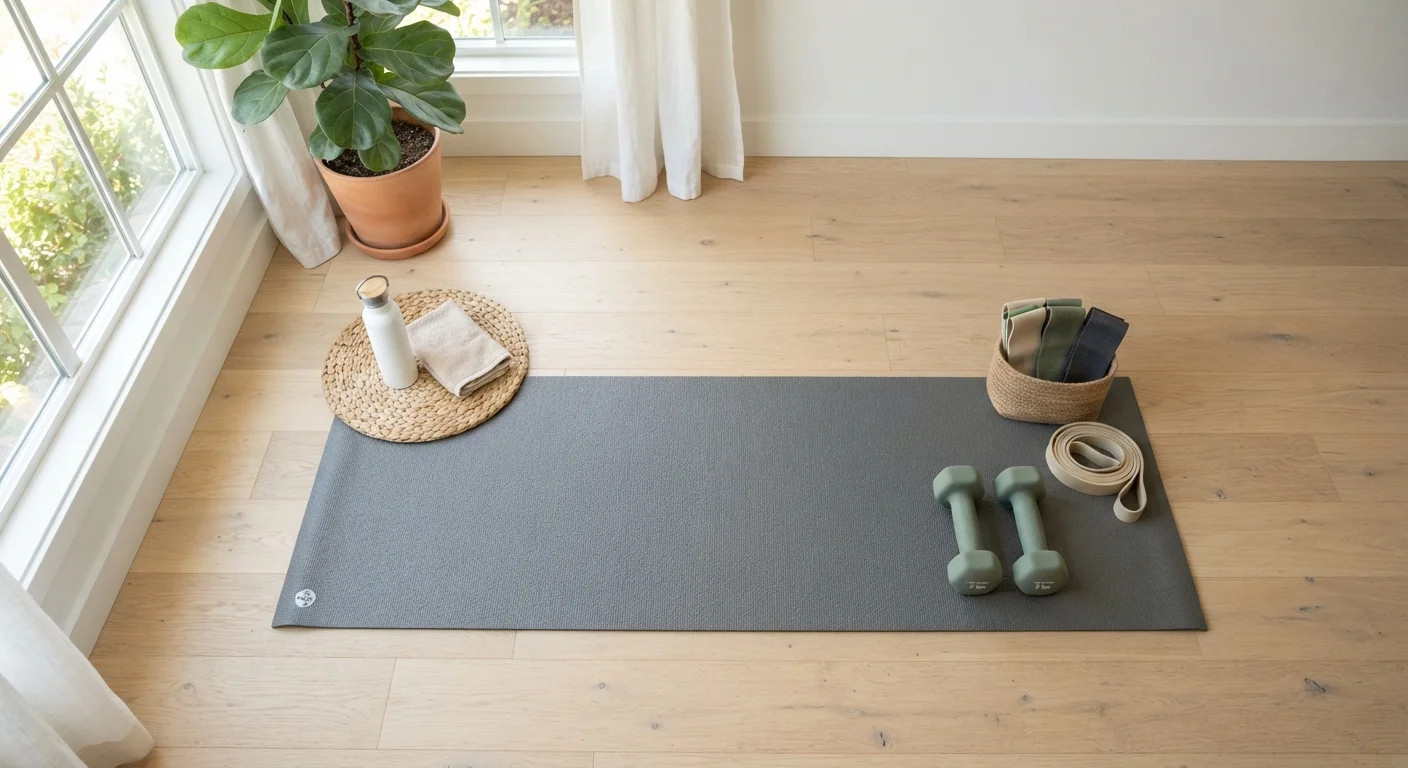
A yoga mat defines your workout space — a small cue that helps build lasting routine.
Resistance Bands (The Versatility Workhorse)
Resistance bands are arguably the highest-value beginner purchase available. A set of loop bands in two or three resistance levels covers strength training for the upper body, lower body, and core — often replacing equipment that costs twenty times as much.
They're especially valuable for beginners because the resistance is scalable, joint-friendly, and easy to adjust mid-exercise. Banded squats, glute bridges, rows, and shoulder presses are all effective starting-point movements. Bands also travel easily, making it simple to keep workouts consistent while away from home.
For a deeper look at how resistance-based training compares to machine work as you progress, see the free weights vs. resistance machines breakdown.
Resistance bands scale with you — making them one of the smartest early investments in any home gym.
A Pair of Adjustable Dumbbells (When Bodyweight Isn't Enough)
Once bodyweight movements start feeling easy — typically after four to eight weeks for most beginners — a pair of adjustable dumbbells extends what's possible considerably. A single adjustable set replaces an entire rack of fixed weights, making them practical for home use where space is limited.
Start with a weight range that lets you perform eight to twelve repetitions of a basic movement with moderate effort. You shouldn't be struggling on rep three or breezing through rep fifteen with no challenge. Adjustable dumbbells let you fine-tune this as your strength develops over time.
Adjustable dumbbells extend your training without filling your living room with equipment.
Supportive Athletic Footwear (Often Overlooked, Always Important)
Footwear isn't glamorous, but it's genuinely equipment. Training in unsupportive shoes — or in socks on hard flooring — increases the risk of ankle instability, knee discomfort, and slipping during dynamic movements.
Cross-training shoes with lateral support are the most versatile option for a beginner doing a mix of cardio, strength, and floor work. Running shoes, while excellent for running, have elevated heels that can actually reduce stability during squats and lunges. For floor-based strength work, minimalist or flat-soled shoes are often preferred by trainers.
The right footwear reduces injury risk — don't treat it as an afterthought before your first session.
A Jump Rope (Optional But Underrated for Cardio)
If cardiovascular conditioning is a goal and outdoor walking or running isn't practical, a basic jump rope is among the most efficient tools available. It requires minimal space, costs very little, and provides a genuine cardiovascular challenge at any fitness level.
Beginners typically start with short intervals — thirty seconds of jumping followed by thirty seconds of rest — rather than sustained skipping. This approach, sometimes called interval training, is widely supported in exercise science literature as effective for improving aerobic fitness in less total time. Before jumping in — literally — review the pre-workout readiness checklist to make sure you're set up safely.
A jump rope delivers real cardio challenge in minimal space for minimal cost.
What You Can Confidently Skip (For Now)
It's worth being direct: the fitness equipment market is built around aspiration, not necessity. Several categories are routinely marketed to beginners but deliver little extra value at the start of a training journey.
Start With What You Have
Before purchasing anything, spend two to three weeks with bodyweight-only workouts. Push-ups, squats, lunges, and planks require zero equipment and will tell you a great deal about which movement patterns feel natural and which need more attention. This approach also helps you identify real gaps before spending money on gear that may not suit your actual needs.
Weight benches are useful later but unnecessary when floor-based pressing, rows, and bodyweight movement cover the same muscle groups. Ab rollers and specialized core devices are redundant when planks, dead bugs, and hollow-body holds train the core just as effectively — and more safely for those new to exercise. Treadmills and stationary bikes are expensive single-purpose items; brisk walking outdoors or a jump rope achieves the same cardiovascular benefit.
If you're thinking carefully about how gear fits into your broader spending plan, the general principles covered in budgeting basics apply here: set a ceiling before you shop, not after. And if you're weighing home training against a gym membership, this comparison of gym versus home workouts lays out the real trade-offs clearly.
This article is for general informational purposes only and does not constitute medical or fitness advice. Consult a qualified healthcare or fitness professional before beginning any new exercise program, especially if you have existing health conditions or injuries.