

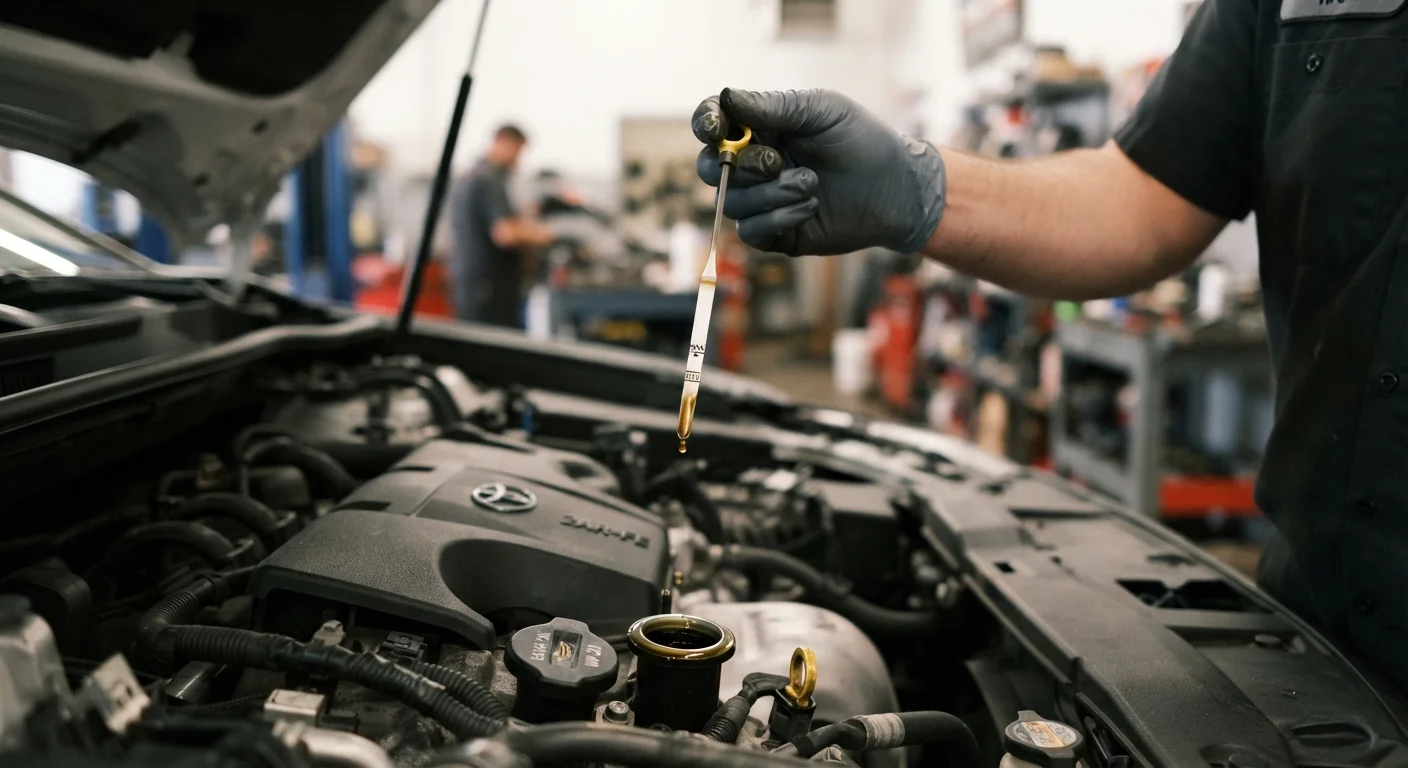
Key Takeaways
- Engine oil lubricates, cools, and cleans your engine simultaneously.
- The viscosity grade on the bottle (e.g., 5W-30) tells you how the oil flows in cold and hot conditions.
- Your owner's manual — not a general rule of thumb — sets the correct oil type and change interval for your car.
- Driving habits and conditions can shorten the recommended interval between oil changes.
- Low oil level is a warning sign; don't wait for the next service if the dipstick reads low.
Engine Oil
Engine oil is a lubricant that circulates through your car's engine to reduce friction between moving metal parts, carry away heat, and suspend contaminants until they're trapped by the oil filter. Without adequate oil, metal components grind against each other, generating destructive heat within seconds. It's the single most important fluid in your vehicle.
Engine oils are rated by the Society of Automotive Engineers (SAE) using a viscosity grade such as 5W-30, where the number before 'W' indicates cold-weather flow and the number after indicates resistance to thinning at operating temperature.
What Engine Oil Actually Does
Think of your engine as thousands of metal parts moving at high speed, millimeters apart from each other. Engine oil forms a thin film between those surfaces, preventing direct contact and the catastrophic friction that would follow without it. But lubrication is only part of the job.
Oil also acts as a coolant, absorbing heat from components the cooling system can't reach. It carries microscopic debris — metal particles, combustion byproducts — away from critical surfaces and into the oil filter, where they're trapped. Over time, the oil itself breaks down and becomes saturated with these contaminants, which is why regular changes are essential.
For a broader look at all the fluids that keep your car running safely, see our guide to car fluid checks every owner should know.
Oil Level vs. Oil Quality Are Different Things
A dipstick showing the correct level only confirms there's enough oil — it doesn't tell you whether that oil is still doing its job effectively. Oil that looks clean on the dipstick may still be past its service interval based on mileage or time. Check both level and service history separately.
Reading the Grade on the Bottle
Oil viscosity grades follow a standard format set by the Society of Automotive Engineers (SAE). A label like 5W-30 contains two pieces of information:
- 5W — how the oil flows when cold. The lower the number, the faster the oil reaches critical engine components on a cold start, which is when most engine wear occurs.
- 30 — how thick the oil remains at normal operating temperature. A higher number means greater resistance to thinning under heat.
Manufacturers engineer each engine around a specific viscosity range. Using a grade outside that range — even slightly — can reduce the oil film's effectiveness. Your owner's manual lists the approved grades; that's the only specification that matters for your vehicle.
~30%
Engine wear occurring at cold startup
Engineering research consistently attributes a disproportionate share of total engine wear to the first moments after starting when oil hasn't yet circulated — underscoring why cold-flow viscosity ratings matter.
7,500–10,000 mi
Typical synthetic oil change interval
Many vehicle manufacturers now specify intervals of 7,500 to 10,000 miles for full synthetic oil under normal driving conditions, compared with older 3,000-mile conventional oil guidance.
Synthetic vs. Conventional Oil
Conventional oil is refined directly from crude oil and has been the standard for decades. Synthetic oil is engineered in a lab to have a more uniform molecular structure, which gives it more predictable performance across temperature extremes and a slower breakdown rate.
Most newer vehicles are factory-filled with full synthetic oil and are designed around its properties. Switching a vehicle that calls for synthetic to conventional — or vice versa — isn't a decision to make casually. Again, the owner's manual is your authority here. A qualified mechanic can also help you evaluate options if your vehicle's documentation is unclear.
Always Check Your Owner's Manual First
Before purchasing any oil or scheduling a change, look up the exact viscosity grade and service interval your manufacturer specifies. This information is typically in the maintenance section and sometimes on a sticker inside the oil filler cap. Using the wrong spec — even a well-intentioned upgrade — can affect warranty coverage and engine performance.
How Often Should You Change Your Oil?
The old "every 3,000 miles" rule is outdated for most modern vehicles and can lead first-time owners to spend money on unnecessary service. Many cars today running full synthetic oil have manufacturer-recommended intervals of 7,500 to 10,000 miles — some even longer.
That said, certain driving conditions genuinely shorten the effective life of your oil. Mechanics and manufacturers often call this severe service, and it includes:
- Frequent short trips under five miles (oil never fully warms up, allowing moisture to accumulate)
- Stop-and-go city driving
- Towing or hauling heavy loads regularly
- Driving in extreme heat or very cold climates
If your driving habits fit this pattern, follow the shorter interval your manual lists for severe-duty use. Many modern vehicles also include an oil life monitoring system that calculates remaining oil life based on actual driving data — a reliable guide when present.
It's worth reading our article on common car maintenance myths if you've heard conflicting advice about change intervals. And if you want to understand how oil changes fit into your car's broader upkeep, our car service schedule explainer breaks down what each type of service actually covers.
Warning Signs You Shouldn't Ignore
Between scheduled changes, a few signals indicate your oil needs attention sooner rather than later:
- Oil warning light — This indicates low oil pressure, not just low level. Stop safely as soon as possible and check the dipstick before driving further.
- Dark, gritty oil on the dipstick — Fresh oil is amber and slightly translucent. Black, opaque oil with a gritty texture is overdue for a change.
- Milky or frothy appearance — This can indicate coolant mixing with oil, a serious mechanical issue requiring immediate professional inspection.
- Burning smell inside the cabin — Can indicate oil leaking onto hot engine components.
Checking the dipstick takes under two minutes and is one of the highest-value habits any car owner can build. If you're not sure how to do it correctly, a step-by-step walkthrough is available in our car fluid checks guide.
This article is for general informational purposes only. For maintenance decisions specific to your vehicle, consult a qualified mechanic or your vehicle's official documentation.