

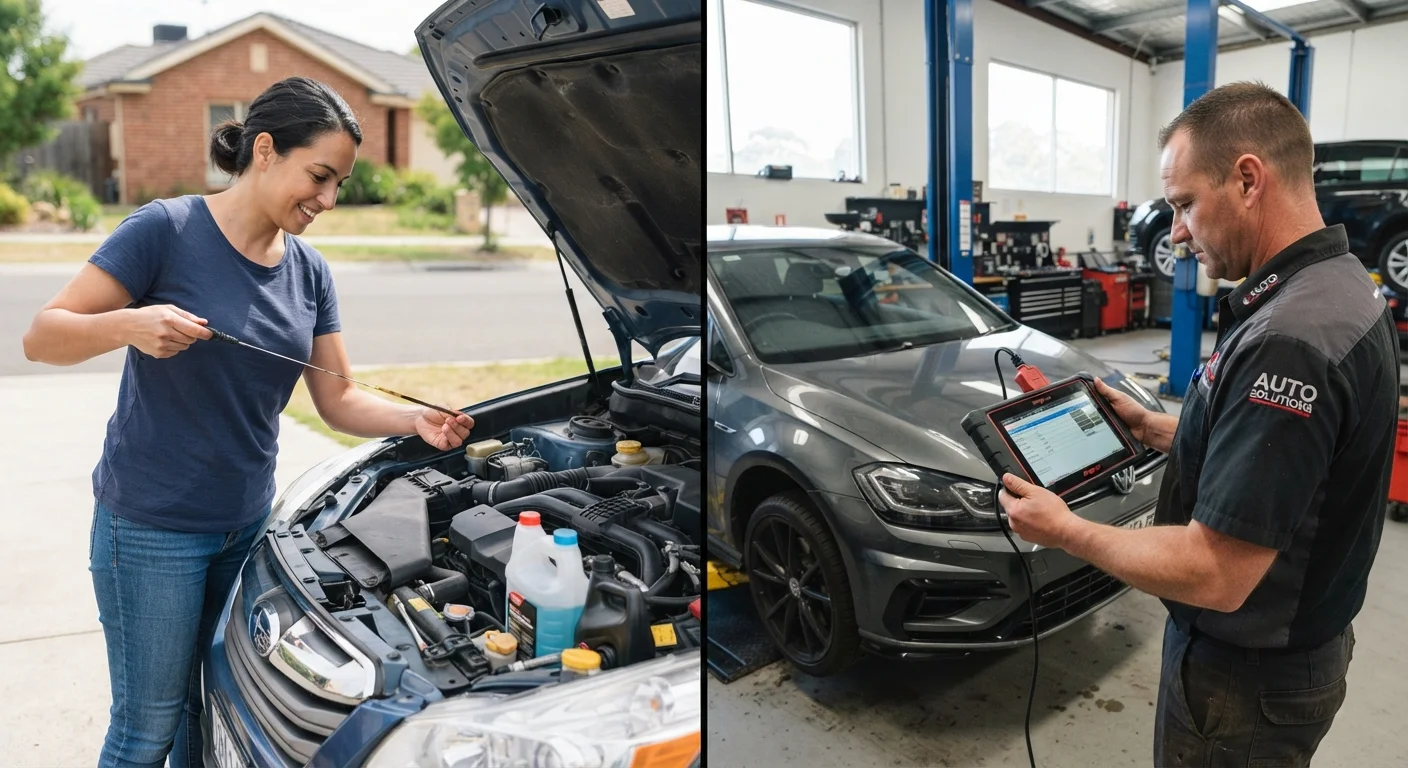
Key Takeaways
- Many routine checks like fluid levels, tire pressure, and air filters are safe for owners to handle at home.
- Brake systems, suspension components, and electrical faults require a qualified mechanic for safety reasons.
- DIY maintenance saves money on labor but requires the right tools, knowledge, and honest self-assessment.
- Attempting complex repairs without training can void warranties and create costly secondary problems.
- Your owner's manual is the most reliable guide to your car's specific maintenance schedule and requirements.
Our Verdict
DIY maintenance is genuinely practical for straightforward, low-risk tasks that require minimal tools and no specialist knowledge. However, anything involving safety-critical systems, complex diagnostics, or structural components should always go to a qualified mechanic. The smartest approach for most first-time owners is a hybrid: handle the simple stuff yourself, and invest in professional service where it counts.
| Best for | Recommended |
|---|---|
| Owners comfortable with basic tools and learning | DIY for routine checks and simple replacements |
| Safety-critical systems like brakes and suspension | Qualified workshop every time |
| Owners with limited time or no suitable workspace | Workshop for most or all tasks |
| Vehicles still under manufacturer warranty | Authorized service center to protect coverage |
Why This Decision Matters More Than You Think
For many first-time car owners, maintenance decisions fall into two extremes: doing everything themselves to save money, or handing every minor issue to a shop out of caution. Neither approach is ideal on its own. The real skill is knowing which category a given task belongs in.
Getting this wrong costs you either way. Paying a mechanic to swap your cabin air filter is unnecessary; attempting to bleed your own brake lines without training is genuinely dangerous. This guide draws a practical line between the two, so you can build confidence without overstepping it.
See our first-year maintenance walkthrough to understand what routine upkeep actually looks like across the full calendar.
What First-Time Owners Can Realistically Handle at Home
Several routine tasks are genuinely low-risk, require minimal tools, and are well-documented in your owner's manual. These are the jobs where DIY makes sense:
- Fluid level checks: Engine oil, coolant, brake fluid, and windshield washer fluid can all be checked visually with no tools required. Our guide to fluid checks walks through each one step by step.
- Tire pressure: A basic digital gauge costs a few dollars and checking pressure takes under five minutes. Correct pressure affects fuel economy, handling, and tire wear.
- Replacing wiper blades: Most wiper blades click on and off without tools. Instructions are usually printed on the packaging.
- Swapping the cabin air filter: On most vehicles, this filter sits behind the glove box and can be replaced in minutes — no mechanical knowledge needed.
- Engine air filter: Slightly more involved than the cabin filter, but typically accessible with a screwdriver and covered clearly in your manual.
- Checking and replacing fuses: Blown fuses for simple circuits (like a non-working interior light) are easy to identify and replace using the fuse diagram in your manual.
Start With Your Owner's Manual
Your owner's manual is the most accurate source for your car's specific maintenance needs — fluid types, filter part numbers, and service intervals are all listed there. Before attempting any task, verify it applies to your exact vehicle configuration. Many newer vehicles also have digital manuals accessible through the manufacturer's app or website.
Before attempting any DIY task, consult your owner's manual for your vehicle's specific requirements. Generic advice online may not apply to your engine type or configuration.
Tasks That Belong in a Professional Workshop
Some jobs look approachable but carry real risk if done incorrectly — either to your safety or to the vehicle itself. A qualified mechanic has the tools, training, and liability coverage to handle these correctly.
Never Compromise on Safety-Critical Systems
Brake, steering, and suspension components directly determine your ability to control the vehicle in an emergency. Even a small error during DIY repair on these systems can have serious consequences. If you're not fully confident in your training and tools, the professional route is always the right one — the cost of a proper repair is far lower than the cost of a failure on the road.
- Brake system work: Pad replacement, rotor resurfacing, and brake fluid bleeding require precision. An error here can result in brake failure. This is non-negotiable for professional service.
- Suspension and steering components: Worn ball joints, tie rods, or shocks affect vehicle control. Diagnosing and replacing these requires alignment equipment and specialist knowledge.
- Timing belt or chain service: An incorrectly fitted timing belt can destroy an engine. This is one of the highest-consequence DIY mistakes a new owner can make.
- Transmission service: Fluid changes on automatic transmissions, in particular, vary significantly by vehicle and require specific fluids and procedures.
- Electrical and diagnostic faults: Modern vehicles use complex computer systems. A warning light usually needs a diagnostic scan tool to interpret accurately — guessing costs more in the long run.
- Oil changes (for newer owners): While experienced DIYers handle this routinely, it requires the right oil grade, a torque wrench, and safe vehicle lifting. If you're new to it, a shop visit while you learn the process is reasonable.
Understanding what each professional service covers helps you have more informed conversations with your mechanic. Our breakdown of car service schedules explains what interim, full, and major services each include.
How to Make the Call: A Practical Framework
When you're unsure which category a task falls into, run through these four questions:
- Is it safety-critical? If the system directly affects your ability to stop, steer, or control the vehicle, it goes to a professional.
- Do I have the right tools? Some tasks genuinely only need your hands. Others require specialized equipment. Don't improvise with tools that don't fit.
- Is my vehicle under warranty? Unauthorized repairs or non-OEM parts can complicate warranty claims. Check what your warranty requires.
- Can I find reliable, vehicle-specific instructions? Generic YouTube tutorials vary in quality and may not match your exact make and model. Your owner's manual is always the primary reference.
| Task | DIY Friendly | Workshop Required | |
|---|---|---|---|
| Fluid level checks | Yes — visual, no tools needed | Not necessary | |
| Wiper blade replacement | Yes — simple clip mechanism | Not necessary | |
| Cabin/engine air filter | Yes — manual-guided, minimal tools | Not necessary | |
| Tire pressure checks | Yes — basic gauge required | Not necessary | |
| Brake system service | No — safety-critical | Yes — always | |
| Timing belt replacement | No — high consequence if wrong | Yes — specialist required | |
| Electrical/warning light diagnosis | No — requires scan tools | Yes — diagnostic equipment needed | |
| Oil change | Possible with experience | Advisable for first-time owners |
It's also worth reading about common maintenance myths before you start — some DIY habits that feel like savings actually add unnecessary cost or wear.
This article provides general educational information about vehicle maintenance. It is not a substitute for advice from a qualified mechanic familiar with your specific vehicle. Always prioritize safety, and consult a professional when in doubt.