

Key Takeaways
- Dealership financing offers convenience but may include a markup on the interest rate.
- Banks and credit unions let you shop with a pre-approved rate, strengthening your negotiating position.
- Credit unions often offer competitive rates, especially for members with good standing.
- Getting pre-approved before visiting a dealership does not commit you to that lender.
- The total cost of a loan — not just the monthly payment — is the number that matters most.
Our Verdict
Neither financing route is universally better — each suits different situations. Dealer financing can work well when manufacturer-backed rates are genuinely low, but arriving with a pre-approved offer from a bank or credit union gives you a concrete benchmark and meaningful negotiating leverage. Understanding both options before you sign is the strongest position any first-time buyer can be in.
| Best for | Recommended |
|---|---|
| Buyers who want a streamlined, one-stop experience | Dealership financing |
| Buyers seeking the most competitive rate and negotiating leverage | Bank or credit union pre-approval |
| Members with an established banking relationship and solid credit | Credit union financing |
| First-time buyers comparing total loan cost across scenarios | Both routes compared side-by-side before deciding |
How Each Route Works
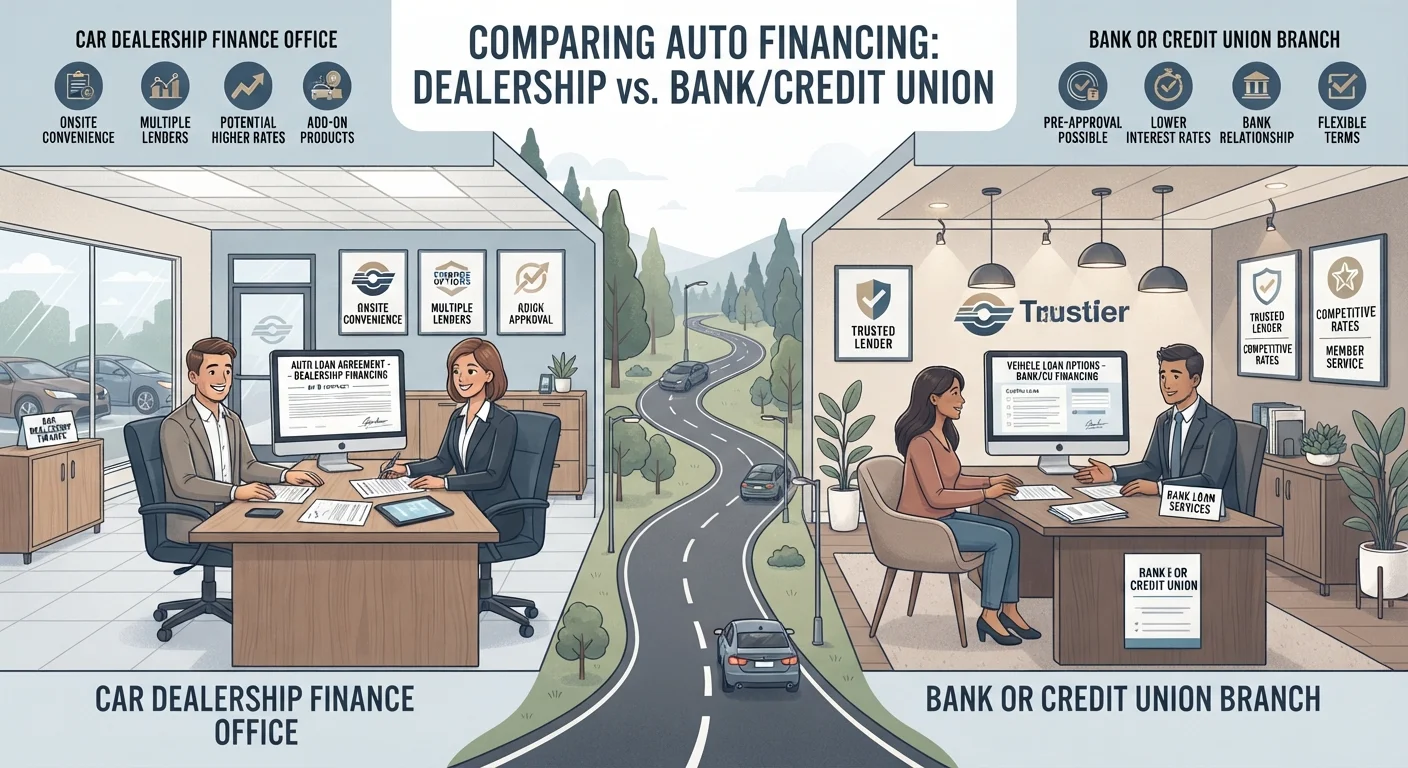
When you finance a car through a dealership, the dealer acts as a middleman. You fill out a credit application on-site, and the dealer submits it to one or more lenders — typically banks or finance companies they have relationships with. The lender sets a base rate; the dealer may then add a margin (sometimes called a "dealer reserve") before presenting the rate to you. You sign a single contract and drive away the same day.
When you go directly to a bank or credit union, you apply for a loan before or after choosing a vehicle. The lender reviews your application and, if approved, issues a commitment for up to a set loan amount at a specific annual percentage rate (APR). You bring that pre-approval to the dealership and use it to pay for the vehicle — or compare it against whatever rate the dealer offers.
A credit union is a member-owned, nonprofit financial institution. Because it returns earnings to members rather than shareholders, it often offers lower loan rates than traditional banks, though membership eligibility rules vary by institution.
Key Differences to Weigh
| Dealership Financing | Bank or Credit Union | |
|---|---|---|
| Where you apply | At the dealership, during purchase | Before or after choosing a vehicle |
| Rate transparency | Rate may include dealer markup | Rate quoted directly to you by lender |
| Negotiating position | Dealer controls rate presentation | Pre-approval gives you a benchmark |
| Speed and convenience | Single-visit, all-in-one process | Requires separate application step |
| Promotional rates | Manufacturer offers available (credit-dependent) | Standard market rates apply |
| Typical rate competitiveness | Varies; can be higher than direct lenders | Often competitive, especially credit unions |
A few points deserve extra attention:
- Rate markup: Dealers are legally permitted to mark up the rate above what a lender quoted them. This is a normal part of how dealer financing works — understanding it helps you negotiate.
- Convenience vs. control: Dealer financing compresses the process into one visit. Direct lending spreads it out but puts rate information in your hands first.
- Rate shopping impact on credit: Multiple loan applications within a short window (typically 14–45 days, depending on the credit-scoring model) are generally counted as a single inquiry. Rate shopping is generally considered acceptable behavior by scoring models.
For a broader look at what financing actually costs over time, see how financing compares to paying in full.
The Case for Getting Pre-Approved First
Arriving at a dealership with a pre-approved offer changes the dynamic of the conversation. Instead of accepting whatever rate the finance manager presents, you have a concrete number to compare against. If the dealer can beat it — including through manufacturer-subsidized promotional rates — that's a genuine win. If they can't, you already have your financing arranged.
Apply to Multiple Lenders Before You Shop
Check your own credit report before applying so there are no surprises. Then submit applications to two or three lenders — your bank, a credit union, and perhaps one online lender — within the same short window to minimize the impact on your credit score. Having multiple offers lets you compare APRs, loan terms, and total repayment amounts side by side before you ever sit down in a finance office.
Pre-approval also separates two negotiations that dealers often combine: the price of the vehicle and the terms of the loan. Keeping them separate makes it easier to evaluate each on its own merits. This connects directly to avoiding common first-timer mistakes — car-buying myths that trip up first-timers covers several of them.
When Dealer Financing Can Make Sense
Dealer financing isn't inherently a bad deal. Automakers periodically offer manufacturer-subsidized rates — sometimes as low as 0% APR on certain models — through their affiliated finance arms. These promotional offers can be genuinely competitive, though they're typically reserved for buyers with strong credit and may come with trade-offs like a shorter loan term or a higher vehicle price.
Dealer financing is also useful when you need to close a transaction quickly or when your credit profile makes direct lender approval more difficult. Some dealers specialize in working with buyers who have limited or impaired credit history, though the rates in those situations tend to be significantly higher.
Whatever route you take, look beyond the monthly payment. A lower payment stretched over a longer term often means more interest paid overall. Before signing anything, review questions worth asking before signing a purchase agreement to make sure the loan terms are fully clear.
And remember: the loan is only part of your total ownership cost. Registration, insurance, fuel, and maintenance all factor in — car ownership costs beyond the sticker price explains what to budget for beyond the monthly payment.
This article is for general informational and educational purposes only and does not constitute personalized financial or legal advice. Loan terms, rates, and eligibility vary by lender and individual circumstances. Consult a licensed financial professional before making borrowing decisions.