

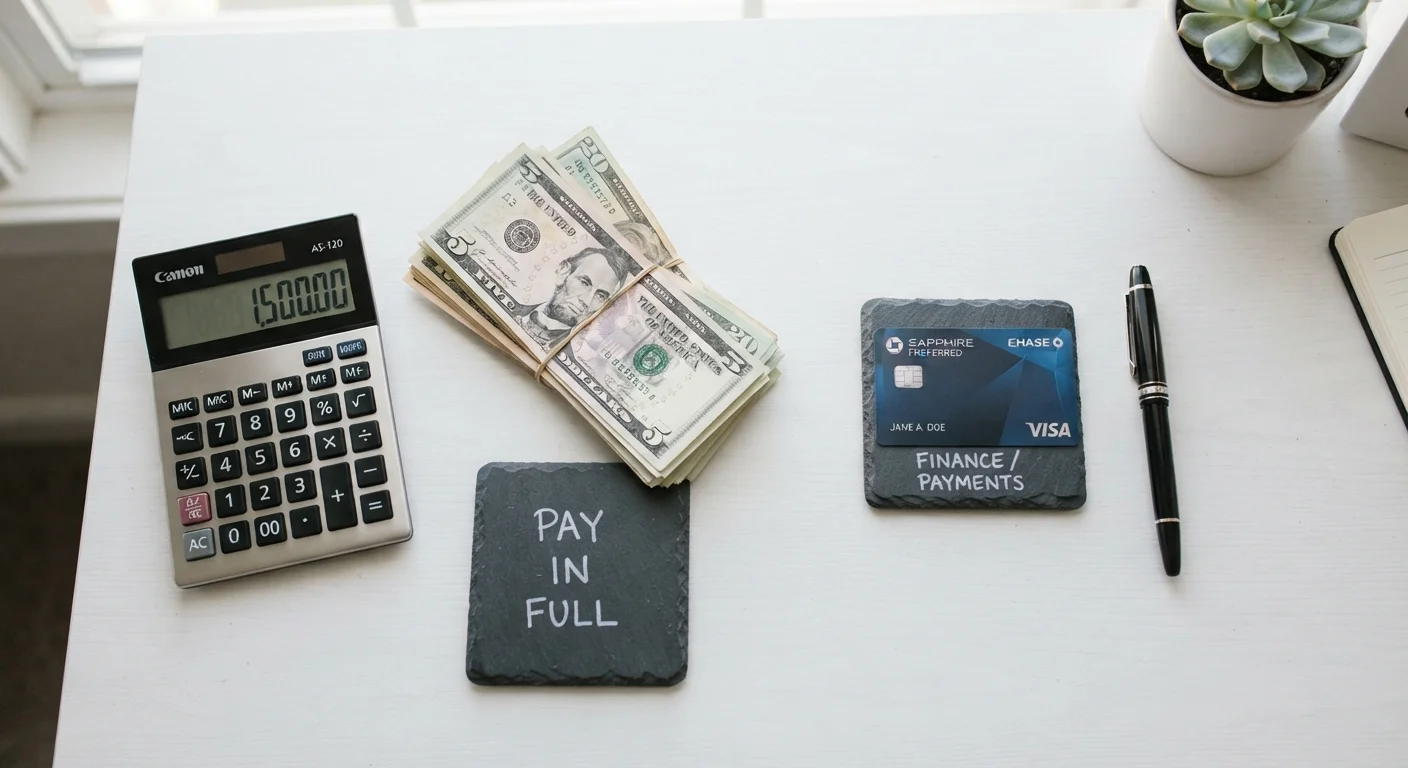
Key Takeaways
- Financing always costs more than the sticker price once interest is added up over the loan term.
- Paying in full eliminates interest charges and simplifies the transaction considerably.
- Financing can be a practical tool when it preserves emergency savings or fits within a sound budget plan.
- The annual percentage rate (APR) and loan term are the two variables that most affect total financing cost.
- Neither approach is universally better — the right choice depends on your savings, cash flow, and financial goals.
Option A
Paying in Full
The straightforward, interest-free approach.
Best for: Buyers who have the savings available and want to avoid paying more than the purchase price over time.
Option B
Financing a Purchase
The spread-it-out, pay-over-time option.
Best for: Buyers who need to preserve cash flow and can manage a structured monthly payment within their budget.
If you have enough savings without depleting your emergency fund
Paying in Full
You pay exactly the purchase price — nothing more. Eliminating interest means the item costs less overall and you have no ongoing monthly obligation.
If financing lets you keep three to six months of expenses in reserve
Financing a Purchase
Preserving a liquid emergency fund is a sound financial priority. A manageable monthly payment may be worth the interest cost for the security it provides.
If you are comparing a high-interest financing offer to your savings
Paying in Full
High APRs can add hundreds or thousands of dollars to a purchase. If savings are available, avoiding that interest expense is generally the stronger financial move.
If you are making a large purchase like a vehicle with a competitive loan rate
Financing a Purchase
Lower APR loans on large purchases can be structured affordably. See how a car loan actually works before committing to any term.
Why the Payment Method Changes the True Price
A $1,200 laptop and a $25,000 car share something in common: if you finance either one, you will pay more than the listed price. That gap — driven entirely by interest — is what separates these two approaches in a way that a monthly payment alone never reveals.
The purchase price is what the item costs. The total cost is purchase price plus every dollar of interest paid over the loan term. For first-time buyers evaluating a big purchase, understanding that gap is the starting point. The real cost of a purchase goes beyond the price tag in ways that are easy to underestimate.
| Criterion | Paying in Full | Financing a Purchase |
|---|---|---|
| Total cost | Exactly the purchase price | Purchase price plus interest |
| Monthly cash impact | Large, one-time outflow | Smaller, recurring payments |
| Interest paid | None | Varies by APR and term length |
| Effect on savings | Reduces savings immediately | Preserves savings short-term |
| Complexity | Simple, no ongoing obligation | Requires tracking payments and terms |
| Risk of overspending | Lower — limited to available funds | Higher — monthly payments can obscure real cost |
| Credit impact | None (cash transactions) | Can build credit history if managed well |
How Interest Adds Up: A Straightforward Example
Consider a $5,000 purchase — a home appliance, a computer setup, or a piece of furniture. Here is how two financing scenarios compare to paying in full:
- Pay in full: Total cost = $5,000. No interest, no monthly obligation.
- Finance at 10% APR over 24 months: Monthly payment ≈ $230. Total paid ≈ $5,520. Interest cost = ~$520.
- Finance at 20% APR over 36 months: Monthly payment ≈ $186. Total paid ≈ $6,696. Interest cost = ~$1,696.
The lower monthly payment in the third option can feel more manageable, but stretching the term and raising the rate more than triples the interest cost. This is one of the most common spending traps for first-time buyers.
~20%
Average credit card APR in the US
The Federal Reserve tracks average credit card interest rates, which have risen substantially in recent years, making card-financed purchases significantly more expensive.
2–3x
How much longer terms multiply interest costs
Extending a loan from 24 to 60 months at the same rate can more than double total interest paid, even if the monthly payment drops.
0%
Interest added when paying in full
Paying the full purchase price upfront — with no financing — means every dollar spent goes toward the item itself, not to a lender.
Before taking on financing, it helps to have a concrete spending plan in place. The guide to budgeting for a big purchase walks through how to set a ceiling and account for total cost.
When Financing Can Be the Right Tool
Financing is not inherently a bad choice — it depends heavily on your financial position and the terms offered. It can make sense when:
- Your emergency fund stays intact. Using all available savings to pay in full could leave you without a buffer for unexpected expenses. If financing preserves three to six months of living expenses in liquid savings, the interest cost may be worthwhile.
- The APR is genuinely low. Promotional 0% APR offers — common on furniture and electronics — let you spread payments with no added cost, provided you pay off the balance before the promotional period ends.
- The purchase is a depreciating asset with a competitive rate. Auto financing is a common example. For context on how leasing compares to buying in terms of total outlay, the numbers differ significantly by approach.
Watch Out for Deferred Interest Offers
Some promotional financing deals advertise "no interest if paid in full" within a set period. This is different from a true 0% APR loan. If any balance remains at the end of the promotional window, the full interest accrued from the original purchase date may be charged retroactively. Read the financing agreement carefully before accepting any promotional offer.
Where you borrow also matters. Financing through a dealership versus a bank or credit union involves trade-offs in rate, flexibility, and process worth reviewing before signing.
Making the Decision: A Practical Checklist
Before choosing between paying in full and financing, work through these questions honestly:
- What is the total cost if financed? Multiply the monthly payment by the number of months to get the real number.
- Will paying in full leave me without an emergency fund? If yes, financing may be the safer short-term choice.
- Is the monthly payment genuinely within my budget? Use a budgeting basics framework to stress-test the payment against your actual income and expenses.
- Are there hidden costs beyond the purchase? For major purchases like vehicles, ongoing costs add up quickly. Car ownership costs beyond the sticker price is a useful reference for that category.
- Can I compare multiple financing offers? The framework for comparing products applies equally to loan terms as to product features.
Neither approach is universally correct. Paying in full is the simpler path when savings allow it. Financing is a legitimate tool when used intentionally and within a clear repayment plan. The key is running the actual numbers — not just the monthly payment — before committing.
This article is for general informational and educational purposes only and does not constitute personalised financial advice. Please consult a qualified financial professional for guidance specific to your circumstances.