

| Typical entry-level storage | 64 GB – 128 GB |
| Standard display refresh rate | 60 Hz |
| High-refresh display rate (common mid-range and above) | 90 Hz – 120 Hz |
| Average smartphone battery capacity | 4,000 – 5,000 mAh |
| Dominant mobile operating systems | iOS and Android |
| Common cellular network generations | 4G LTE and 5G |
Why Spec Sheet Jargon Feels So Confusing
When you pick up a phone or tablet for the first time, the product listing reads like a foreign language: "6.7-inch AMOLED, Snapdragon octa-core, 12 GB RAM, 5G sub-6 GHz." Each of those terms carries real meaning that affects how you'll experience the device every day — but manufacturers rarely explain them in plain language.
This glossary cuts through the noise. The terms below are organized by category so you can look up exactly what you need. For a broader look at comparison vocabulary across any product category, see The Smart Shopper's Glossary.
Processor (SoC)
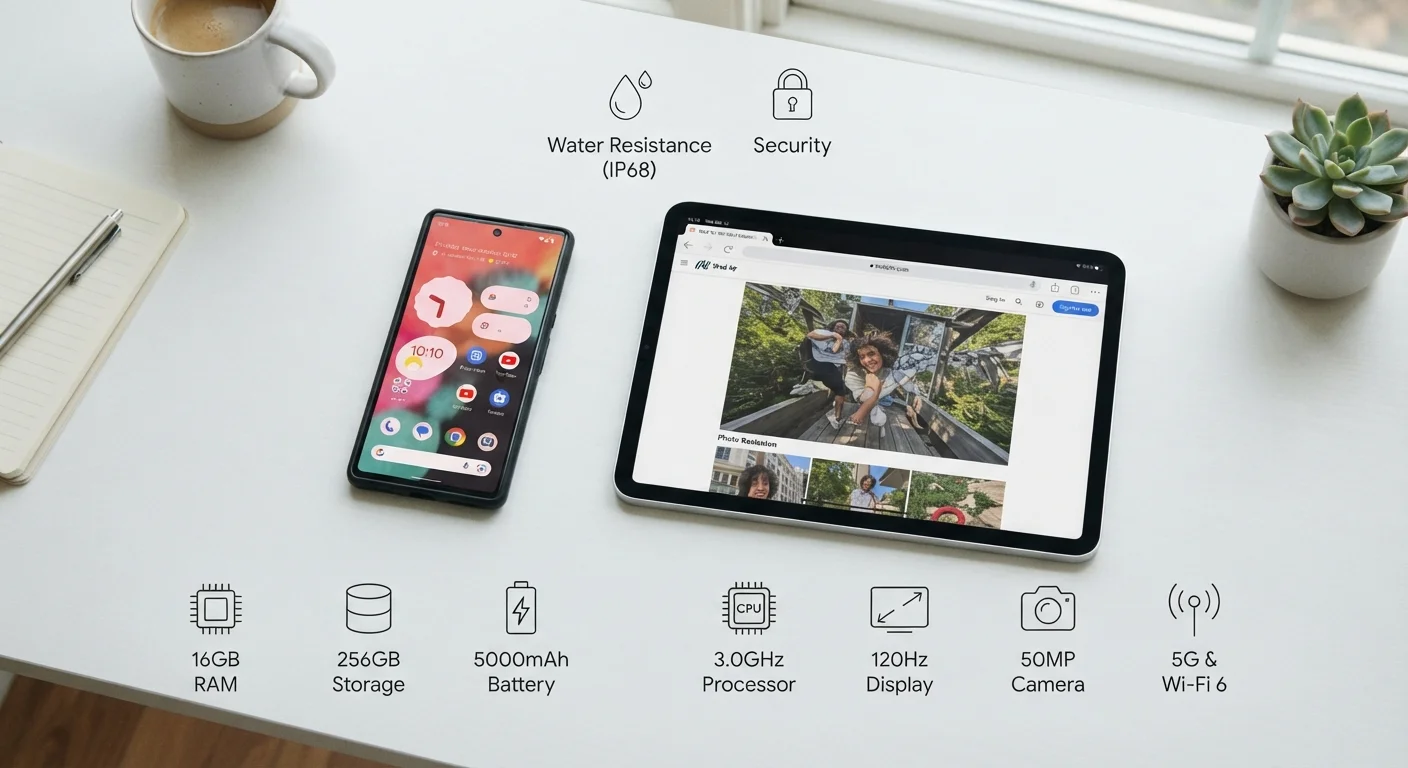
The chip that runs all the calculations on your device. SoC stands for System on a Chip and bundles the CPU, graphics unit, and cellular modem into one component. A faster processor generally means smoother app performance and better multitasking.
RAM
Random Access Memory is the short-term workspace your device uses to keep apps running. More RAM means more apps can stay open simultaneously without needing to reload, which reduces lag when switching between tasks.
Storage (ROM/Internal Storage)
This is where your photos, apps, music, and files are saved permanently. Unlike RAM, storage is not cleared when you turn the device off. Common sizes range from 64 GB to 512 GB or more.
Display Resolution
The number of pixels packed into the screen, typically written as width × height (e.g., 1080 × 2400). Higher resolution means sharper text and images, though the visual difference becomes less noticeable above a certain pixel density.
Refresh Rate
How many times per second the screen redraws its image, measured in Hertz (Hz). A 90 Hz or 120 Hz display looks noticeably smoother during scrolling and video compared to the standard 60 Hz, but typically uses more battery.
Battery Capacity (mAh)
Measured in milliamp-hours, this indicates how much charge the battery holds. A higher mAh rating generally supports longer use between charges, but real-world battery life also depends heavily on the processor efficiency, screen brightness, and how you use the device.
5G
The fifth generation of mobile network technology, offering faster data speeds and lower latency than 4G LTE where coverage exists. Sub-6 GHz 5G offers broader coverage; mmWave 5G offers faster speeds but a much shorter range.
Operating System (OS)
The core software that manages the device and lets you run apps. iOS (used on Apple devices) and Android (used on many other devices) are the two dominant mobile operating systems, each with its own ecosystem of apps and settings.
OLED / AMOLED
Screen technologies where each pixel produces its own light, enabling deeper blacks and more vibrant colors than traditional LCD panels. AMOLED is Samsung's branded version of OLED. Both types tend to be more battery-efficient when displaying dark content.
Biometric Authentication
Security methods that use your unique physical characteristics — like a fingerprint or facial scan — to unlock your device. Common implementations include under-display fingerprint sensors and front-camera face recognition.
Wi-Fi Calling
A feature that routes phone calls over a Wi-Fi connection instead of the cellular network, useful in areas with weak mobile signal. It requires both carrier and device support to function.
eSIM
An embedded SIM card built directly into the device rather than a removable physical card. It allows you to activate a carrier plan digitally without needing a physical SIM tray, and some devices support multiple eSIM profiles simultaneously.
Key Specs You'll See on Almost Every Listing
Knowing the numbers is only half the battle — understanding what they mean in practice is what matters. Here's a quick-reference summary of the most common figures and why they show up so often.
| Typical entry-level storage | 64 GB – 128 GB |
| Standard display refresh rate | 60 Hz |
| High-refresh display rate (common mid-range and above) | 90 Hz – 120 Hz |
| Average smartphone battery capacity | 4,000 – 5,000 mAh |
| Dominant mobile operating systems | iOS and Android |
| Common cellular network generations | 4G LTE and 5G |
Once you're comfortable with these basics, it's worth exploring what else affects the ownership experience. Factors like software update timelines and repairability rarely appear on spec sheets at all — Eight Things First-Time Phone Buyers Tend to Overlook walks through exactly those hidden considerations.
Display technology is another area where terminology matters more than most buyers expect. The difference between an LCD and an OLED panel shapes how bright your screen looks outdoors and how long your battery lasts. Display Technology on Phones and Tablets explains those distinctions in depth.
On the software side, the operating system you choose shapes your daily experience in ways specs alone don't capture. Mobile Operating Systems: A First-Timer's Map of iOS and Android is a useful companion read once you've got the hardware vocabulary down.
Finally, if you encounter financial terms at the point of purchase — like APR on installment plans or restocking fees — Key Financial Terms Every New Shopper Should Know provides the same plain-language treatment for that side of the buying process.