

Key Takeaways
- A high star rating alone is not a reliable signal of product quality or fit for your needs.
- Fake and incentivized reviews are common; specific language patterns can help you spot them.
- Reading one-star and three-star reviews often reveals more honest, useful detail than five-star praise.
- Review volume and recency matter as much as the average score.
- Cross-checking reviews across multiple platforms reduces the risk of being misled by a single source.
What you will need
Why Online Reviews Are Harder to Trust Than They Look
Star ratings feel objective. A product sitting at 4.7 out of 5 with thousands of reviews seems like safe ground. But that number is shaped by forces most shoppers never see: incentivized posting, review gating (where sellers only ask satisfied customers to leave feedback), and in some cases, outright fabrication.
Understanding these dynamics is not about becoming cynical — it is about becoming a more effective shopper. As explored in how ratings can mislead, selection bias and platform incentives routinely distort the numbers. The good news: with a structured approach, you can still extract genuine signal from user feedback.
What you will need
Step-by-Step: How to Evaluate Reviews Without Being Misled
Check the distribution, not just the average
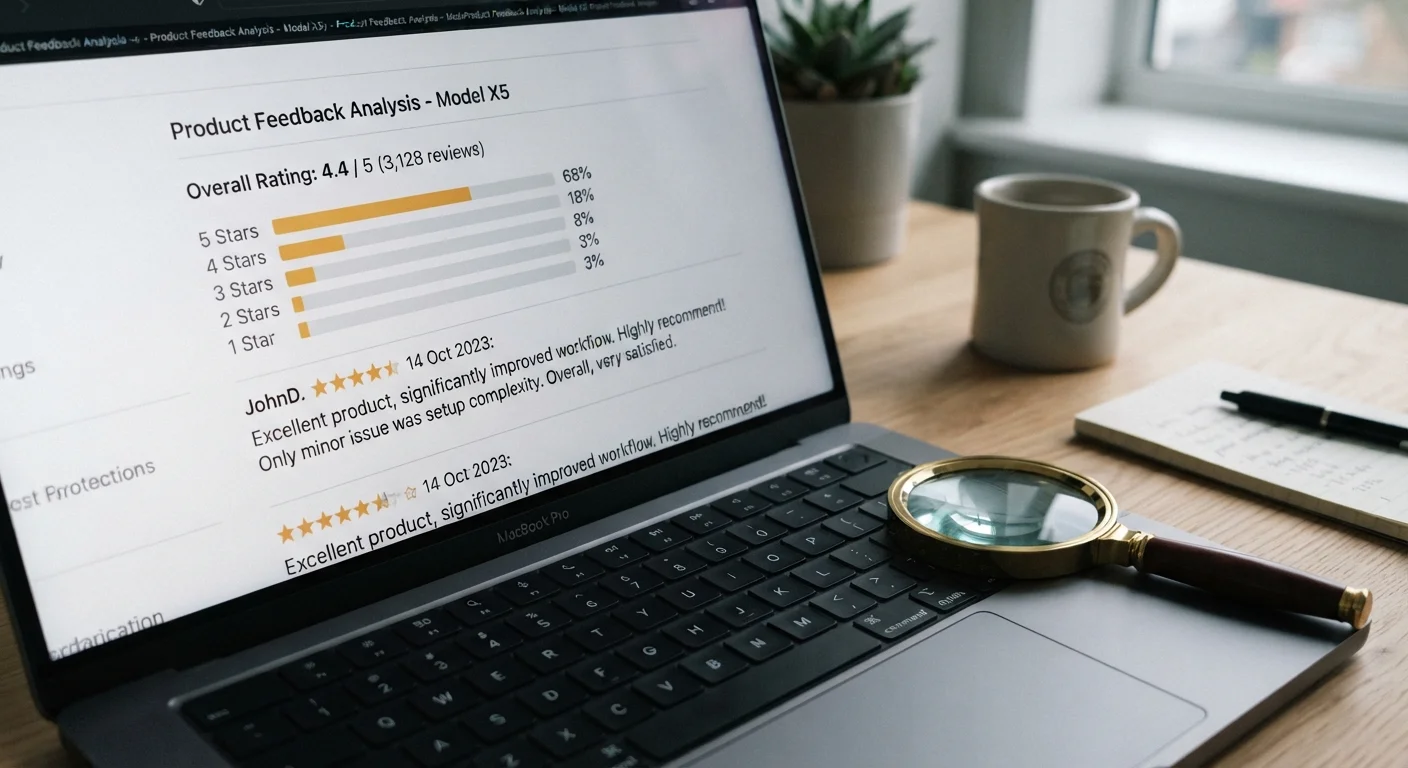
Pull up the full rating breakdown — the bar chart showing how many reviewers gave 1, 2, 3, 4, or 5 stars. A product with 80% five-star ratings and 15% one-star ratings is telling a very different story than one with a steady taper from five to one. That bimodal shape (lots of highs and lows, few middles) often signals the product works well for a specific use case but fails badly for others. Your job is to figure out which camp you fall into.
Read three-star reviews for balanced perspective
Three-star reviews occupy a useful middle ground. Reviewers who land here often liked the product enough to use it but had specific, concrete complaints. This is where you are likely to find real-world trade-offs: battery life that does not match marketing claims, sizing that runs small, or customer service that disappointed. These practical details are far more actionable than effusive praise.
Look for specificity as a quality signal
Authentic reviews tend to contain specific, verifiable detail: dimensions, materials, how long the reviewer has owned the item, a particular task they used it for. Vague superlatives — "Amazing product! Love it!" — carry almost no information. As you read, mentally sort reviews into specific and generic piles. Weight the specific ones more heavily.
Check the recency of reviews
Products change — formulations are updated, manufacturing shifts to different suppliers, features get removed in later production runs. A product with glowing reviews from three years ago may be a different item today. Filter for reviews from the past six to twelve months, and check whether recent reviewers note any changes compared to earlier versions.
Cross-reference across platforms
A single retailer's review section reflects only the customers who bought through that channel and chose to leave feedback. Search for the same product on two or three independent platforms, forums, or community sites relevant to the category. Consistent themes across unrelated sources are a stronger signal than any single aggregate score. The comparison of influencer recommendations versus independent reviews is also worth consulting when you encounter enthusiastic endorsements alongside product reviews.
Test your conclusions against your own criteria
Before acting on your review research, write down the two or three factors that matter most to you — durability, portability, ease of setup, or whatever is specific to your situation. Then ask: do the reviews actually address those factors? If most reviewers care about aesthetics but you care about longevity, their enthusiasm may be largely irrelevant to your decision. Keeping your own criteria front and center prevents you from being swept along by others' priorities. For more on this, see myths that lead shoppers to make worse comparisons.
Common Red Flags and What to Do With Them
Even after working through the steps above, some situations call for extra caution. Watch for these patterns:
- A sudden spike in five-star reviews followed by a long quiet period may signal a coordinated campaign.
- Reviewer profiles with only one review, especially if the account was created recently, are a weak signal of authenticity.
- Reviews that describe features not listed in the product description may have been left for a different item — a known manipulation tactic on some platforms.
Use Independent Sources as a Sanity Check
Consumer-focused nonprofit testing organizations and category-specific editorial publications apply consistent, disclosed methodology to product evaluation. They are not immune to all bias, but their incentive structures differ meaningfully from retailer review systems. Consulting one independent editorial source alongside user reviews gives you a more complete picture before committing to a purchase.
When reviews feel unreliable, independent editorial sources — consumer publications, category-specific forums, or nonprofit testing organizations — can provide more verifiable assessments. For a broader framework on separating useful signal from noise, see what user reviews actually tell you.
It is also worth remembering that reviews reflect other people's experiences, not a prediction of yours. The principles for evaluating products objectively apply here too: define what matters to you before letting aggregate opinion drive a decision.
Avoid Letting Volume Override Quality
A product with 50,000 reviews and a 4.3-star rating can feel safer than one with 200 reviews and a 4.6-star rating. But volume amplifies whatever biases are present in a review pool — it does not dilute them. A large number of low-information reviews does not add up to one high-quality review. Assess the substance of what reviewers are saying, not the count alone.