

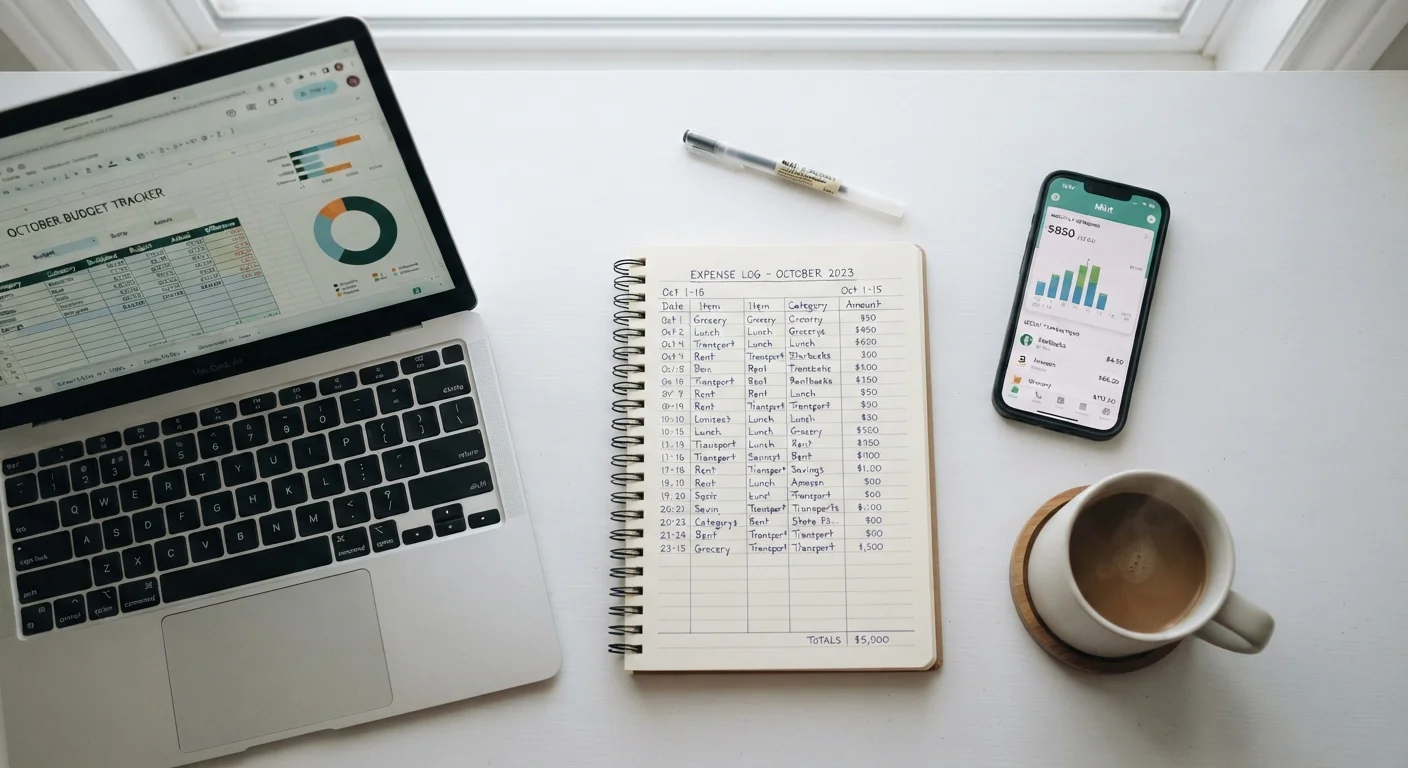
Key Takeaways
- Manual logs build awareness through deliberate, hands-on recording of every transaction.
- Spreadsheets offer flexible, customizable tracking but require consistent upkeep and basic formulas.
- Apps automate data capture but introduce privacy trade-offs and can encourage passive engagement.
- The best method is the one you will actually use consistently — consistency beats sophistication.
- Combining two approaches (e.g., app plus weekly manual review) often yields the strongest results.
Our Verdict
No single tracking method is objectively superior — each suits a different personality, routine, and level of financial complexity. Manual logs build the strongest awareness habits; spreadsheets offer the most control; apps deliver the most automation. The method that fits seamlessly into your daily life will outperform a technically superior system you abandon after two weeks.
| Best for | Recommended |
|---|---|
| Those who want to build mindful money habits from scratch | Manual Log |
| Those who want full customization and don't mind a learning curve | Spreadsheet |
| Those with busy schedules who need low-friction, automated tracking | App |
| Those who want automation with deeper periodic reflection | App + Weekly Manual Review |
Why Tracking Method Matters
Most first-time budgeters focus all their energy on what limits to set and very little on how they will actually record spending day to day. That gap is where budgets break down. Before you can set realistic limits, you need reliable data — and before you can get reliable data, you need a tracking system you will stick with.
This article compares the three most common approaches: handwritten or typed manual logs, spreadsheets, and dedicated budgeting apps. Each method captures the same information — what you spent, when, and on what — but they differ enormously in effort, accuracy, privacy implications, and what kind of habits they reinforce. Understanding those differences helps you choose with confidence rather than guessing. Once you have consistent data, you can put it to work with the process outlined in our guide to reading your own spending patterns.
Manual Logs: High Effort, High Awareness
A manual log is exactly what it sounds like: you record every transaction by hand — in a notebook, a pocket notepad, or a simple text file — as it happens or at the end of each day. The method is low-tech and costs nothing.
Where it works well: The act of writing forces a moment of conscious acknowledgment. Research in behavioral finance consistently suggests that deliberate, effortful recording tends to increase awareness of spending patterns more than passive or automated tracking. For people who feel disconnected from their money, this friction can be genuinely useful.
Where it breaks down: Manual logs are only as good as your memory and discipline. Miss a few transactions and the data becomes unreliable. They also don't do math for you — totaling categories at month-end requires extra work, which many people skip.
Start With a 7-Day Trial Run
Before committing to a tracking method, test it for one week with no stakes. Pick the approach that feels least burdensome, record everything honestly, and note how often you forgot or skipped an entry. That single week will reveal more about the right system for your habits than any comparison chart. If you missed entries more than twice, the method may not fit your daily rhythm.
Best suited for: People who spend mostly in cash, want to build a mindful money habit from scratch, or are tracking spending for a short defined period (30–60 days) to diagnose a problem area.
Spreadsheets: Full Control, Real Learning Curve
A spreadsheet — whether in a free tool like Google Sheets or a desktop program — gives you a structured, customizable ledger. You enter transactions manually or paste them from bank exports, and formulas handle the totals and category breakdowns automatically.
Where it works well: Spreadsheets are highly adaptable. You can build exactly the categories and views that reflect your life, create charts, and adjust the structure as your needs change. Unlike apps, a spreadsheet stores your data locally or in your own cloud account, which some people prefer from a privacy standpoint.
Where it breaks down: Setup requires upfront effort, and ongoing entry is still manual. If you're not comfortable with basic formulas or feel intimidated by blank cells, you may abandon the system before it becomes useful. Errors (duplicate entries, missed rows) can silently distort your data.
Best suited for: People who enjoy organizing data, have some comfort with basic software, and want a system they can shape entirely to their situation. This approach pairs well with a structured end-of-month review — see our monthly budget review checklist for a practical routine to follow.
Apps: Low Friction, Lower Engagement
Budgeting and expense-tracking apps can connect directly to your bank accounts and credit cards, pulling in transactions automatically and sorting them into categories. Entry effort drops close to zero on days when everything is a card purchase.
Where it works well: Automation dramatically lowers the barrier to maintaining a complete record. If you frequently forget to log purchases, an app that captures transactions at the source removes that failure point. Many apps also provide visual summaries that make it easy to spot trends at a glance.
Where it breaks down: Automation can work against engagement. When the app does everything, it's easy to ignore the data entirely. Apps also require you to grant access to financial account credentials, which carries real privacy and security considerations — review an app's data-sharing and security practices before connecting accounts. Cash transactions still require manual entry, and category auto-sorting is often imprecise.
| Manual Log | Spreadsheet | App | |
|---|---|---|---|
| Setup effort | Minimal — pen and paper | Moderate — build or download template | Low — install and connect accounts |
| Daily time required | 5–10 min of active entry | 5–15 min of entry and review | Under 2 min if accounts linked |
| Accuracy for cash | Strong if logged promptly | Strong if entered promptly | Weak — must enter manually |
| Customization | Unlimited but unstructured | Highly customizable | Limited to app categories |
| Privacy considerations | None — fully offline | Low — your own file | Higher — third-party data access |
| Habit-building value | High — deliberate effort builds awareness | Medium — depends on review routine | Low if used passively |
| Cost | Free or minimal | Free tools available | Free tiers available; paid plans exist |
Best suited for: People with mostly digital spending, busy schedules, and the discipline to review (not just collect) their data regularly. For a fuller picture of how digital tracking tools compare to cash-based systems, see our comparison of envelope budgeting and digital apps.
Choosing the Right Fit
There is no universally correct answer. The right method depends on three things: how you primarily spend (cash vs. card), how much time you realistically have each day, and how motivated you are by the process itself versus the outcome.
A practical starting point: try one method for 30 days without judging the results. At the end, ask yourself two questions — did it capture most of my spending accurately, and did I actually look at the data? If either answer is no, switch or add a layer. Many people find that a combination — an app for automatic capture plus a brief weekly manual review — delivers both completeness and genuine engagement.
Whatever system you choose, consistency matters far more than sophistication. A simple notebook you update daily will tell you more about your habits than a feature-rich app you open once a month. Once your tracking is solid, you'll be ready to translate that data into a real budget plan — our overview of budgeting methods walks through the most widely used approaches and who each tends to suit.
This article is for general informational and educational purposes only and does not constitute personalized financial advice. Consult a qualified financial professional for guidance specific to your situation.