

Key Takeaways
- A monthly budget starts with your total take-home income, not your gross salary.
- Expenses fall into fixed, variable, and discretionary categories — treat each differently.
- The 50/30/20 framework is a widely used starting point for allocating income.
- Tracking actual spending each month reveals where estimates missed the mark.
- A budget is a living document — adjusting it regularly is part of the process.
What you will need
Why a Monthly Budget Works Better Than Guessing
Most people have a rough sense of what they earn and a hazier sense of what they spend. That gap — between perceived and actual spending — is where financial stress tends to live. A monthly budget closes that gap by making every dollar visible and intentional before it's spent.
A monthly cycle aligns naturally with how most bills, rent, and pay schedules work in the US. It's long enough to capture irregular costs but short enough to course-correct quickly. Whether you're managing your finances for the first time or rebuilding after a messy stretch, a monthly budget gives you a structure that's repeatable and adjustable. For those focused specifically on managing spending across purchases, the complete guide to setting and sticking to a shopping budget extends these principles into everyday buying decisions.
What you will need
The Six Steps
The process below walks you through building a complete monthly budget from scratch. Each step builds on the last — work through them in order the first time.
Bank or credit card statements (last 2–3 months)
Used to identify actual spending patterns across expense categories.
Pay stubs or direct-deposit records
Used to calculate accurate monthly take-home income.
Spreadsheet software or budgeting app
Used to organize, total, and track income and expense categories.
List of recurring bills
Used to identify fixed expenses such as rent, utilities, and subscriptions.
Calculate Your Monthly Take-Home Income
Add up every source of income you reliably receive each month — your salary, hourly wages, side income, or any regular transfers. Use the net amount that actually lands in your account after taxes and deductions, not the number on your offer letter.
If your income varies, calculate a conservative average using your lowest two or three recent months. This protects you from overcommitting during leaner periods. For deeper strategies on irregular pay, see budgeting on an irregular income.
List Every Fixed Expense
Fixed expenses are costs that stay the same every month: rent or mortgage, car payment, insurance premiums, loan minimums, and recurring subscriptions. Pull your bank statements to confirm exact amounts — estimates here lead to structural shortfalls.
Total these up. This number is your non-negotiable floor — the minimum your budget must cover before anything else is allocated.
Estimate Variable and Discretionary Expenses
Variable expenses change month to month but are still necessities: groceries, gas, utilities, and medical co-pays. Review two to three months of statements to find a realistic average for each.
Discretionary expenses — dining out, clothing, entertainment, hobbies — are wants, not needs. List these separately. Seeing them grouped helps you make conscious trade-offs rather than letting them drain your budget invisibly.
Apply an Allocation Framework
Once you have income and expenses mapped, apply a simple framework to guide proportions. The 50/30/20 rule is a widely used starting point:
- 50% of take-home income toward needs (housing, food, transport, utilities)
- 30% toward wants (dining, entertainment, hobbies)
- 20% toward savings and debt repayment beyond minimums
These percentages are guidelines, not rigid rules. High-cost-of-living areas may push housing well above 50% — adjust other categories proportionally rather than abandoning the framework entirely.
Balance the Budget
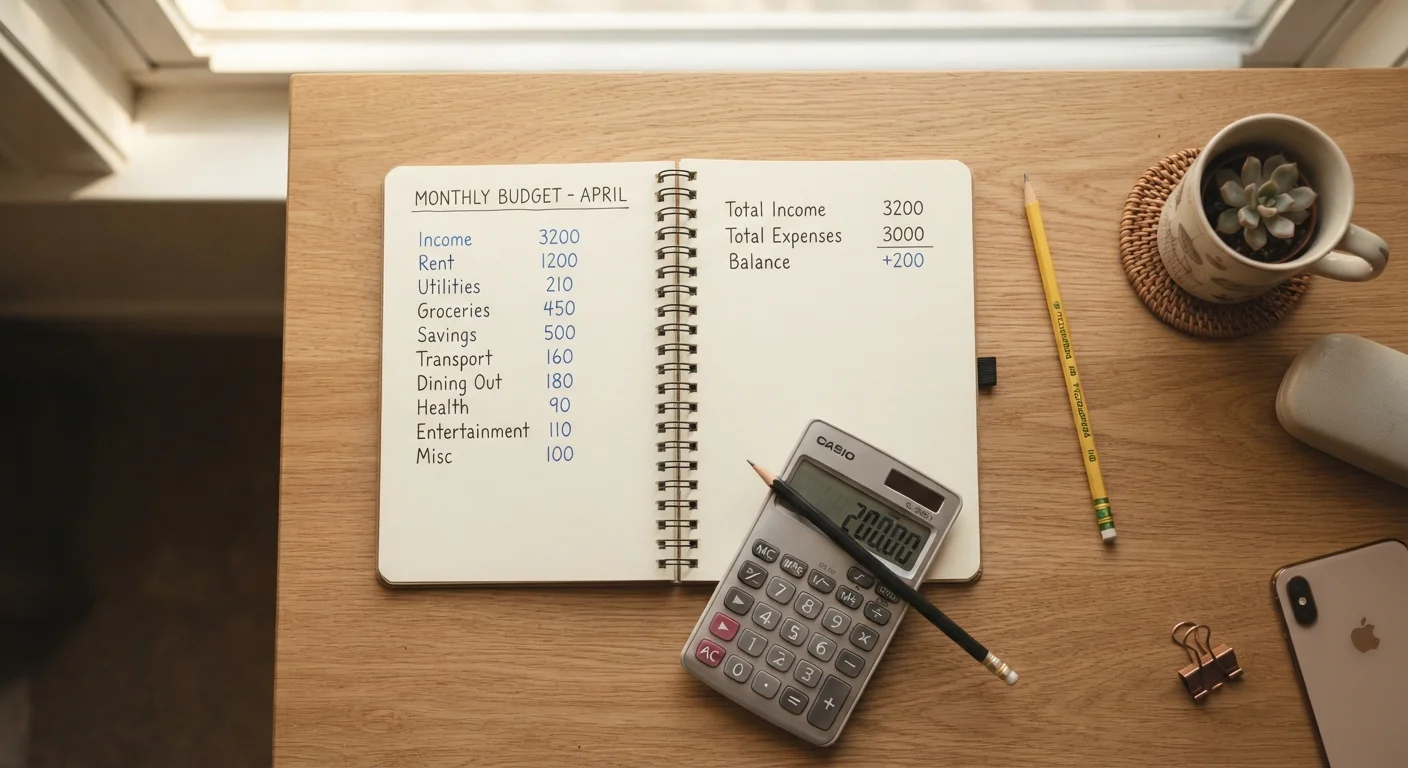
Subtract total expenses from total income. If the result is zero or positive, your budget is balanced. If it's negative, you're spending more than you earn — a gap you need to close before the month begins, not after.
To close a gap: first reduce discretionary spending, then look at variable expenses, and finally consider structural changes (renegotiating bills, reducing subscriptions). Avoid reducing savings to zero — that line should be treated as a fixed expense. For a broader look at budget structure, this complete starting framework covers foundational concepts in depth.
Track and Adjust Every Month
At month's end, compare what you planned against what you actually spent in each category. Mark overages and underspend clearly. This review — which takes 15 to 20 minutes — is where a budget earns its value.
Update your estimates for the following month based on real data. After two or three months, your budget will reflect how you actually live, not just how you hope to. Once your budget is stable, the logical next step is building intentional savings — the Saving & Goals hub is a strong starting point.
Start Simple, Then Refine
Your first budget doesn't need to be perfect. Aim for a reasonable estimate and commit to reviewing it after 30 days. Real spending data will sharpen your numbers far more than extended upfront planning. Progress beats perfection every time.
This Is General Financial Education
This article provides general budgeting information for educational purposes only. It is not personalised financial, tax, or legal advice. Your financial situation is unique — consider consulting a licensed financial adviser before making significant money decisions.
What to Do When Your Budget Isn't Working
Even a carefully constructed budget can unravel in the first few weeks. Common culprits include underestimating variable expenses, forgetting irregular costs, or treating the budget as finished rather than as a draft. If you find your plan breaking down early, the issue is almost always in the inputs — not your discipline.
Revisit your expense estimates with actual receipts rather than memory. Add a small buffer (5–10%) to variable categories until you have three months of real data. And if your budget consistently falls short despite adjustments, look at income-side options alongside spending cuts. For a detailed breakdown of why early budgets fail, why your budget keeps falling apart after the first week addresses the most common patterns.
Don't Budget From Gross Income
A common beginner mistake is planning around pre-tax pay. Always use your net (take-home) income — the amount deposited after taxes, insurance premiums, and retirement contributions are deducted. Budgeting from gross income leads to shortfalls every month.
Once your monthly budget is running smoothly, the next milestone is turning your surplus into intentional savings. Building your first savings plan from scratch walks through that transition step by step.
This article is for general informational and educational purposes only. It does not constitute personalised financial, tax, or legal advice. Consult a qualified financial professional for guidance specific to your circumstances.