

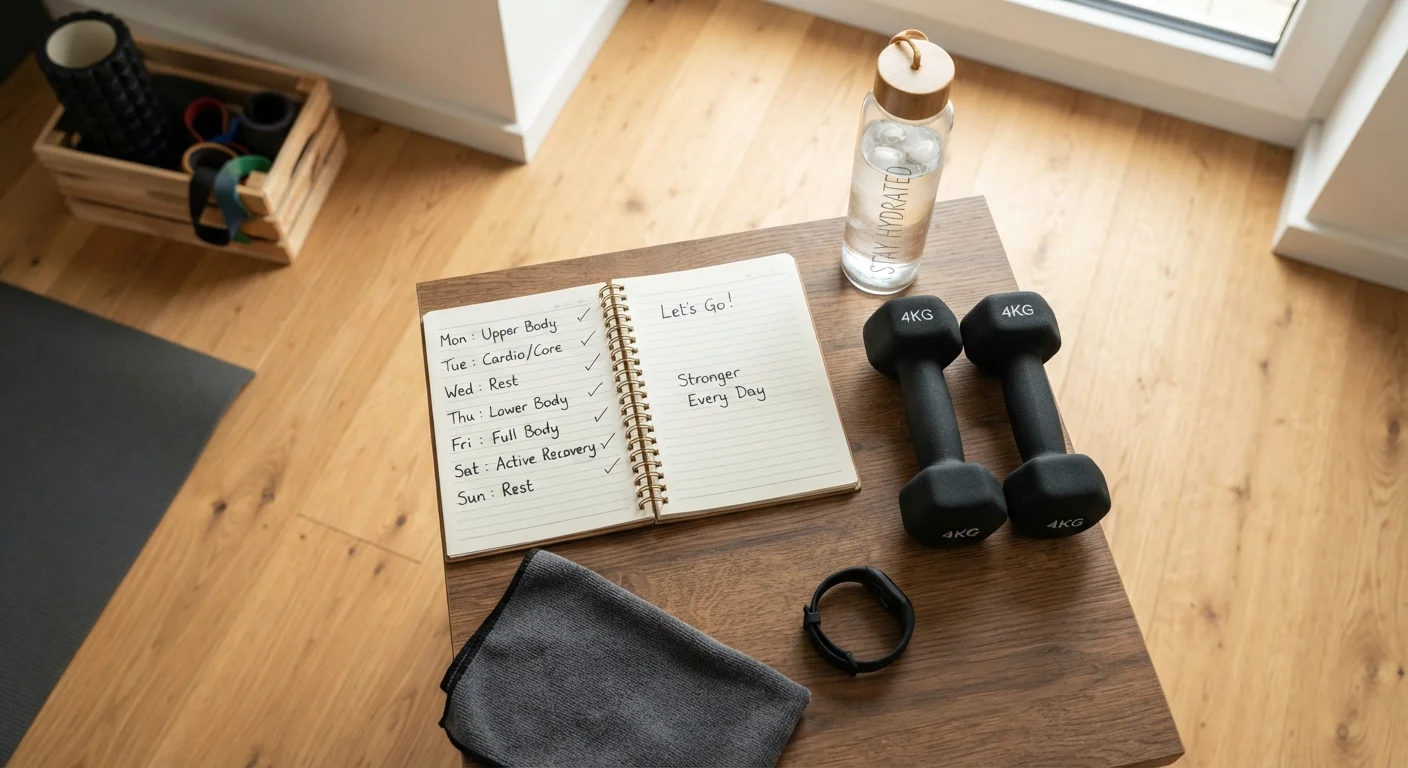
Key Takeaways
- Beginners need consistency more than intensity — three days per week is enough to start.
- A balanced routine includes cardiovascular movement, strength training, and scheduled rest days.
- Choosing activities you tolerate (or enjoy) dramatically improves long-term adherence.
- Progression should be gradual — adding more too soon is the leading cause of early dropout.
- No gym membership or equipment is required to build an effective beginner routine.
What you will need
Why Most Beginner Routines Fail Before They Start
The most common reason new exercisers stop within the first month isn't laziness — it's an unrealistic plan. Programs designed for intermediate or advanced athletes get marketed broadly, and beginners adopt them without the base fitness needed to recover between sessions. The result is soreness, fatigue, and the belief that "exercise just isn't for me."
Building a routine from scratch means building your routine — one scaled to your actual schedule, current fitness level, and preferences. Before diving in, check the Before Your First Workout readiness checklist to confirm you're set up safely.
What you will need
The steps below give you a repeatable framework, not a rigid prescription. Treat them as decisions to make, not rules imposed from outside.
This article is for general informational and educational purposes only, and is not a substitute for advice from a qualified healthcare or fitness professional. If you have any health conditions, injuries, or concerns, consult a professional before beginning any exercise program.
What You'll Need to Get Started
One of the most freeing truths about beginner fitness: the barrier to entry is low. You don't need a gym membership, a personal trainer, or expensive equipment to build a foundation. What you do need is a plan you've actually written down and the right expectations going in.
Weekly planner or calendar app
Used to map out workout days and rest days so exercise becomes a scheduled appointment rather than an afterthought.
Workout journal or notes app
Tracks exercises, sets, reps, and how you felt — essential for measuring progress over time.
Resistance bands or dumbbells
Provides progressive resistance for strength training without requiring a full gym setup.
Fitness timer app
Helps structure interval-based cardio or rest periods between sets with precision.
Fitness and nutrition work together over time. As your routine takes shape, building a nutritionally varied weekly eating pattern can support your energy levels and recovery without requiring a complete diet overhaul.
Your Step-by-Step Routine Builder
Follow these steps in order. Each one builds on the last, so resist the urge to skip ahead to "the workout" before you've set a realistic foundation.
Assess your starting point honestly
Before choosing any exercises, take stock of where you are right now. Ask yourself: How many days per week can you realistically commit to movement? Do you have any injuries or conditions that limit certain movements? What does your typical day look like energy-wise?
Honesty here prevents the most common beginner mistake — overcommitting in week one and disappearing by week three. A realistic baseline is your actual foundation, not an aspirational one.
Choose a weekly structure that fits your life
A simple and effective beginner structure is three days of exercise with rest or light activity between each session — for example, Monday, Wednesday, and Friday. This gives your body time to recover while keeping the habit consistent.
Avoid scheduling workouts on consecutive days until you've built a foundation of at least four to six weeks. Recovery is not optional — it's when your muscles actually adapt and strengthen. Learn more in Rest Days Are Part of the Plan.
Select movement types that cover the basics
A well-rounded beginner routine includes three types of movement:
- Cardiovascular exercise — walking, cycling, swimming, or dancing. Aim for sessions that elevate your heart rate moderately.
- Strength training — bodyweight exercises like squats, lunges, push-ups, and planks are sufficient to start. No gym required.
- Flexibility and mobility work — gentle stretching or yoga-style movements at the end of sessions help reduce soreness and support joint health.
You don't need to do all three in every session. Many beginners alternate: cardio one day, strength the next.
Set a realistic session length
Beginner sessions of 20 to 30 minutes are sufficient — and sustainable. Longer isn't automatically better when you're starting out. A 25-minute session you complete consistently beats a 60-minute session you dread and skip.
Structure each session simply: 5 minutes of warm-up movement (light walking, arm circles, leg swings), 15–20 minutes of the main activity, and 5 minutes of cool-down stretching.
Write the plan down and schedule it
Put your workout days into your calendar the same way you'd schedule any appointment. Decide in advance what type of movement you'll do each day so there's no decision fatigue in the moment. A simple entry like "Wednesday – 25 min walk + bodyweight squats and push-ups" removes all friction.
Keep a brief log after each session — what you did, how long, and how it felt. This record becomes motivating as early weeks accumulate.
Build in progression every two to three weeks
Once a routine feels manageable, add a small challenge: one extra set, five more minutes of cardio, or a slightly more demanding exercise variation. Gradual progression is what drives continued improvement without overwhelming your body.
Avoid the temptation to overhaul your plan every week. Consistency with modest progression outperforms intensity spikes followed by rest. For broader context on starting safely, see Fitness for Everyday Life.
Track Effort, Not Just Output
In the early weeks, how a workout feels is as important as what you did. Logging a simple effort rating (easy, moderate, hard) alongside your sets and reps helps you recognize patterns — like consistently overdoing Mondays or underdoing Fridays — and adjust accordingly.
Troubleshooting Common Early Setbacks
Even a well-planned routine will hit friction. Here's how to handle the most common beginner stumbling blocks:
- Missed sessions: Don't try to "make up" missed workouts by doubling up. Simply return to your schedule the next planned day. Consistency over time matters more than any single session.
- Persistent soreness: Some muscle soreness in the first week or two is normal. Soreness that lasts more than 72 hours, or that affects a joint rather than a muscle, warrants rest and possibly a conversation with a healthcare provider.
- Boredom: Swap in a different exercise that targets the same muscle group, or change your cardio format. The principle stays the same; the activity can vary.
- Plateaus: If progress stalls after several weeks, revisit your progression plan. Small increases in difficulty every two to three weeks are the standard solution.
Pain Is Not the Same as Soreness
General muscle fatigue and mild next-day soreness are expected when starting out. Sharp, acute, or joint pain during or immediately after exercise is a signal to stop and seek guidance from a qualified professional. Pushing through pain — as opposed to ordinary effort — risks injury that sets you back far longer than a rest day would.
Starting a fitness routine shares something with other structured life habits — like building your first savings plan: the system you design upfront determines how well the habit holds under real-life pressure.