

Key Takeaways
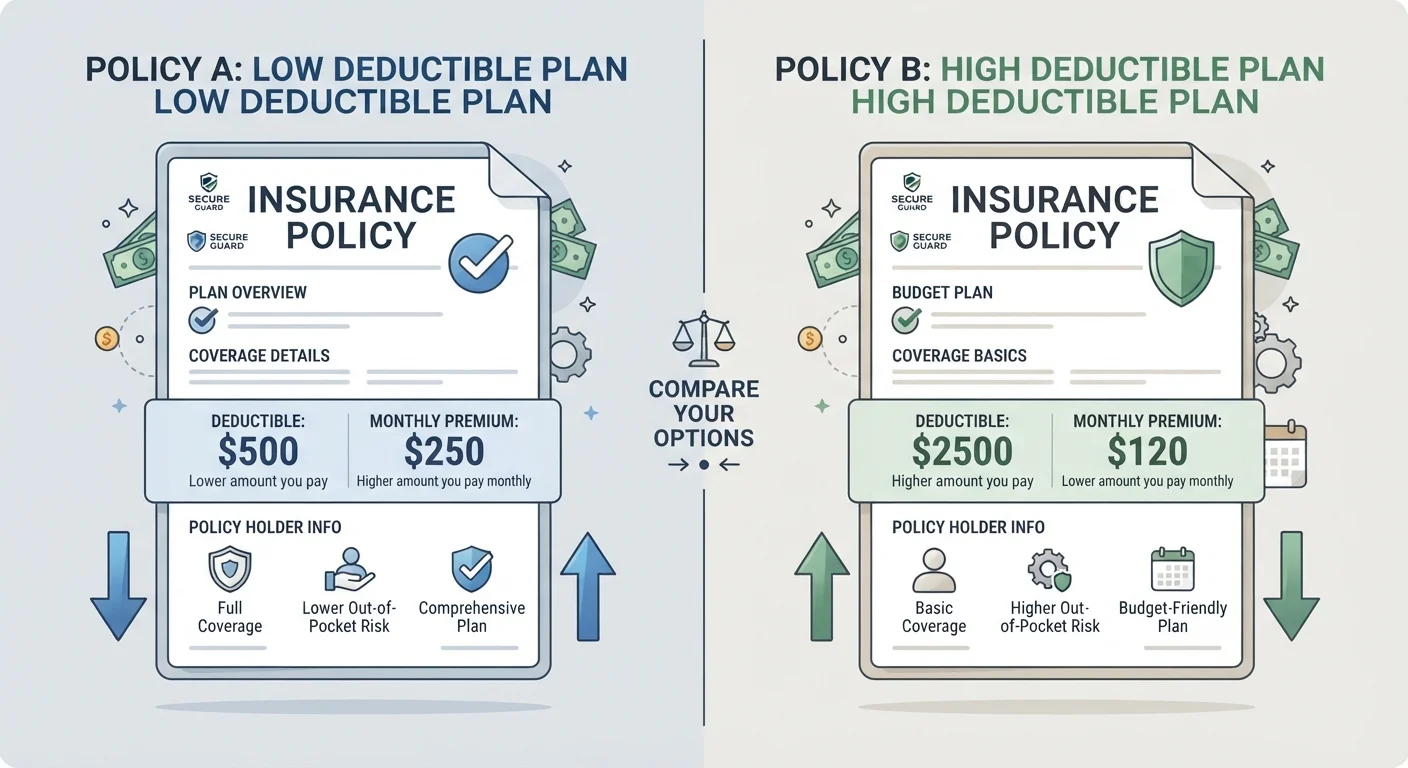
- A higher deductible means lower monthly premiums but more out-of-pocket cost after a claim.
- Deductibles apply per claim event, not once per year like health insurance deductibles often do.
- Collision and comprehensive coverages each carry their own deductible amount.
- Your emergency savings balance should inform what deductible level is realistic for you.
- The math only works in your favor if you can actually afford the deductible when a claim happens.
Auto Insurance Deductible
A deductible is the dollar amount you agree to pay out of your own pocket before your insurance company covers the rest of a claim. For example, if you have a $500 deductible and a covered repair costs $2,000, you pay $500 and your insurer pays $1,500. Choosing a higher deductible generally lowers your monthly premium, while a lower deductible raises it.
Deductibles typically apply per claim, not per policy period, and are usually separate for collision and comprehensive coverages. Liability coverage does not carry a deductible.
The Core Trade-Off: Monthly Cost vs. Claim Cost
Your deductible and your premium move in opposite directions — that's the fundamental relationship every driver should understand before choosing a policy. When you agree to absorb more of the financial risk yourself (a higher deductible), the insurer takes on less, and your monthly payment drops. When you want the insurer to step in sooner after a loss (a lower deductible), they charge more each month to offset that exposure.
This isn't a trick or fine print — it's how risk-sharing works. The question isn't which end of the spectrum is objectively better. It's which trade-off fits your financial situation right now. For a deeper look at how insurers factor in risk when pricing a policy, see what shapes your premium.
$500
Most common collision deductible chosen by US drivers
Industry data consistently shows $500 as the most frequently selected deductible tier, balancing premium savings against out-of-pocket exposure.
~15–30%
Typical premium reduction from doubling your deductible
Raising a deductible from $500 to $1,000 can reduce collision and comprehensive premiums by roughly 15–30%, though the exact figure varies by insurer and driver profile.
How Deductibles Actually Apply After a Claim
One of the most common points of confusion is when your deductible kicks in. Unlike some health insurance plans that accumulate toward an annual total, auto insurance deductibles apply per claim. File two separate collision claims in the same year, and you pay your deductible twice.
Here's how the math plays out: If your car sustains $1,800 in hail damage and you carry a $1,000 comprehensive deductible, your insurer pays $800. If that same damage costs $900 to fix, you'd cover the entire repair yourself — filing a claim wouldn't make financial sense. This is worth keeping in mind: a claim that barely exceeds your deductible may not be worth filing once potential premium increases are factored in.
For plain-language definitions of terms like collision, comprehensive, and subrogation, the auto insurance glossary is a useful reference.
Think Before Filing Small Claims
If a repair cost is only slightly above your deductible, consider paying out of pocket rather than filing. Insurers track claim frequency, and multiple small claims can result in premium increases that cost more over time than the claim itself covered.
Matching Your Deductible to Your Financial Reality
The deductible you choose should be an amount you can access quickly — ideally within a few days of an incident. If your emergency fund holds $500 and you've set a $1,500 deductible to chase lower premiums, you've created a gap between your policy and your actual financial capacity. That gap becomes a problem at the worst possible moment.
A practical approach: calculate how much your premium changes between deductible tiers. If increasing from $500 to $1,000 saves you $15 a month, you're saving $180 a year — but you've taken on $500 more risk per claim. It would take about 2.8 years of savings just to break even on one claim. That math may or may not work in your favor depending on your driving patterns and local conditions.
Your declarations page shows your current deductible for each coverage type at a glance. If you're not sure where to find it, reading your declarations page walks through exactly what to look for.
Deductibles Can Differ by Coverage Type
Most policies let you set collision and comprehensive deductibles independently. Some drivers choose a higher collision deductible (since they have more control over collision risk) and a lower comprehensive deductible (for events like theft or storm damage that are harder to prevent). Review both figures on your declarations page to ensure each reflects your actual financial comfort level.
A Few Common Misconceptions Worth Clearing Up
Many first-time buyers assume their deductible applies to all types of claims — it doesn't. Liability coverage, which pays for injuries or property damage you cause to someone else, carries no deductible. You only encounter your deductible when you file a claim against your own coverage.
Another misconception: that a low deductible always means better coverage. A low deductible simply means you pay less upfront after a covered incident. The scope of what's actually covered is determined by your policy terms, not your deductible level. Confusing the two can lead to real financial surprises — the kind covered in common auto insurance myths.
This article is for general informational and educational purposes only. It does not constitute personalized insurance or financial advice. Coverage terms, deductibles, premiums, and eligibility vary by insurer, policy, and state. Read your actual policy documents carefully and consult a licensed insurance agent for guidance specific to your situation.