

Key Takeaways
- The declarations page is a one-page summary of your entire auto policy — not the full contract.
- Coverage limits are written as split numbers (e.g., 100/300/100) that represent maximum payout amounts.
- Your deductible is the out-of-pocket amount you pay before the insurer covers the rest of a claim.
- Exclusions listed on the dec page tell you what your policy will not cover — read them carefully.
- Discrepancies between the dec page and your expectations should be resolved before a claim occurs.
What you will need
What the Declarations Page Actually Is
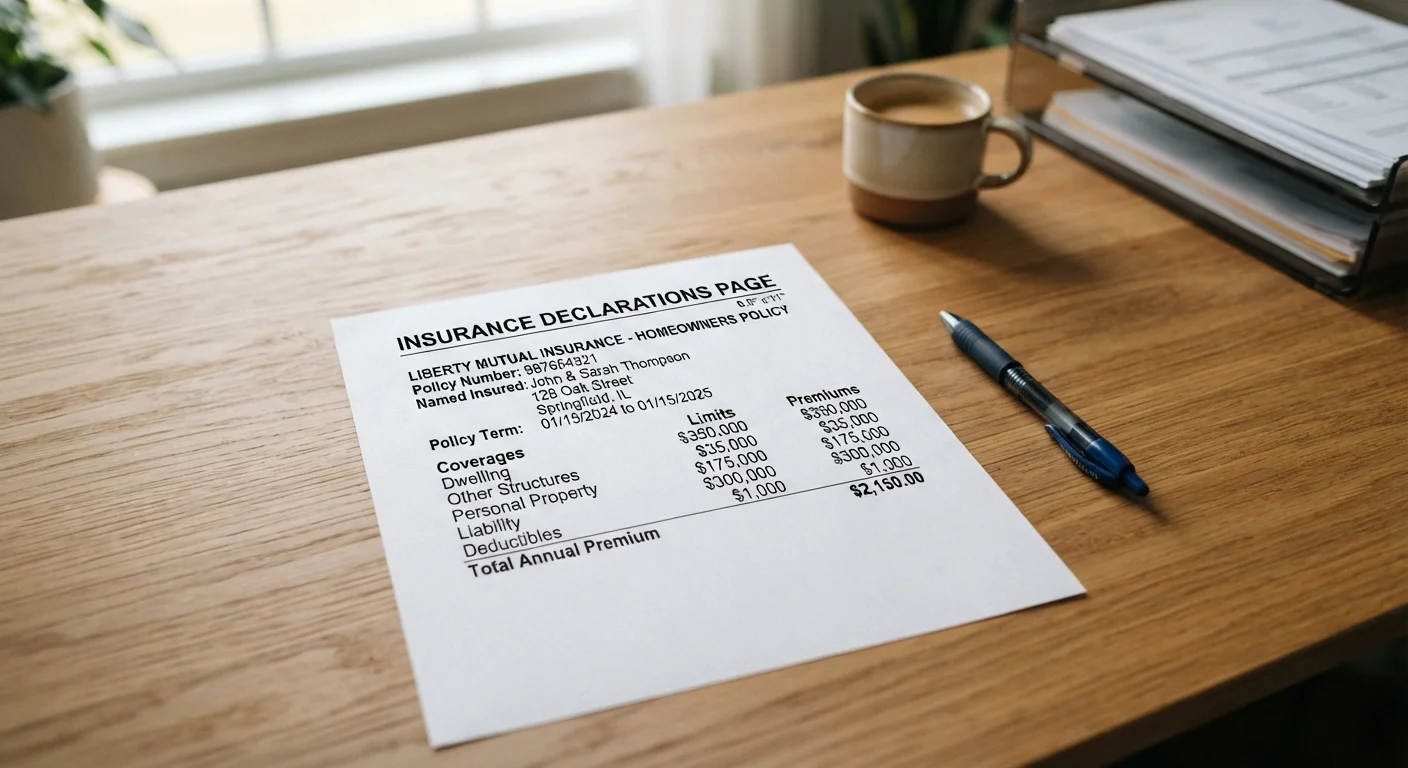
When your auto insurer sends you a policy, you receive a substantial document — sometimes dozens of pages of legal language covering every term, condition, and scenario. The declarations page sits at the front of all of that, and it distills the most critical facts about your coverage onto a single sheet.
Think of it less like a contract and more like a receipt that confirms what you've purchased. It names the insured, identifies the covered vehicle, states the active dates, and lists every coverage type along with its limit and deductible. If you ever need to quickly verify whether you have roadside assistance or what your liability limit is, the dec page is where you look first.
What it doesn't do is replace your full policy. Exclusions, definitions, and detailed claim procedures live in the body of the policy document. The dec page points you in the right direction; the full policy fills in all the details.
This Article Is General Information, Not Advice
The guidance here is educational and intended to help you understand common auto insurance documents. Coverage terms, limits, and exclusions vary by insurer, policy type, and state. Always read your actual policy documents and consult a licensed insurance agent or adviser for guidance specific to your situation.
What You'll Need Before You Start
Pull out your current policy packet — or download it from your insurer's portal — and have both the declarations page and the full policy document available. A pen and highlighter are helpful for marking the figures you want to remember or question.
What you will need
Auto Insurance Declarations Page
The primary document you will be reading and interpreting throughout these steps.
Full Policy Document
Used to verify details and definitions that the declarations page summarises.
Pen and Highlighter
For annotating key figures like limits, deductibles, and effective dates as you review.
Step-by-Step: Reading Every Section of the Dec Page
Work through each section of the declarations page in order. Rushing to find one number (like your deductible) while skipping others (like listed drivers) is where most first-time policyholders miss important details.
Locate and Identify Your Declarations Page
The declarations page — commonly called the dec page — is usually the first one or two pages of the policy packet your insurer mails or emails you. It may be labelled "Declarations," "Policy Summary," or "Coverage Summary." If you received your policy digitally, search the PDF for those terms.
This page is a condensed snapshot, not the full contract. Think of it as the table of contents and receipt combined.
Confirm the Named Insured and Vehicle Information
At the top of the dec page you'll find the named insured (the policyholder's legal name) and the listed vehicle details: year, make, model, and VIN. Verify every field matches your actual information.
If a name is misspelled, a vehicle is missing, or the VIN is incorrect, contact your insurer immediately. Errors here can complicate or delay a claim.
Check the Policy Period and Effective Dates
The policy period shows the exact start and end dates of your coverage — typically a six- or twelve-month term. Confirm the dates are current and that you haven't accidentally let the policy lapse.
A lapse in coverage, even for a single day, can affect your rates and leave you unprotected. Set a calendar reminder for your renewal date.
Read Your Coverage Types and Limits
This is the core of the dec page. Each coverage type is listed alongside its limit — the maximum your insurer will pay per incident or policy period. Common coverage lines you'll see include:
- Bodily Injury Liability: Often shown as split limits, e.g., 100/300, meaning $100,000 per person and $300,000 per accident.
- Property Damage Liability: A single dollar amount covering damage you cause to others' property.
- Collision: Covers repair or replacement of your vehicle after a crash, regardless of fault.
- Comprehensive: Covers non-collision events like theft, weather damage, or a fallen tree.
- Uninsured/Underinsured Motorist: Protects you if the at-fault driver carries little or no insurance.
For a deeper look at what each type actually protects, see our guide on liability, collision, and comprehensive coverage.
Find and Understand Your Deductibles
A deductible is the amount you agree to pay out of pocket before your insurer covers the rest of a covered claim. Deductibles typically apply to collision and comprehensive coverage separately.
For example, if your collision deductible is $500 and a repair costs $2,000, you pay $500 and your insurer pays $1,500. A higher deductible generally means a lower monthly premium — and vice versa. To understand how that trade-off works in practice, read what your deductible actually does to your premium.
Review Any Endorsements, Riders, or Exclusions
Endorsements (also called riders) are add-ons that modify or extend your base coverage — things like roadside assistance or rental reimbursement. They appear as line items with their own limits.
Exclusions are what your policy will not cover. The dec page may list key exclusions or reference specific policy sections. Common exclusions include intentional damage, using a personal vehicle for commercial delivery, or damage that occurs while a non-listed driver is at the wheel.
Understanding these gaps now prevents costly surprises at claim time. Our article on things first-time policyholders wish they'd known covers the most common coverage gaps new drivers overlook.
Flag Any Discrepancies and Follow Up
After completing your review, note anything that doesn't match your expectations: a coverage type you thought you had but don't see listed, a limit that seems different from what you agreed to, or a vehicle or driver that's missing.
Contact your insurer or agent to resolve discrepancies in writing before you need to file a claim. Once you're satisfied, use our coverage review checklist to confirm everything is in order.
Store Your Dec Page Where You Can Find It
Keep a digital copy of your current declarations page in your email or a cloud folder, and a printed copy in your glove compartment. If you're ever in an accident, you'll want to confirm your coverage details quickly without digging through a full policy binder.
Don't Rely on the Dec Page Alone
The declarations page summarises your policy but does not include the full terms, conditions, or exclusions. Always cross-reference it with your complete policy document before assuming you are covered for a specific situation. If anything is unclear, call your insurer directly for clarification.
After the Review: Keeping Your Coverage Current
Reading your dec page once is a good start — but coverage needs change. If you move to a new state, add a driver to your household, buy a new vehicle, or change how you use your car, your policy may need to be updated. Each of those changes can affect your limits, your exclusions, and your premium.
Make it a habit to review your declarations page at every renewal period. Compare the new dec page to the previous one line by line to catch any unintended changes. For a structured way to do that, see our coverage review checklist.
This article is for general informational purposes only and does not constitute insurance, financial, or legal advice. Coverage terms, limits, exclusions, and regulations vary by insurer, policy, and state. Consult a licensed insurance agent or adviser for guidance specific to your situation.