

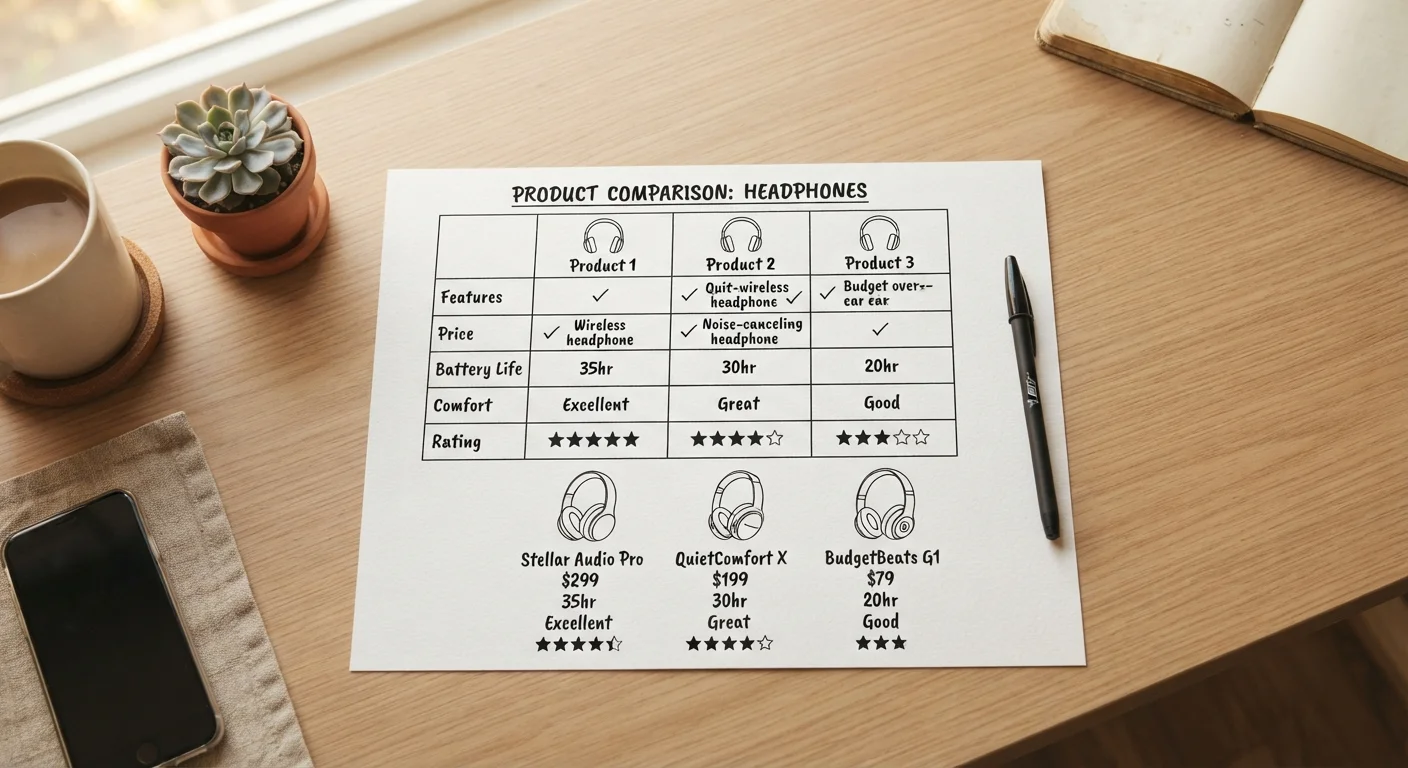
Key Takeaways
- A reusable comparison framework reduces decision fatigue across every shopping category.
- Defining your must-have criteria before browsing prevents marketing noise from distorting your priorities.
- Weighted scoring lets you compare unlike options on a level, objective playing field.
- A saved template means each future purchase takes less effort than the last.
- Knowing when to stop comparing is as important as knowing how to start.
What you will need
Why a Reusable Framework Beats One-Off Research
Most shoppers approach each new purchase as an isolated problem — researching from scratch, reading whichever reviews surface first, and making a decision shaped more by recency and marketing than by personal priorities. The result is inconsistent: sometimes satisfying, often regrettable.
A comparison framework flips this dynamic. It encodes your priorities into a structured process before any product enters the picture. The same template that helps you evaluate a laptop works — with minor column adjustments — for evaluating a winter coat, a kitchen appliance, or an insurance policy. Over time, the framework becomes faster to use and more finely tuned to how you actually make decisions. For broader context on building shopping confidence, comparing products across categories is a strong companion resource.
Set Your Criteria Before You Browse
Looking at products before defining your requirements is one of the most common shopping mistakes. Exposure to marketing language and feature lists will quietly reshape what you think you need. Build your framework — especially your must-have criteria — before opening a single product page.
Before building your framework, it's worth familiarizing yourself with common buyer traps that can distort even a well-structured evaluation process.
Spreadsheet application
Create a reusable scoring grid with weighted columns for each evaluation criterion.
Notepad or paper
Capture initial requirements and priority rankings before building the digital framework.
Manufacturer or retailer spec pages
Source factual product data to populate your comparison grid accurately.
How to Build and Apply Your Framework
The following steps walk you through constructing a comparison framework from the ground up. You'll define what you need, establish measurable criteria, weight them by personal importance, and score your options systematically. Complete the steps in order — each one builds on the last.
What you will need
Define the job this purchase needs to do
Before listing any product names, write one or two sentences describing what you need the item to accomplish. Focus on outcomes, not features. For example: "I need a jacket that keeps me dry during commutes in heavy rain" rather than "I want a waterproof jacket." This framing anchors every later decision to a real-world purpose and prevents feature creep from inflating your requirements.
List your criteria and separate must-haves from nice-to-haves
Brainstorm every attribute that matters to you — durability, size, energy use, compatibility, warranty, ease of use, and so on. Then divide the list into two columns: must-haves (non-negotiable requirements) and nice-to-haves (preferences that add value but aren't deal-breakers). Any option that fails a must-have is eliminated immediately, regardless of its score elsewhere. This step is explained in depth in the anatomy of a good product comparison.
Assign a weight to each nice-to-have criterion
Not all preferences are equally important. Assign each nice-to-have criterion a weight from 1 to 3, where 3 reflects the highest personal priority. For example, battery life might be a 3 for a frequent traveler but a 1 for someone who works at a desk. These weights ensure that a product excelling in high-priority areas outscores one that merely performs adequately across all criteria. If unfamiliar with terms like TCO or compatibility flags, the Smart Shopper's Glossary is a useful reference at this stage.
Score each candidate option
Select two to four candidate products or options. For each, score their performance against every nice-to-have criterion on a scale of 1 to 5. Multiply each score by its criterion weight to get a weighted score, then sum the weighted scores for a total. The candidate with the highest total — assuming it also passes all must-haves — is your framework's recommended choice. For a deeper look at objective evaluation principles, see evaluating products objectively.
Sense-check the result and make your decision
Review the top-scoring option against your original "job" statement from Step 1. If the result feels right, proceed. If something feels off, examine which criteria or weights might not reflect your actual priorities — then adjust them honestly, not to favor a preferred result. Once satisfied, make the purchase. A completed framework also protects your shopping budget by removing impulsive upgrades from the equation.
Save Your Framework as a Template
Once you've completed one purchase using this method, save a blank copy of your scoring grid. A simple spreadsheet works well — label columns for criteria, weights, and candidate scores. The next time you shop, you'll start with structure already in place rather than from scratch.
Don't Let Perfect Be the Enemy of Good
A comparison framework is a decision-support tool, not a guarantee of a perfect outcome. If you find yourself endlessly adjusting scores or adding new criteria, you may be experiencing analysis paralysis. Set a firm deadline for your final decision and commit to it. For more on this risk, see when comparison shopping backfires.