

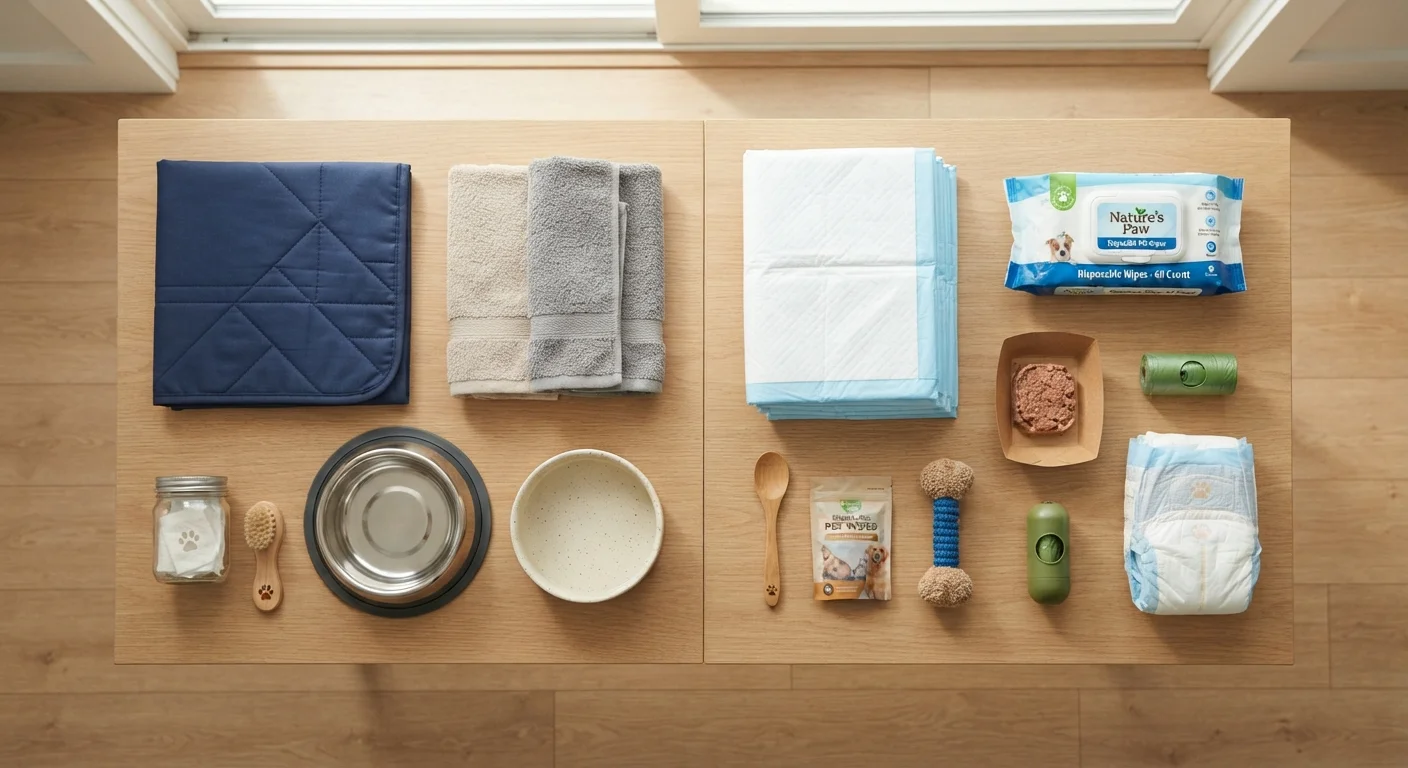
Key Takeaways
- Reusable supplies typically cost more upfront but can reduce long-term spending significantly.
- Disposable options offer convenience and hygiene advantages in specific situations, such as illness or travel.
- Neither format is universally better — the right choice depends on the product category and your household.
- Waste and environmental impact differ meaningfully between formats across a pet's lifetime.
- New pet owners often overbuy supplies before knowing what their pet actually needs.
Lower long-term cost with consistent use
Reusable supplies spread their upfront cost across months or years of use, often undercutting the cumulative expense of repeated disposable purchases by a significant margin.
Reduced household waste over a pet's lifetime
A pet that lives over a decade can generate a large volume of disposable waste. Switching key categories to washables meaningfully reduces that environmental impact.
Often higher quality and more durable
Products designed for repeated use — such as stainless-steel bowls or sturdy grooming brushes — tend to be built to a higher standard than single-use equivalents.
More consistent hygiene with proper maintenance
Reusable supplies that are washed and sanitized on a regular schedule can match or exceed the hygiene of disposables in most everyday household situations.
Better long-term value for routine staples
For everyday items like food bowls, grooming tools, and bedding, reusables pay for themselves relatively quickly and continue providing value with no ongoing cost.
Higher upfront purchase cost
Quality reusable supplies — particularly washable training pads or durable grooming equipment — can require a noticeably larger initial outlay than their disposable counterparts.
Maintenance and laundering commitment required
Reusables only deliver their benefits if they're cleaned regularly. For owners with unpredictable schedules, this commitment can become a practical barrier.
Less practical during illness or travel
When a pet is unwell or you're away from home, the ability to launder and dry reusable supplies may not exist, making disposables the more realistic option in those moments.
Not every category has effective reusable alternatives
Some disposable products — certain medical or hygiene items, for example — don't have widely available reusable equivalents that perform comparably in everyday use.
Risk of investing in supplies the pet doesn't accept
Purchasing a high-quality reusable item before knowing your pet's preferences — for bedding texture or litter type, for example — can mean the cost is wasted entirely.
Our Verdict
Reusable pet supplies make strong financial and environmental sense for everyday staples like food bowls, grooming tools, and washable bedding. Disposables earn their place in specific scenarios — illness containment, travel, or early training stages — where convenience and hygiene genuinely matter. A mixed approach, anchored in your pet's routine rather than impulse purchases, tends to serve most households best.
Pet owners who want to reduce ongoing costs and household waste while still keeping practical disposable options on hand for health or travel situations.
Why This Choice Actually Matters
When you're setting up for a new pet, the supply aisle can feel overwhelming. Reusable or disposable training pads? A durable grooming brush or disposable wipes? A washable bed or a replaceable mat? These decisions seem minor individually, but they compound quickly — in cost, in waste, and in how well your routine actually holds together.
The reusable vs. disposable question isn't just about convenience. It has real implications for your long-term budget, your home's hygiene, and the environmental footprint of pet ownership. Understanding the trade-offs up front prevents the kind of overbuy cycle that catches many first-time owners off guard. For a broader look at that pattern, see why new pet owners overbuy.
The Case for Reusable Pet Supplies
Reusable supplies — washable training pads, stainless-steel bowls, silicone grooming tools, cloth bandanas — generally require a larger initial investment but pay for themselves over time. A washable training pad, for example, may cost several times more than a pack of disposables but can withstand hundreds of wash cycles, eliminating the recurring cost entirely.
Lower long-term cost with consistent use
Reusable supplies spread their upfront cost across months or years of use, often undercutting the cumulative expense of repeated disposable purchases by a significant margin.
Reduced household waste over a pet's lifetime
A pet that lives over a decade can generate a large volume of disposable waste. Switching key categories to washables meaningfully reduces that environmental impact.
Often higher quality and more durable
Products designed for repeated use — such as stainless-steel bowls or sturdy grooming brushes — tend to be built to a higher standard than single-use equivalents.
More consistent hygiene with proper maintenance
Reusable supplies that are washed and sanitized on a regular schedule can match or exceed the hygiene of disposables in most everyday household situations.
Better long-term value for routine staples
For everyday items like food bowls, grooming tools, and bedding, reusables pay for themselves relatively quickly and continue providing value with no ongoing cost.
Beyond cost, durability matters for your pet's comfort and safety. Stainless steel and ceramic food bowls are easier to sanitize thoroughly than plastic, and they don't degrade or leach material over time. Grooming tools — brushes, combs, nail files — are almost always worth buying once in a quality reusable form rather than reaching for single-use alternatives.
The environmental argument is also straightforward: a pet that lives 12–15 years generates a substantial volume of waste if disposable products dominate the routine. Switching to washable training pads or reusable grooming cloths meaningfully reduces that footprint.
Where Disposables Earn Their Place
Disposable pet supplies aren't simply a lazy choice — in certain contexts, they're the more hygienic and practical option. During illness, for instance, disposable training pads prevent contamination spread between wash cycles. They're also genuinely useful for travel, where laundering isn't feasible.
Higher upfront purchase cost
Quality reusable supplies — particularly washable training pads or durable grooming equipment — can require a noticeably larger initial outlay than their disposable counterparts.
Maintenance and laundering commitment required
Reusables only deliver their benefits if they're cleaned regularly. For owners with unpredictable schedules, this commitment can become a practical barrier.
Less practical during illness or travel
When a pet is unwell or you're away from home, the ability to launder and dry reusable supplies may not exist, making disposables the more realistic option in those moments.
Not every category has effective reusable alternatives
Some disposable products — certain medical or hygiene items, for example — don't have widely available reusable equivalents that perform comparably in everyday use.
Risk of investing in supplies the pet doesn't accept
Purchasing a high-quality reusable item before knowing your pet's preferences — for bedding texture or litter type, for example — can mean the cost is wasted entirely.
For puppies or kittens in early training, disposables can reduce stress during the adjustment period — you're not worried about a ruined washable pad while the pet is still learning. Some owners also find disposable grooming wipes helpful for quick clean-ups between full grooming sessions, particularly for senior pets who tire easily.
The key is treating disposables as situational tools rather than defaults. When the convenience is real and the alternative creates a hygiene or practicality problem, disposables are justified. When they're simply habit, they add cost and waste without a proportionate benefit.
A Note on "Eco-Friendly" Disposables
Some disposable pet products are marketed as biodegradable or compostable. While these can reduce environmental impact compared to conventional disposables, their actual breakdown rate depends heavily on disposal conditions — most municipal landfills don't provide the heat and oxygen needed for rapid biodegradation. Treating them as environmentally equivalent to reusables is generally not accurate. Reusables remain the more reliably low-waste option for routine supply categories.
Comparing Costs Across Supply Categories
The financial trade-off varies significantly by product type. Consider three common categories:
- Training pads: Washable pads have a higher upfront cost but eliminate recurring purchases. Disposables carry a steady monthly expense that scales with pet size and training duration.
- Food and water bowls: Reusables win clearly here. A durable bowl purchased once serves for years; disposables offer no meaningful advantage in this category.
- Grooming supplies: Quality reusable brushes and combs outlast dozens of disposable alternatives and typically perform better. Disposable wipes are a reasonable complement for targeted use, not a replacement.
~$1,000–$5,000
Estimated first-year pet ownership costs
The American Society for the Prevention of Cruelty to Animals (ASPCA) has estimated that first-year costs for common pets can range considerably depending on species and size, with supplies representing a meaningful share.
500+
Wash cycles typical washable training pads withstand
Manufacturer specifications for washable training pads commonly cite durability of several hundred wash cycles, replacing what could otherwise be thousands of disposable units over a pet's lifetime.
For first-time owners still figuring out what their pet actually needs, comparing products carefully before committing to either format can prevent costly missteps. This is especially relevant for supplies tied to training, where your pet's individual behavior will determine what actually gets used.
Hygiene Considerations New Owners Often Miss
One of the strongest arguments for disposables is hygiene — but it's more nuanced than it first appears. Reusable supplies can be highly hygienic if maintained correctly. Washing training pads at appropriate temperatures, sanitizing food bowls regularly, and replacing worn grooming tools on schedule keeps reusables functionally clean.
Where reusables fall short hygienically is in households managing active illness, immunocompromised pets, or situations where washing cadence is unpredictable. In those cases, the disposable option isn't just convenient — it's genuinely the safer choice. If you're navigating health decisions for your pet, a guide on preventive care vs. reactive treatment can help frame when hygiene protocols become more critical.
The honest answer for most healthy households: reusables are sufficiently hygienic with consistent care. The maintenance commitment is real, but manageable as part of a standard pet routine.
This article is for general informational purposes only and does not constitute veterinary or financial advice. Consult a qualified professional for guidance specific to your pet's health needs or your financial situation.