

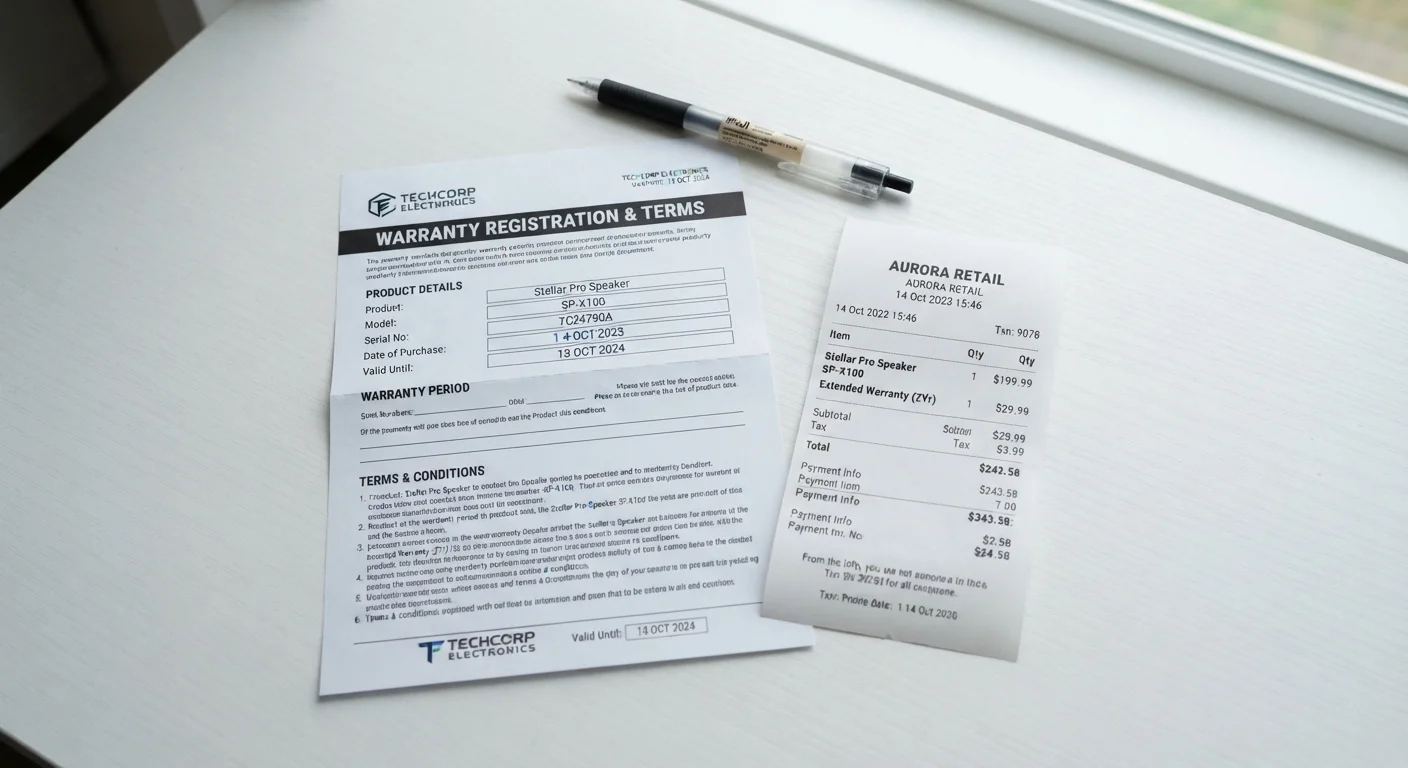
| Who provides a manufacturer's warranty | The product's maker — included at no extra cost |
| Who sells extended warranties | Retailers, third-party administrators, or manufacturers |
| U.S. law governing written warranties | Magnuson-Moss Warranty Act (federal) (Federal Trade Commission) |
| Implied warranty protection | Available in most U.S. states by default |
| Common warranty duration (consumer electronics) | 90 days to 2 years depending on manufacturer |
| Extended warranty typical cost | 10%–50% of product purchase price |
Why Warranty Language Misleads First-Time Buyers
The word "warranty" appears on almost every product box, but it rarely means the same thing twice. Manufacturers, retailers, and third-party sellers each use the term differently — and the gap between what you assume is covered and what actually is can cost you hundreds of dollars.
This reference breaks down the four main warranty types you'll encounter, what each one actually promises, and which questions to ask before relying on coverage you haven't read. For a parallel look at how coverage assumptions create problems in another domain, first-time policyholders share hard-learned lessons worth knowing.
| Who provides a manufacturer's warranty | The product's maker — included at no extra cost |
| Who sells extended warranties | Retailers, third-party administrators, or manufacturers |
| U.S. law governing written warranties | Magnuson-Moss Warranty Act (federal) (Federal Trade Commission) |
| Implied warranty protection | Available in most U.S. states by default |
| Common warranty duration (consumer electronics) | 90 days to 2 years depending on manufacturer |
| Extended warranty typical cost | 10%–50% of product purchase price |
The Four Warranty Types Explained
1. Manufacturer's (Express) Warranty
This is the written guarantee the maker includes with a new product. It typically covers defects in materials or workmanship for a fixed period. Crucially, it does not cover accidental damage, misuse, or normal wear. Always check whether it covers parts only, labor only, or both — and who pays shipping for returns.
2. Limited Warranty
Nearly every manufacturer's warranty is technically a limited warranty. The word "limited" signals that coverage applies only under specific conditions. A limited warranty might cover the motor in an appliance but not its exterior parts. Reading the exclusions section — not just the headline coverage — tells you what you actually have.
3. Extended Warranty (Service Contract)
Sold separately, usually at checkout, an extended warranty is a paid contract — not a manufacturer promise. It may duplicate coverage you already have during the manufacturer's active warranty period. Evaluate what new risks it covers, the deductible amount, the claims process, and whether the provider is financially stable enough to honor future claims.
4. Implied Warranty
Under most U.S. state laws, every product sale carries an unwritten implied warranty of merchantability — meaning the product must work for its ordinary purpose. Sellers can limit implied warranties in writing in many states, but cannot eliminate them entirely when a written warranty is offered, under federal law.
Manufacturer's Warranty
A guarantee provided by the product's maker at no additional cost, covering defects in materials or workmanship for a set period. Sometimes called a factory or express warranty.
Limited Warranty
A warranty that restricts coverage to specific parts, defect types, or time periods. It does not cover all possible failures and typically excludes user damage or normal wear.
Extended Warranty
A paid service contract — often sold by retailers or third parties — that extends or supplements coverage beyond the manufacturer's original terms. It is not the same as a manufacturer guarantee.
Implied Warranty
An unwritten, legally established protection under most U.S. state laws guaranteeing that a product is fit for its intended purpose, even if no written warranty exists.
Exclusions
Specific situations, damage types, or parts explicitly not covered by a warranty. Common exclusions include accidental damage, cosmetic wear, and damage from misuse.
Deductible
An amount you pay out of pocket before warranty or service contract coverage kicks in for a repair or replacement claim.
What Warranties Almost Never Cover
Knowing exclusions is as important as knowing coverage. Across nearly all warranty types, the following are commonly excluded:
- Accidental damage — drops, spills, or impacts
- Cosmetic wear — scratches, dents, fading
- Consumable parts — batteries, filters, ink cartridges
- Damage from misuse — using a product outside its intended purpose
- Pre-existing conditions — defects you knew about at purchase
Extended warranties sometimes fill one or two of these gaps (accidental damage plans, for example), but read the contract carefully before assuming so. The smart product comparison hub includes practical checklists for evaluating purchases before you commit.
Warranties Are Not Insurance Policies
A warranty is a seller's or manufacturer's promise about product quality, while insurance protects against unpredictable events. For protection involving liability, accidents, or major assets like vehicles, separate insurance coverage is required. See how auto coverage types differ from warranties when it comes to protecting your car.
~55%
Consumers who never use their extended warranty
Consumer Reports surveys have consistently found that most extended warranties go unused over the coverage period.
1–2 years
Typical manufacturer warranty length for electronics
Most major consumer electronics manufacturers offer one to two years of limited parts-and-labor coverage.
How to Evaluate Warranty Value Before You Buy
Use these practical steps when reviewing any warranty:
- Read the exclusions first. The coverage headline is marketing; the exclusions define your real protection.
- Check for overlap. Your credit card may already provide purchase protection or extended coverage on eligible items — verify before buying an add-on.
- Confirm the claims process. Does a repair require shipping to a service center? Is there a deductible? How long does repair or replacement take?
- Assess product reliability. High-reliability products with low historical failure rates often make extended warranty purchases less cost-effective.
- Compare coverage to cost. If an extended warranty costs 30% of the product's price and covers only manufacturer-type defects already covered for another year, the value proposition is weak.
This article is for general informational and educational purposes only and does not constitute financial, legal, or consumer advice tailored to your individual situation. Consult a qualified professional for decisions specific to your circumstances.