

Key Takeaways
- Needs are essential purchases with real consequences if skipped; wants and nice-to-haves are optional.
- The three-tier framework works across all spending categories, from groceries to electronics.
- Applying this filter before purchasing reduces impulse spending and budget regret.
- Most people misclassify wants as needs due to habit, marketing, or social pressure.
- Nice-to-haves are not inherently bad — they become a problem only when they crowd out needs.
Need vs. Want vs. Nice-to-Have
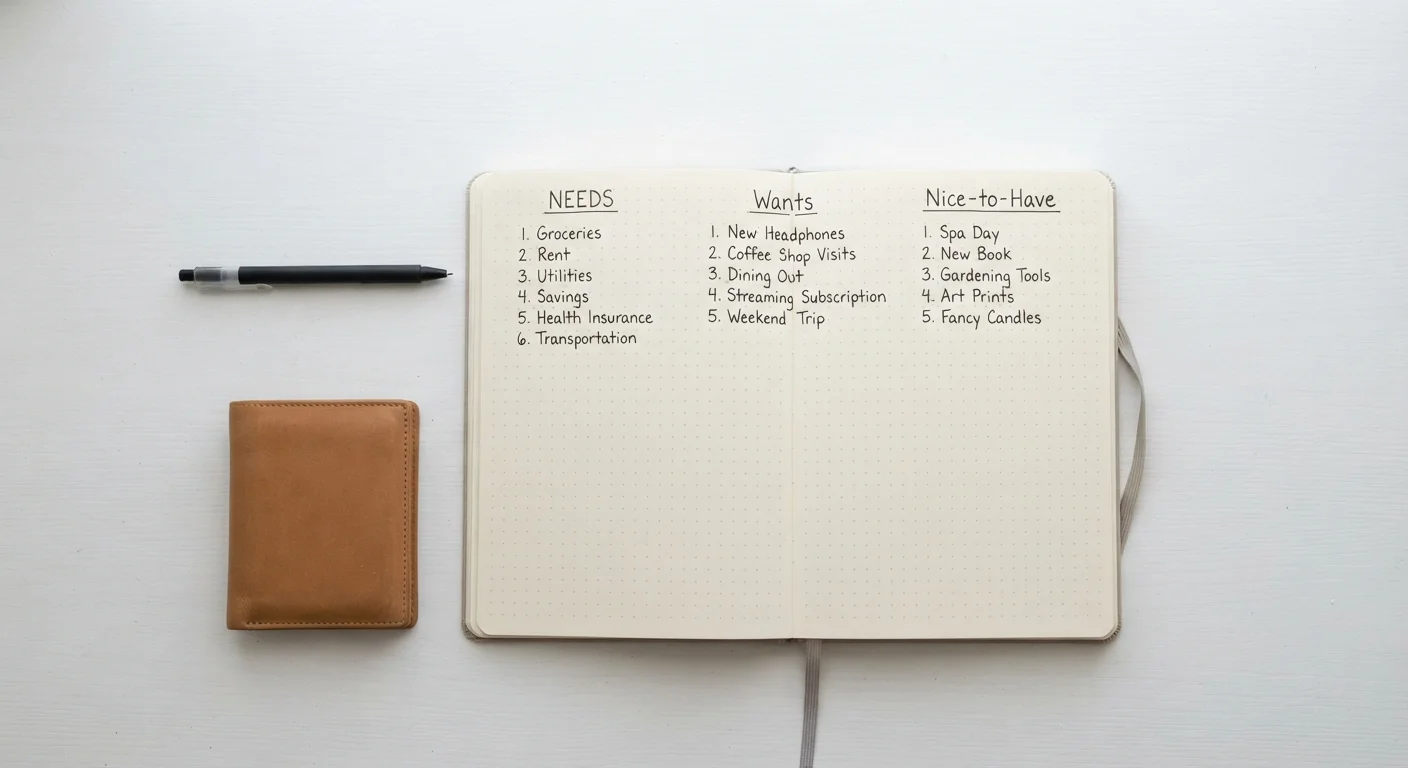
A "need" is something essential to your daily functioning or safety — without it, you face a real consequence. A "want" is something desirable but not essential, while a "nice-to-have" is an upgrade or bonus feature that adds comfort without filling a genuine gap. Sorting purchases into these three tiers before spending helps you make decisions based on priority rather than impulse.
In behavioral economics, this distinction maps loosely to Maslow's hierarchy of needs — differentiating survival and functional requirements from psychological desires and aspirational preferences.
Why Most People Skip This Step
Most spending mistakes don't happen because people are careless with money — they happen because purchases feel justified in the moment. A retailer frames a product as essential, a friend recommends it enthusiastically, or you simply want the feeling of buying something new. Without a pre-purchase filter, those feelings substitute for real evaluation.
The need vs. want vs. nice-to-have framework gives you that filter. It takes about 30 seconds to apply and works across every spending category — groceries, clothing, electronics, subscriptions, and more. The goal isn't to restrict every purchase; it's to make sure your spending reflects your actual priorities rather than the loudest influence in the room.
For a broader foundation on spending intentionally, see this guide to smarter spending across categories.
Try the 24-Hour Pause Rule
For any non-essential purchase above your personal comfort threshold — whether that's $20 or $200 — wait 24 hours before buying. This single habit interrupts the automatic path from impulse to purchase and gives the three-tier framework time to work. Most wants that feel urgent in the moment feel optional the next day.
Breaking Down the Three Tiers
Tier 1 — Needs: These are purchases where skipping them creates a real, concrete consequence. Rent, utilities, groceries, required medications, transportation to work — these are needs. The test isn't whether life would be harder without them; it's whether life would be functionally compromised. If you can honestly answer "yes, something important breaks down," it's a need.
Tier 2 — Wants: Wants are purchases that improve your experience but don't fill an essential gap. Dining out instead of cooking, a streaming subscription, a new pair of shoes when your current ones still function — these are wants. They're not inherently wrong to buy, but they shouldn't be treated as non-negotiable. The distinction between needs and wants is worth examining carefully, especially when a want has become so habitual it feels like a need.
Tier 3 — Nice-to-Haves: These are the upgrades, extras, and bonus features that add comfort or enjoyment but serve no functional requirement you don't already have covered. The premium model with more storage when the standard one does the job. The plush bath towels when yours still work fine. Nice-to-haves are fine when your budget allows — the problem arises when they quietly displace higher-priority spending.
~33%
Of purchases consumers later regret
Research from multiple consumer behavior studies consistently shows roughly one in three purchases is reported as regretted, often because buyers didn't pause to evaluate before spending.
$314
Average monthly impulse spend per US adult
A Slickdeals consumer survey found that US adults reported spending an average of around $314 per month on unplanned purchases, much of which went toward wants and nice-to-haves.
How to Apply the Framework in Real Life
Before any purchase, pause and ask three questions in order:
- What happens if I don't buy this? If the answer is a real, near-term problem — you go without a meal, you can't get to work, a health issue goes unaddressed — it's a need. If the answer is "nothing serious," move to tier two.
- Does this improve my life in a meaningful way, and does my budget allow it? If yes to both, it's a reasonable want. If the budget doesn't allow it right now, it stays on a list for later.
- Am I buying the baseline version, or am I upgrading? If you're choosing between a functional version and a premium version, that upgrade cost sits in nice-to-have territory. Budget for the baseline first; decide whether the upgrade is worth the difference separately.
This sequence takes the emotion out of the decision without eliminating enjoyment. You're not being told never to buy wants or nice-to-haves — you're being asked to make that choice consciously.
Understanding why unplanned spending feels so compelling can also help. The psychology behind impulse purchases reveals that marketing environments are specifically designed to short-circuit this kind of deliberate thinking.
Common Misclassifications to Watch For
Certain categories consistently trick buyers into upgrading a want into a need. Being aware of these patterns helps you catch them before they cost you.
- Habit disguised as necessity: Buying a daily coffee from a café isn't a need — it's a want that has become a comfortable routine. That doesn't make it wrong, but it should be budgeted as a want, not treated as a fixed essential.
- Social comparison spending: Buying something because peers have it, or because you'd feel out of place without it, places a social pressure in the need column where it doesn't belong. Recognizing buyer traps like this is a foundational skill for confident spending.
- Manufactured urgency: Feeling like you need something immediately — because a sale is ending or stock is limited — is a marketing trigger, not a genuine need signal. Real needs don't expire in 24 hours.
- Feature inflation: When comparing products, it's easy to convince yourself you need the premium tier because it has a feature you might use. Apply the framework to features the same way you apply it to whole products.
Not every unplanned purchase is irresponsible — see the difference between impulse buying and spontaneous buying for a more nuanced look at unplanned spending.
Context Changes the Category
The same item can be a need for one person and a nice-to-have for another. A high-quality pair of running shoes is a need for someone managing a joint condition that requires specific support — and a nice-to-have for a casual weekend walker. Always apply the framework to your specific circumstances, not to the product in the abstract.
This article is for general informational and educational purposes only. It does not constitute personalized financial advice. For guidance specific to your financial situation, consider speaking with a qualified financial professional.