

Key Takeaways
- Your nervous system needs deliberate cues to shift from alertness into sleep-readiness.
- A wind-down routine works by reducing stimulation gradually, not all at once.
- Consistency in timing matters as much as the specific activities you choose.
- Dim lighting and screen reduction are among the most evidence-supported steps.
- Short routines of 20–30 minutes can be enough to make a measurable difference.
What you will need
Why Your Brain Needs a Transition Signal
Sleep doesn't switch on like a light. It's a gradual physiological shift — body temperature drops, heart rate slows, and the nervous system moves from its active, alert state into one that supports rest. For most adults, that shift doesn't happen automatically the moment they lie down. It requires environmental and behavioral cues that tell the brain the active part of the day is ending.
This is where a wind-down routine earns its value. When you repeat the same sequence of low-stimulation behaviors at the same time each evening, you're essentially training your nervous system to anticipate sleep. Over time, those behaviors become associated with the onset of sleepiness — much like how certain smells or sounds can trigger specific feelings because of repeated pairing.
This process is sometimes called conditioned arousal reduction in sleep research. The principle is straightforward: your brain learns what comes next based on what has consistently come before. A chaotic, stimulation-heavy evening keeps arousal elevated. A calm, predictable one supports the biological transition your body is already trying to make.
This Is General Information, Not Medical Advice
The guidance in this article is educational and intended for general wellness audiences. If you experience persistent insomnia, difficulty staying asleep, or suspect a sleep disorder, please consult a qualified healthcare provider. Do not delay seeking professional care based on lifestyle tips alone.
What to Prepare Before You Start
Before building the steps of your routine, a few simple environmental and behavioral adjustments make the whole process more effective.
What you will need
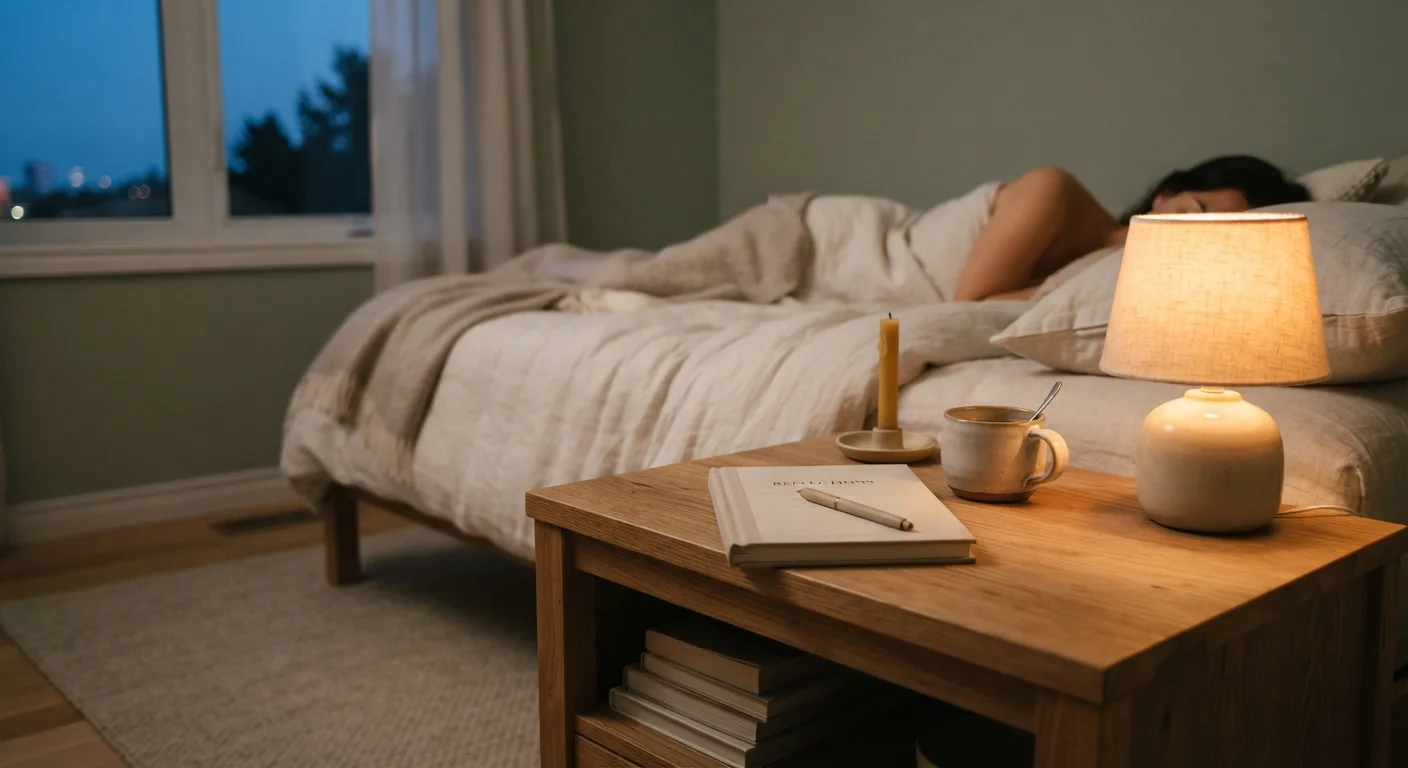
A dim lamp or warm-toned bulb
Reduces blue-spectrum light exposure to support natural melatonin production in the evening.
A notebook or journal
Captures lingering thoughts and to-do items so they don't replay in your mind at bedtime.
A phone or device with a screen timer or Do Not Disturb mode
Enforces a digital boundary so notifications don't pull your attention back into alertness.
Herbal tea (non-caffeinated)
Provides a soothing, screen-free sensory ritual that can serve as a reliable wind-down cue.
A light book or low-stimulation reading material
Gives your mind a gentle focal point that isn't emotionally activating or screen-based.
Stack Your Wind-Down onto an Existing Habit
Behavior research suggests that attaching a new habit to an existing one — called habit stacking — improves follow-through. Try beginning your wind-down routine immediately after brushing your teeth or finishing dinner. The existing habit serves as a reliable trigger for the new one.
Your Step-by-Step Wind-Down Routine
The following steps are ordered to gradually reduce stimulation rather than eliminate it abruptly. Follow them in sequence for the best effect, though you can adapt individual elements to fit your living situation or schedule.
Set a fixed wind-down start time
Work backward from your target bedtime by 30 minutes. Mark this as your wind-down window — not sleep itself, but the transition period. Choosing a consistent start time is important because your brain learns patterns through repetition. Irregular schedules keep the nervous system uncertain about when to begin releasing sleep-promoting signals.
Dim the lights in your space
Switch off overhead lights and move to a lamp with warmer, lower-intensity light. Bright, cool-toned lighting suppresses melatonin — a hormone that naturally rises in the evening to prepare the body for sleep. This step is low-effort but has strong support in sleep science literature as an environmental cue that reinforces circadian timing.
Create a screen boundary
Put your phone into Do Not Disturb mode and set it face-down or in another room. Screens are stimulating both because of light exposure and because of the content they deliver — news, social media, and notifications activate the same arousal pathways your brain uses during problem-solving. A firm boundary, even imperfect, is more effective than passive reduction.
Do a brief brain dump in a notebook
Spend three to five minutes writing down any unfinished tasks, worries, or thoughts circling in your mind. This isn't journaling in the expressive sense — it's a practical offloading exercise. Research on cognitive arousal at bedtime suggests that people who write out a to-do list before sleep fall asleep faster than those who journal about completed tasks. Getting it out of your head and onto paper reduces the brain's need to keep rehearsing it.
Introduce slow, low-stimulation activity
Choose one calming activity to fill the remaining window: reading a physical book, light stretching, a warm shower, or simply sitting quietly with tea. The goal is to give your nervous system a neutral focal point while arousal continues to decrease. Avoid activities that require decisions, problem-solving, or emotional processing — these are stimulating even if they feel passive.
Repeat consistently for at least two weeks
A wind-down routine only becomes a reliable sleep cue through repetition. Your brain needs consistent pairings of the routine's stimuli with sleep onset before those stimuli begin triggering sleepiness on their own. Most people begin to notice a difference in how quickly they feel sleepy at bedtime after one to two weeks of consistent practice — though individual variation is significant. For a broader framework on building sustainable health habits from the ground up, see the mental wellness habit guide.
Avoid Stimulants and Intense Exercise Late
Caffeine can remain active in your system for several hours and may delay sleep onset even when consumed in the afternoon. Similarly, vigorous exercise close to bedtime can elevate your heart rate and core temperature in ways that interfere with the body's natural cooling process that accompanies sleep. The cool-down principles from exercise apply to your evening in a broader sense — winding the body down takes intentional steps.
What to Do When the Routine Doesn't Work Right Away
It's common to lie down after a wind-down routine and still feel mentally active, especially in the first few days. This doesn't mean the approach isn't working — it means the conditioning hasn't fully formed yet. A few principles can help during this adjustment period.
First, don't stay in bed awake for long stretches. If you haven't fallen asleep after roughly 20 minutes, get up, return to a calm activity in dim light, and go back to bed when sleepiness increases. This helps maintain the mental association between your bed and sleep, rather than wakefulness.
Second, resist the urge to check the time repeatedly. Clock-watching activates performance anxiety about sleep, which is itself arousing. Cover your clock or turn your phone face down if this is a pattern for you.
Third, keep your wake time consistent regardless of how the night went. A stable wake time is one of the most powerful anchors for your circadian rhythm, and it makes the following evening's wind-down more effective.
This article is for general informational and educational purposes only and does not constitute medical advice. If you are experiencing significant sleep difficulties, consult a licensed healthcare provider who can evaluate your individual circumstances.