
Minimum Coverage vs. Full Coverage: Understanding What Those Labels Actually Mean

Key Takeaways
- "Full coverage" is not an official insurance term — it typically means liability plus collision and comprehensive.
- State minimum coverage only pays for damage or injury you cause to others, not your own vehicle.
- Lenders and leasing companies almost always require collision and comprehensive on financed vehicles.
- Higher liability limits on a fuller policy can protect your personal assets if you're sued after an accident.
- Neither label guarantees every possible loss — always read the actual policy terms and exclusions.
Option A
Minimum Coverage
The legally required baseline — nothing more.
Best for: Drivers who need to meet state law requirements and accept personal financial risk for damage to their own vehicle.
Option B
Full Coverage
An informal term for a broader protection bundle.
Best for: Drivers who want protection for their own vehicle in addition to liability, especially when financing or leasing a car.
If you own your vehicle outright and it has a low market value
Minimum Coverage
When a car's value is modest, the cost of collision and comprehensive coverage may outweigh the potential payout. State minimums keep you legal at lower cost.
If you're financing or leasing your vehicle
Full Coverage
Most lenders require collision and comprehensive coverage for the duration of the loan or lease to protect their financial interest in the vehicle.
If you drive a newer or higher-value vehicle you own outright
Full Coverage
Replacing or repairing a valuable car out of pocket after theft, weather damage, or an at-fault collision is a significant financial risk worth insuring against.
If you want to minimize monthly premium costs above all else
Minimum Coverage
State minimums carry the lowest premiums, though you should clearly understand what financial exposure that leaves you with before deciding.
Two Labels, Very Different Meanings
When shopping for auto insurance for the first time, you'll quickly encounter two phrases: minimum coverage and full coverage. They sound like official policy tiers, but only one of them is. Understanding the difference is essential before you sign anything.
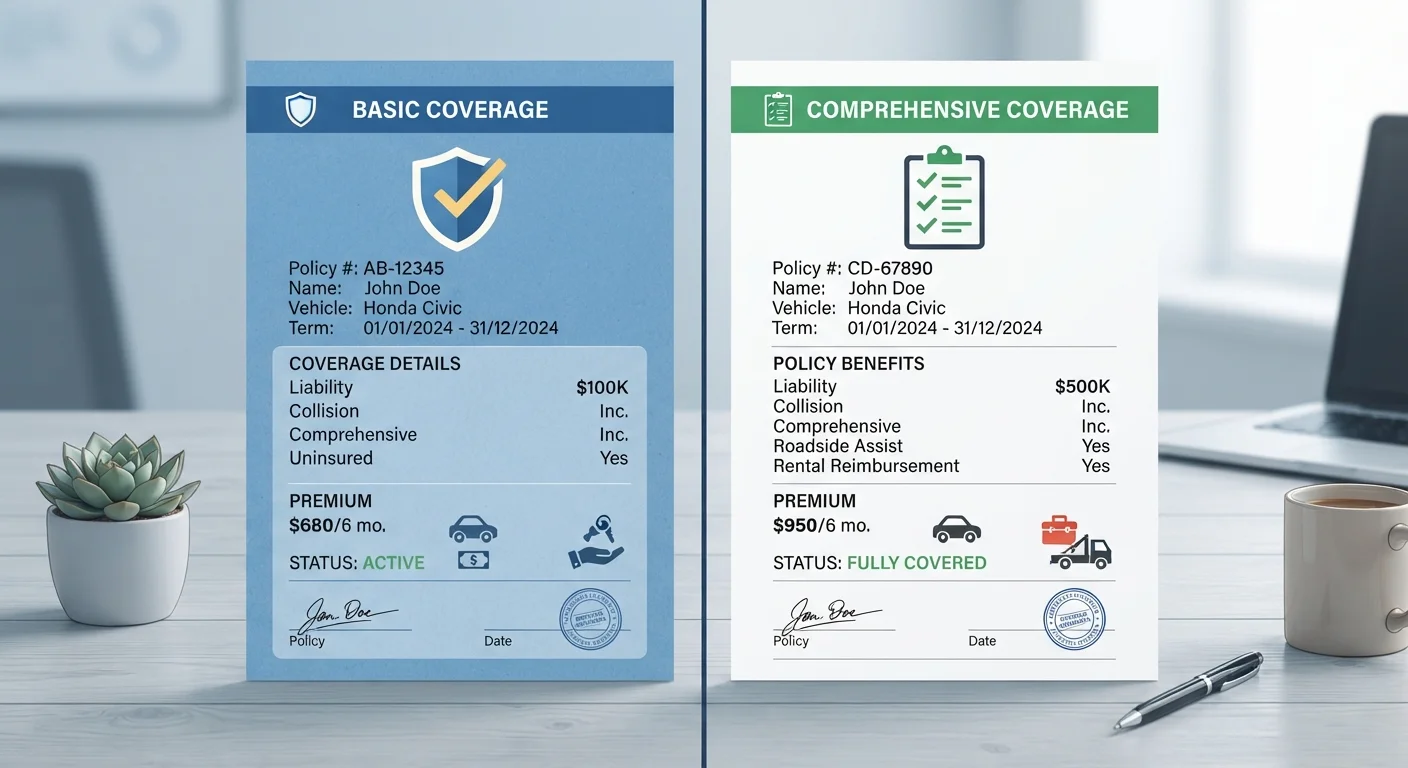
Minimum coverage refers to the legally mandated liability protection each state requires drivers to carry. It's defined by law, and the specific limits vary by state. Full coverage, by contrast, is an informal, industry-shorthand term — no insurer or regulator officially defines it. When most people say "full coverage," they mean a policy that includes liability plus collision and comprehensive coverage. To understand what each of those components actually does, see our guide to the three pillars of auto coverage.
| Criterion | Minimum Coverage | Full Coverage (Informal Term) |
|---|---|---|
| Official policy term? | Yes — defined by state law | No — informal industry shorthand |
| Covers damage to others | Yes (liability required) | Yes (liability included) |
| Covers your own vehicle | No | Yes (collision + comprehensive) |
| Required by lenders/lessors | No — insufficient for most loans | Yes — typically required |
| Covers theft or weather damage | No | Yes (via comprehensive) |
| Typical premium cost | Lower | Higher |
| Protects personal assets if sued | Partially — limits are often low | Better — higher limits available |
What Minimum Coverage Actually Covers
Every state (except New Hampshire and Virginia, which have alternative options) requires drivers to carry a minimum level of liability insurance. This typically includes:
- Bodily injury liability: Pays for injuries you cause to other people in an accident.
- Property damage liability: Pays for damage you cause to another person's vehicle or property.
Some states also mandate personal injury protection (PIP) or uninsured motorist coverage as part of their minimums. For a closer look at how PIP differs from other medical coverage options, the article on personal injury protection vs. medical payments coverage is worth reading.
The critical limitation: state minimums do not pay for damage to your own car. If you cause an accident and your vehicle is totaled, minimum coverage leaves you without reimbursement for the loss.
1 in 7
Drivers estimated to be uninsured
The Insurance Research Council has estimated that roughly 1 in 7 drivers on U.S. roads carries no auto insurance at all.
$25,000
Common state minimum bodily injury limit
Many states set minimum bodily injury liability limits at $25,000 per person — an amount that can be quickly exceeded in a serious accident involving medical costs.
What People Mean by Full Coverage
A policy commonly described as "full coverage" generally adds two types of protection on top of liability:
- Collision coverage: Pays to repair or replace your vehicle after a collision, regardless of fault.
- Comprehensive coverage: Pays for non-collision losses — theft, vandalism, weather damage, animal strikes, and similar events.
Neither collision nor comprehensive coverage is required by state law for most drivers. However, if you're financing or leasing a vehicle, your lender will almost certainly require both for the duration of the loan or lease agreement.
It's also worth noting that "full coverage" does not mean all-encompassing protection. It typically does not include gap insurance, rental reimbursement, or roadside assistance unless those are added separately. First-time policyholders often discover this distinction too late — the article things first-time policyholders wish they'd known covers several of these common gaps.
Gap Insurance Is Not Included
Neither minimum coverage nor what's commonly called full coverage automatically includes gap insurance. Gap coverage pays the difference between what your insurer pays out and what you still owe on your loan if your vehicle is totaled. If you're financing a new vehicle, ask your lender or insurer about gap coverage as a separate add-on — it's not bundled in by default.
Choosing Based on Your Situation
The right level of coverage depends on several factors specific to your circumstances — not a one-size-fits-all answer. Consider the following:
- Your vehicle's value: If repair or replacement costs would be a manageable loss, a leaner policy may make financial sense. If they wouldn't, broader coverage reduces that risk.
- Your loan or lease status: As noted, lenders typically mandate collision and comprehensive. Skipping them on a financed car is usually a contract violation, not just a personal choice.
- Your liability exposure: State minimums often carry low liability limits — sometimes $25,000 or less per person. If you're found liable in a serious accident, costs can far exceed those limits, and you may be personally responsible for the difference. Higher limits on a broader policy help protect your savings and other assets.
- Uninsured drivers on the road: Even a well-chosen policy may leave you exposed if the other driver has no insurance. This is why uninsured and underinsured motorist coverage deserves consideration regardless of which tier you choose.
Before committing to any policy, use a structured review process. The coverage review checklist can help you verify limits and spot gaps before you sign.
This article is for general informational purposes only and does not constitute personalized insurance or financial advice. Coverage terms, requirements, and costs vary by state and insurer. Consult a licensed insurance agent or adviser to evaluate options based on your specific situation.